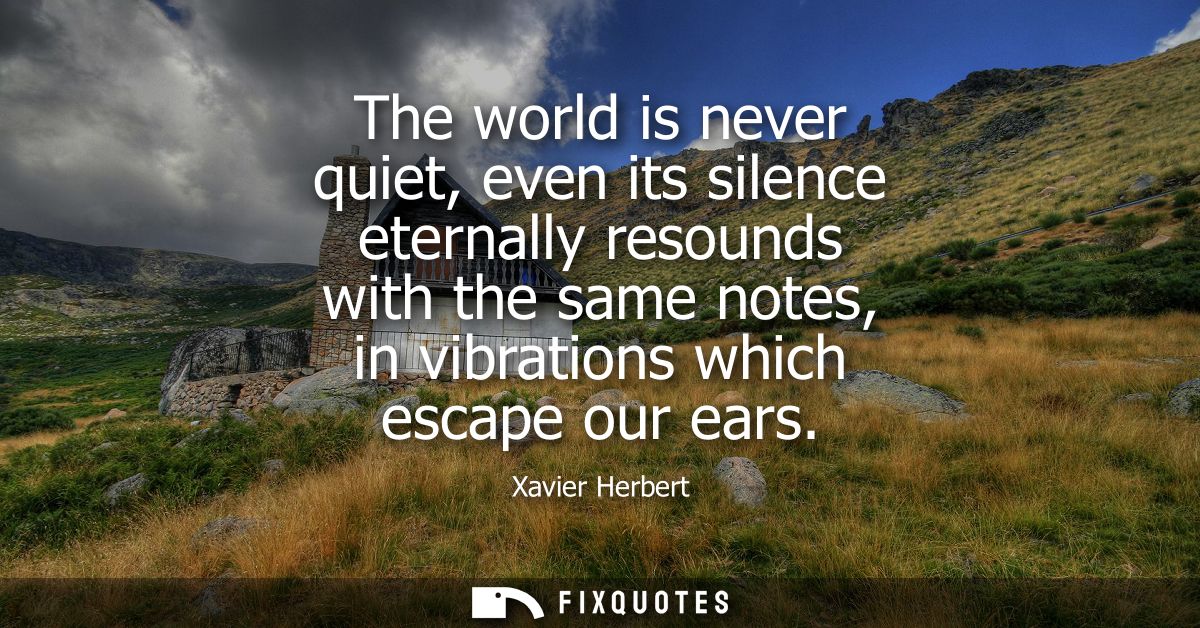
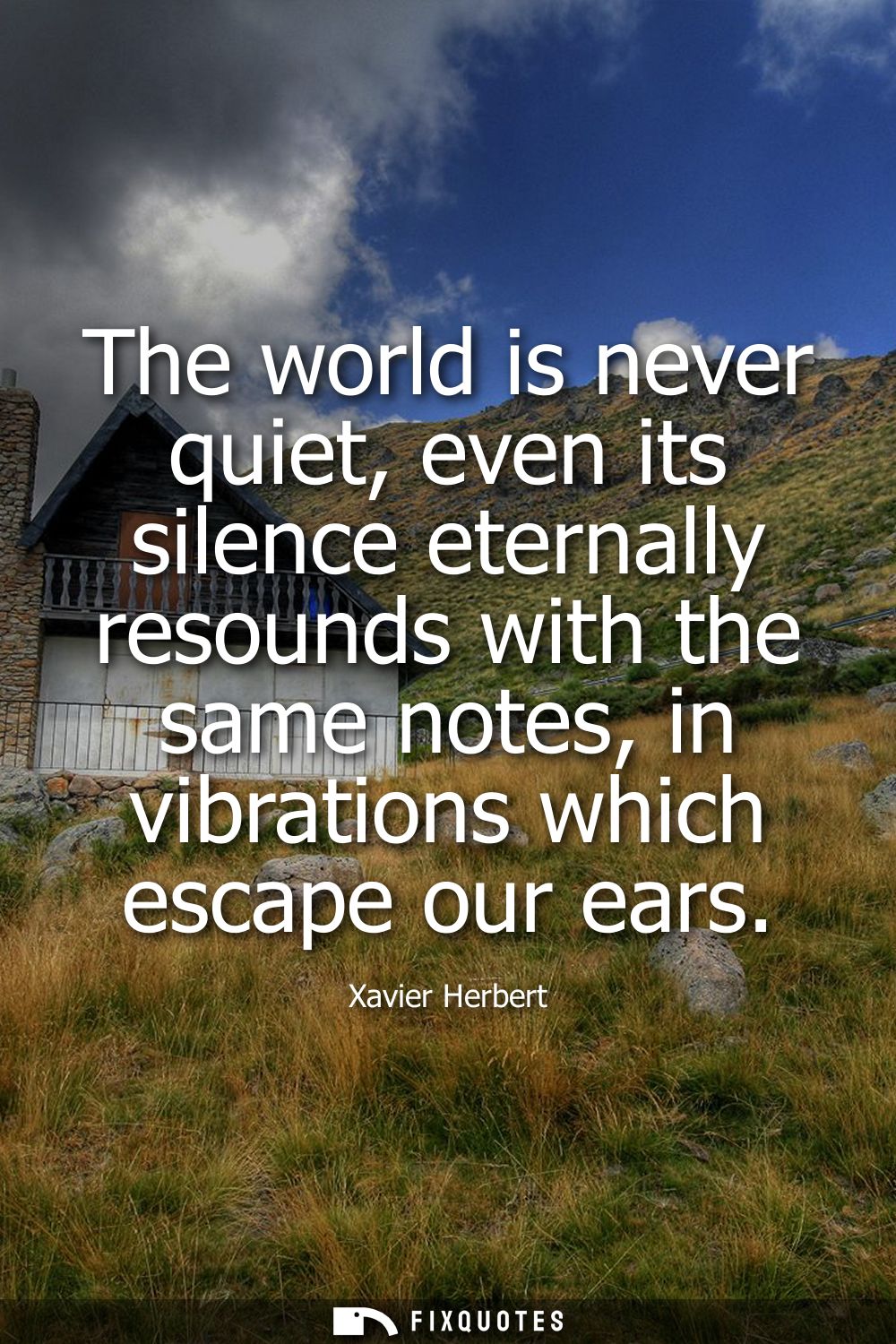
"The world is never quiet, even its silence eternally resounds with the same notes, in vibrations which escape our ears"
About this Quote
Herbert’s sentence turns “silence” into a kind of colonial lie: a comforting label the listener applies when they can’t, or won’t, register what’s actually there. The line hinges on a sly reversal. Quiet isn’t the absence of sound; it’s the failure of perception. Even the world’s hush “resounds,” and the verb choice matters: resound is what caves do, what myths do, what history does. It suggests an environment that keeps echoing regardless of human attention, and a reality that doesn’t need our consent to be real.
The subtext is epistemic humility with teeth. “Vibrations which escape our ears” implies that the limits are ours, not the world’s. There are frequencies of experience - ecological, cultural, moral - that modern sensibility filters out. For an Australian writer working in the long shadow of settlement, that has an obvious political charge: the land was never empty, never mute, never merely scenery. If you hear “nothing,” it may be because you’ve been trained to tune out what doesn’t serve you.
Formally, the line performs what it argues. Its long, rolling cadence resists a clean full stop, like a hum that won’t resolve. “Eternally” is an audacious time-scale: the world’s baseline music outlasts human dramas, including the dramas of ownership and mastery. Herbert isn’t selling mysticism; he’s insisting that reality is thick, continuous, and indifferent to our categories - and that the first ethical act might be recalibrating how we listen.
The subtext is epistemic humility with teeth. “Vibrations which escape our ears” implies that the limits are ours, not the world’s. There are frequencies of experience - ecological, cultural, moral - that modern sensibility filters out. For an Australian writer working in the long shadow of settlement, that has an obvious political charge: the land was never empty, never mute, never merely scenery. If you hear “nothing,” it may be because you’ve been trained to tune out what doesn’t serve you.
Formally, the line performs what it argues. Its long, rolling cadence resists a clean full stop, like a hum that won’t resolve. “Eternally” is an audacious time-scale: the world’s baseline music outlasts human dramas, including the dramas of ownership and mastery. Herbert isn’t selling mysticism; he’s insisting that reality is thick, continuous, and indifferent to our categories - and that the first ethical act might be recalibrating how we listen.
Quote Details
| Topic | Deep |
|---|
More Quotes by Xavier
Add to List