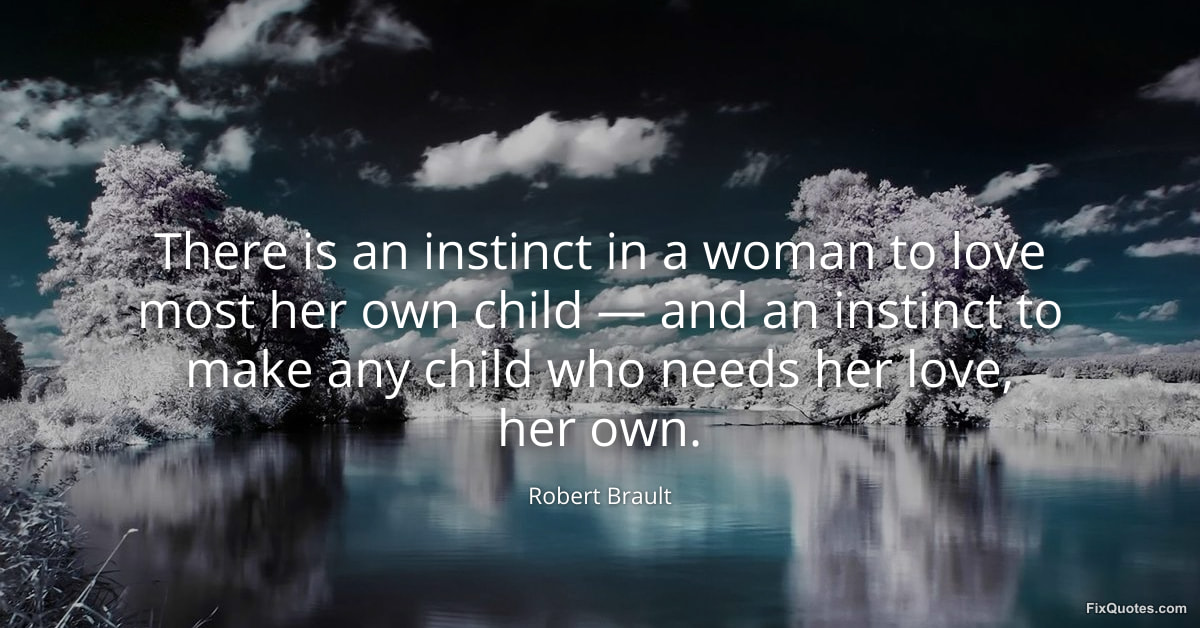
"There is an instinct in a woman to love most her own child — and an instinct to make any child who needs her love, her own"
About this Quote
Brault’s line flatters biology, then quietly edits it. He opens with “instinct,” a word that feels like science and inevitability, as if mother-love is as automatic as breathing. Then he pivots: the second clause isn’t about hormones or lineage but about choice disguised as nature. “An instinct to make” is the tell. You can’t help what you feel; you can help what you do. By framing caretaking as instinctual, Brault gives moral cover to an expansive kind of motherhood that society often treats as optional, sentimental, or second-best.
The subtext is a rebuke to bloodline chauvinism. “Her own” lands twice, and the repetition matters: first it names the culturally sanctioned target (your biological child), then it widens the category to include the vulnerable outsider (“any child who needs her love”). Need, not genetics, becomes the criterion for belonging. That’s a quietly radical hierarchy: caregiving isn’t a private possession but a responsive ethic.
Contextually, the quote lives in a modern moral economy where family is simultaneously idealized and fractured: adoption, fostering, blended families, community parenting, and the long shadow of maternal expectations. Brault isn’t arguing policy, but he’s touching a hot wire: who counts as “real” family, and who gets to claim that title without being accused of playing savior.
It works because it offers a comforting synthesis. It validates the primal bond without imprisoning women inside it, turning “mother” from a biological fact into a generous verb.
The subtext is a rebuke to bloodline chauvinism. “Her own” lands twice, and the repetition matters: first it names the culturally sanctioned target (your biological child), then it widens the category to include the vulnerable outsider (“any child who needs her love”). Need, not genetics, becomes the criterion for belonging. That’s a quietly radical hierarchy: caregiving isn’t a private possession but a responsive ethic.
Contextually, the quote lives in a modern moral economy where family is simultaneously idealized and fractured: adoption, fostering, blended families, community parenting, and the long shadow of maternal expectations. Brault isn’t arguing policy, but he’s touching a hot wire: who counts as “real” family, and who gets to claim that title without being accused of playing savior.
It works because it offers a comforting synthesis. It validates the primal bond without imprisoning women inside it, turning “mother” from a biological fact into a generous verb.
Quote Details
| Topic | Mother |
|---|---|
| Source | Attributed to Robert Brault; listed on his official website (RobertBrault.com). Phrasing as given: "There is an instinct in a woman to love most her own child — and an instinct to make any child who needs her love, her own." |
More Quotes by Robert
Add to List