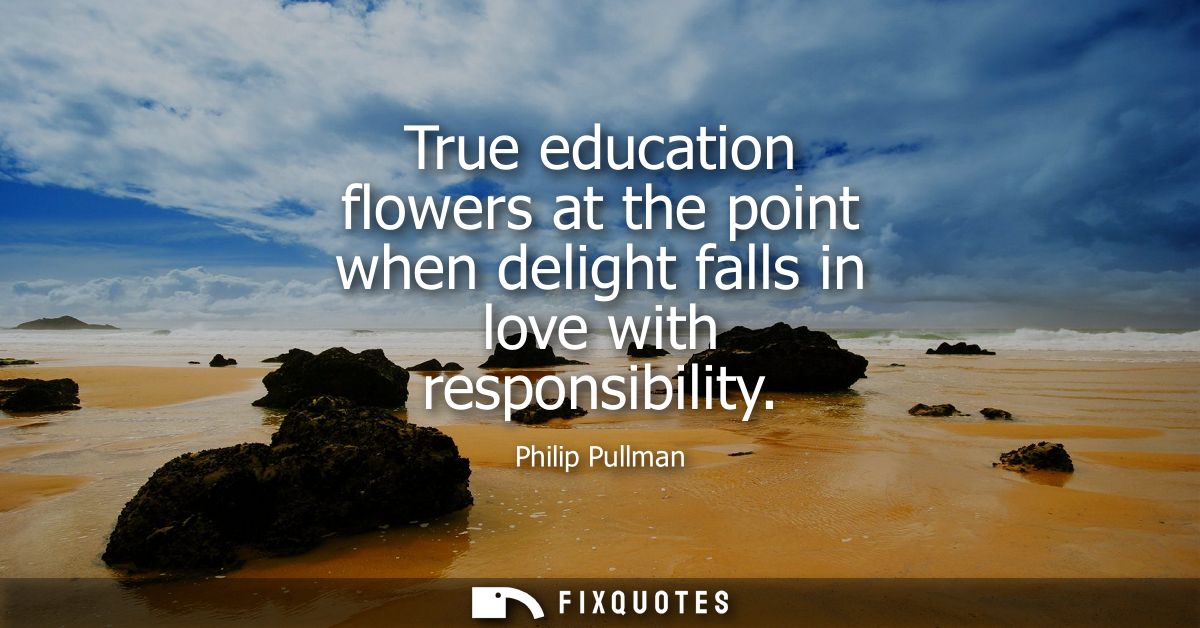
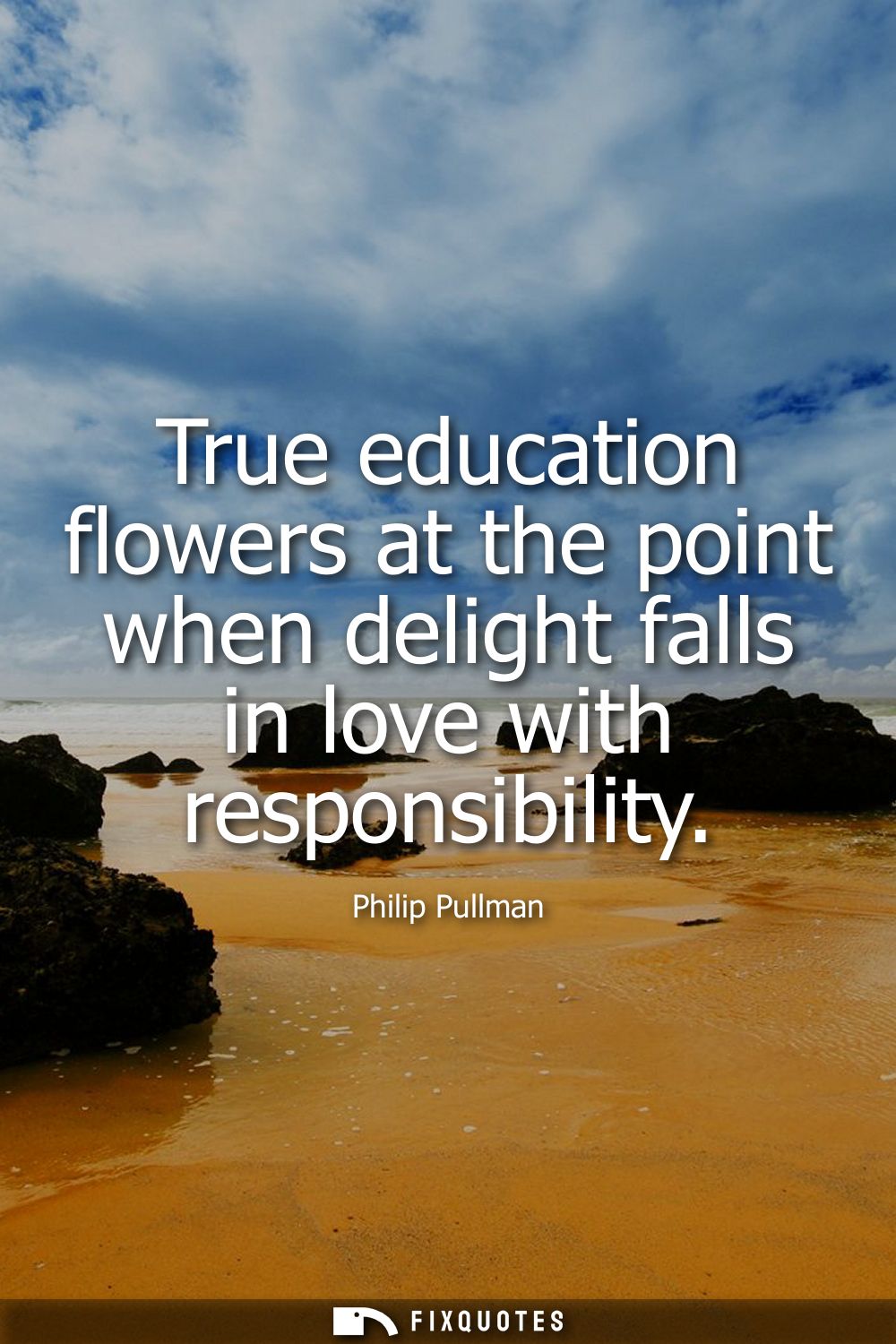
"True education flowers at the point when delight falls in love with responsibility"
About this Quote
The romantic metaphor - “falls in love” - is also strategic. Love isn’t a contract, it’s a commitment you choose again and again, even when it’s inconvenient. Pullman suggests that mature learning happens when curiosity stops being a sugar high and starts accepting limits: deadlines, rigor, the humility of being wrong, the slow craft of mastery. Responsibility, in other words, isn’t the enemy of joy; it’s the structure that keeps joy from evaporating at the first hard chapter.
Context matters: Pullman has spent a career defending imagination, narrative, and intellectual freedom against the idea that children need moral gatekeeping more than they need wonder. This sentence feels like his middle path. He’s not arguing for soft education; he’s arguing for education that earns discipline by seducing the student into caring. The subtext is political, too: a society that can’t marry delight to responsibility raises either obedient test-takers or perpetually distracted consumers - both easy to manage, neither truly educated.
Quote Details
| Topic | Learning |
|---|---|
| Source | Unverified source: Common sense has much to learn from moonshine (Philip Pullman, 2005)
Evidence: Primary source: Philip Pullman’s own Guardian article, published Sat 22 Jan 2005 (06:45 EST / UK publication). The quote appears verbatim near the end of the article: “True education flowers at the point when delight falls in love with responsibility.” ([theguardian.com](https://www.theguardian.c... Other candidates (2) Global Neoliberalism and Education and its Consequences (Dave Hill, Ravi Kumar, 2012) compilation95.0% ... Philip Pullman wrote about the purpose and nature of education in an article for The Guardian newspaper of Januar... Philip Pullman (Philip Pullman) compilation41.2% l free and equal citizens with and this is the important thing responsibilities with the responsibilit |
| Cite |
Citation Formats
APA Style (7th ed.)
Pullman, Philip. (2026, January 13). True education flowers at the point when delight falls in love with responsibility. FixQuotes. https://fixquotes.com/quotes/true-education-flowers-at-the-point-when-delight-7596/
Chicago Style
Pullman, Philip. "True education flowers at the point when delight falls in love with responsibility." FixQuotes. January 13, 2026. https://fixquotes.com/quotes/true-education-flowers-at-the-point-when-delight-7596/.
MLA Style (9th ed.)
"True education flowers at the point when delight falls in love with responsibility." FixQuotes, 13 Jan. 2026, https://fixquotes.com/quotes/true-education-flowers-at-the-point-when-delight-7596/. Accessed 2 Apr. 2026.