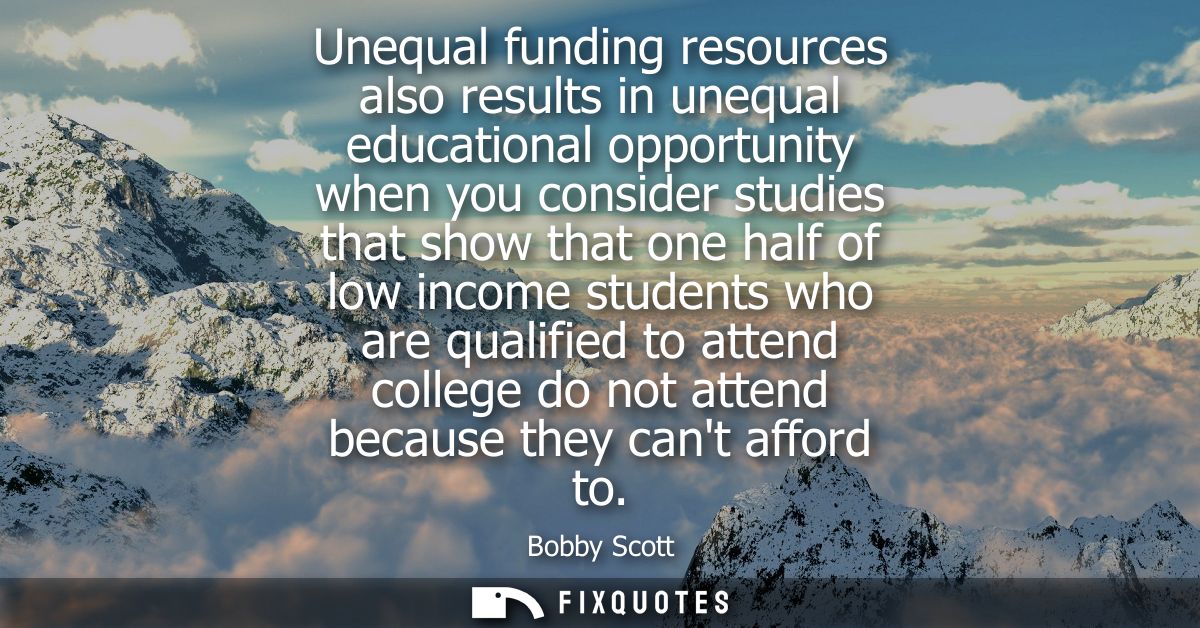
"Unequal funding resources also results in unequal educational opportunity when you consider studies that show that one half of low income students who are qualified to attend college do not attend because they can't afford to"
About this Quote
Scott’s sentence is built like a legal brief disguised as plain talk: start with a structural cause ("unequal funding resources"), move to a consequence ("unequal educational opportunity"), then pin it to a measurable harm (qualified low-income students who don’t enroll). It’s not poetry; it’s prosecutorial. The intent is to collapse the comfortable idea that “opportunity” is an individual choice into a budget line item, and to make the reader feel the moral absurdity of calling higher education a meritocracy while pricing out people who’ve already met the merit threshold.
The subtext is a quiet indictment of political alibis. By emphasizing “qualified,” Scott preemptively blocks the most common escape hatch: that nonattendance reflects lack of preparation or effort. He’s telling you the gate isn’t academic readiness; it’s money. The phrase “when you consider studies” is doing strategic work, too. It signals that this isn’t anecdote-driven outrage but evidence-backed policy critique, aimed at colleagues who demand “data” before they’ll admit inequity has a mechanism.
Context matters: as a longtime Democratic congressman associated with education and labor policy, Scott is speaking into an American landscape where school funding is tethered to local wealth and college costs have ballooned alongside debt anxiety. The line is a pressure point in that debate: if half of qualified low-income students can’t go, then “equal opportunity” isn’t a national value, it’s a slogan subsidized by people who can afford to believe it.
The subtext is a quiet indictment of political alibis. By emphasizing “qualified,” Scott preemptively blocks the most common escape hatch: that nonattendance reflects lack of preparation or effort. He’s telling you the gate isn’t academic readiness; it’s money. The phrase “when you consider studies” is doing strategic work, too. It signals that this isn’t anecdote-driven outrage but evidence-backed policy critique, aimed at colleagues who demand “data” before they’ll admit inequity has a mechanism.
Context matters: as a longtime Democratic congressman associated with education and labor policy, Scott is speaking into an American landscape where school funding is tethered to local wealth and college costs have ballooned alongside debt anxiety. The line is a pressure point in that debate: if half of qualified low-income students can’t go, then “equal opportunity” isn’t a national value, it’s a slogan subsidized by people who can afford to believe it.
Quote Details
| Topic | Equality |
|---|
More Quotes by Bobby
Add to List