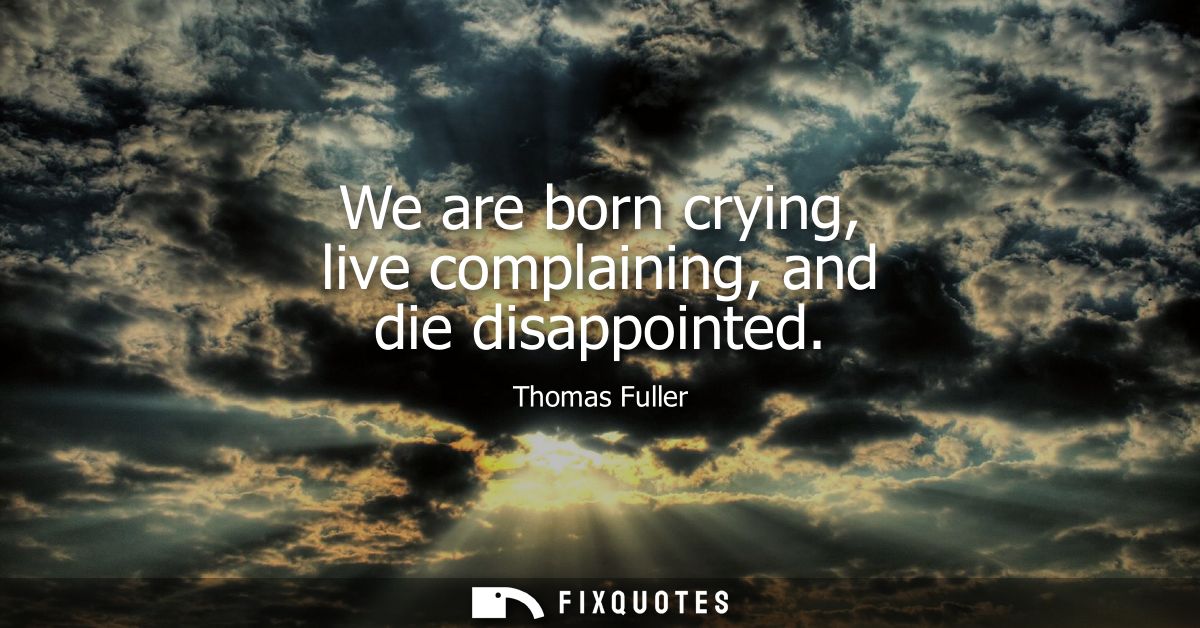
"We are born crying, live complaining, and die disappointed"
About this Quote
A bleak arc is sketched: arrival with a cry, a lifetime of grievance, a final breath colored by unmet hopes. The triad compresses human experience into three gestures, moving from the involuntary to the habitual to the ultimate verdict. Crying is nature, complaining is nurture, disappointment is judgment. The compression works as satire and diagnosis, exposing how expectation, more than circumstance, scripts our sense of life.
Thomas Fuller, an English physician and moralist of the early 18th century, wrote in the aphoristic tradition of Gnomologia, where pithy sentences distilled moral observation. His medical eye gave him intimate access to suffering; his religious context steeped him in Ecclesiastes and Job, the old wisdom that life is trouble and vanity shadows human plans. The line sits at the intersection of those perspectives: empirical sobriety about pain and spiritual wariness about desire.
Read narrowly, it sounds merely pessimistic. Read as moral counsel, it warns that unchecked expectation matures into chronic complaint and ends as bitterness. The implied critique is not of life, but of our calibrations of hope. We are wired to want, and modern thinkers would echo Fuller with terms like hedonic treadmill and negativity bias. Without deliberate gratitude and a right-sized sense of what the world can give, the default setting drifts toward grievance.
There is also compassion in the formulation. If crying brackets existence, then fragility is universal. The line invites patience with ourselves and others and a gentler grasp on ambitions that cannot bear the weight of ultimate meaning. The remedy is not despair but adjustment: to seek joy in what is given, to trade entitlement for stewardship, to frame success as faithfulness rather than acquisition. Under that reframing, complaint loosens, and disappointment yields to a humbler satisfaction that knows both the brevity of life and the dignity possible within it.
Thomas Fuller, an English physician and moralist of the early 18th century, wrote in the aphoristic tradition of Gnomologia, where pithy sentences distilled moral observation. His medical eye gave him intimate access to suffering; his religious context steeped him in Ecclesiastes and Job, the old wisdom that life is trouble and vanity shadows human plans. The line sits at the intersection of those perspectives: empirical sobriety about pain and spiritual wariness about desire.
Read narrowly, it sounds merely pessimistic. Read as moral counsel, it warns that unchecked expectation matures into chronic complaint and ends as bitterness. The implied critique is not of life, but of our calibrations of hope. We are wired to want, and modern thinkers would echo Fuller with terms like hedonic treadmill and negativity bias. Without deliberate gratitude and a right-sized sense of what the world can give, the default setting drifts toward grievance.
There is also compassion in the formulation. If crying brackets existence, then fragility is universal. The line invites patience with ourselves and others and a gentler grasp on ambitions that cannot bear the weight of ultimate meaning. The remedy is not despair but adjustment: to seek joy in what is given, to trade entitlement for stewardship, to frame success as faithfulness rather than acquisition. Under that reframing, complaint loosens, and disappointment yields to a humbler satisfaction that knows both the brevity of life and the dignity possible within it.
Quote Details
| Topic | Life |
|---|
More Quotes by Thomas
Add to List