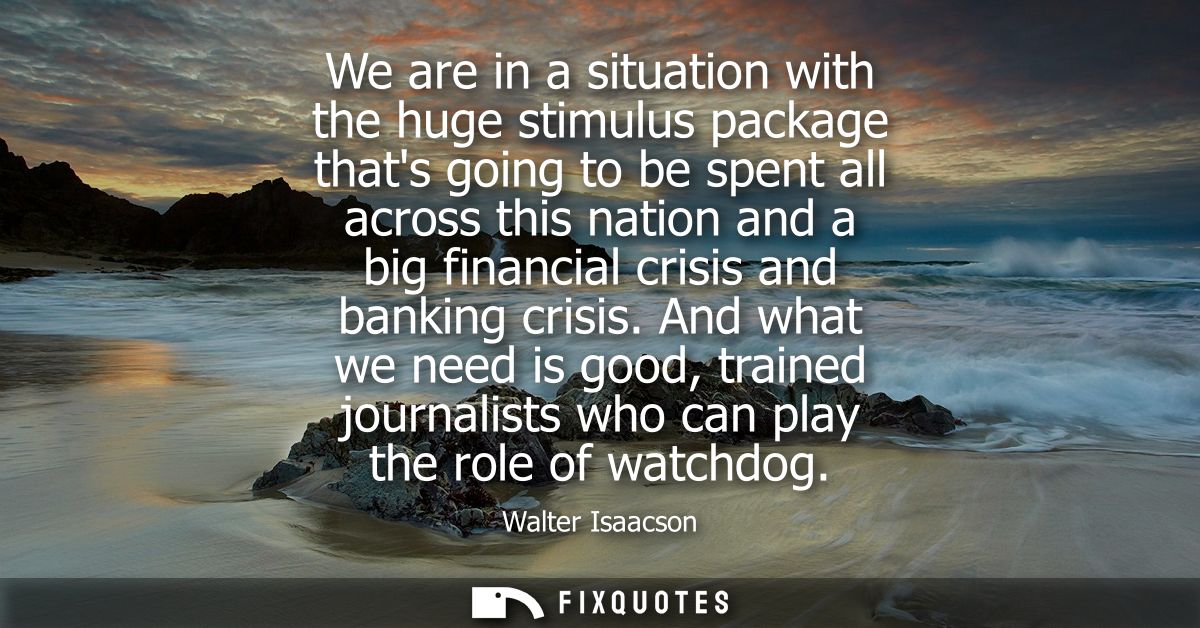
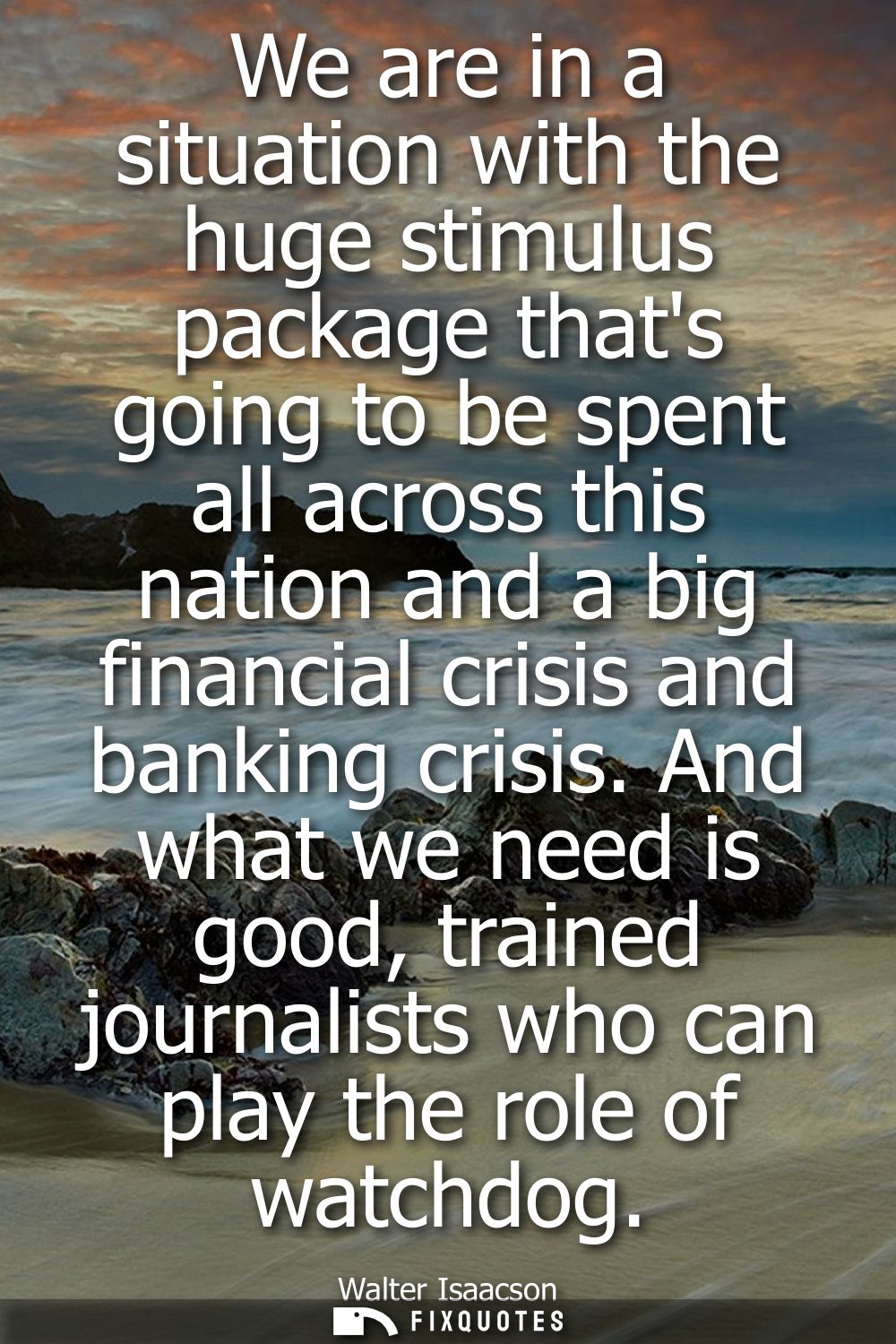
"We are in a situation with the huge stimulus package that's going to be spent all across this nation and a big financial crisis and banking crisis. And what we need is good, trained journalists who can play the role of watchdog"
About this Quote
Walter Isaacson is pointing to a moment when public money and private power converged at historic scale: the late-2000s financial meltdown and the massive federal response that followed. A sprawling stimulus, bank rescues, and emergency interventions created both necessity and temptation. Where funds move quickly and opaquely, waste, fraud, and self-dealing can flourish. The remedy he names is not more press releases or official oversight alone, but a robust corps of reporters trained to scrutinize, verify, and explain.
Watchdog is a skill set, not a slogan. It means understanding derivatives, balance sheets, and procurement rules well enough to detect red flags. It requires fluency with data, public records laws, and the human networks through which money and influence travel. It also demands the patience to follow a paper trail from a congressional appropriation to a local contractor, and the clarity to translate technical findings into stories that citizens can act upon.
The urgency of his appeal gains force from the media landscape of that era. Just as the need for scrutiny spiked, newsroom budgets collapsed under digital disruption and recessionary pain. Local beats were hollowed out, the very places where stimulus dollars would land and where accountability often starts. Isaacson has long argued for sustainable models to fund rigorous reporting; embedded here is the premise that democracy cannot afford to treat investigative journalism as a luxury.
Government inspectors general, independent boards, and transparency portals have roles to play, but they are not substitutes for independent eyes that ask impolite questions and connect dots across institutions. Banking crises erode trust because they are complex and distant; journalists rebuild trust by making the mechanics visible and the powerful answerable. Whenever extraordinary sums flow and rules bend in the name of urgency, the public interest depends on reporters who know how to follow the money and are free to publish what they find.
Watchdog is a skill set, not a slogan. It means understanding derivatives, balance sheets, and procurement rules well enough to detect red flags. It requires fluency with data, public records laws, and the human networks through which money and influence travel. It also demands the patience to follow a paper trail from a congressional appropriation to a local contractor, and the clarity to translate technical findings into stories that citizens can act upon.
The urgency of his appeal gains force from the media landscape of that era. Just as the need for scrutiny spiked, newsroom budgets collapsed under digital disruption and recessionary pain. Local beats were hollowed out, the very places where stimulus dollars would land and where accountability often starts. Isaacson has long argued for sustainable models to fund rigorous reporting; embedded here is the premise that democracy cannot afford to treat investigative journalism as a luxury.
Government inspectors general, independent boards, and transparency portals have roles to play, but they are not substitutes for independent eyes that ask impolite questions and connect dots across institutions. Banking crises erode trust because they are complex and distant; journalists rebuild trust by making the mechanics visible and the powerful answerable. Whenever extraordinary sums flow and rules bend in the name of urgency, the public interest depends on reporters who know how to follow the money and are free to publish what they find.
Quote Details
| Topic | Justice |
|---|
More Quotes by Walter
Add to List