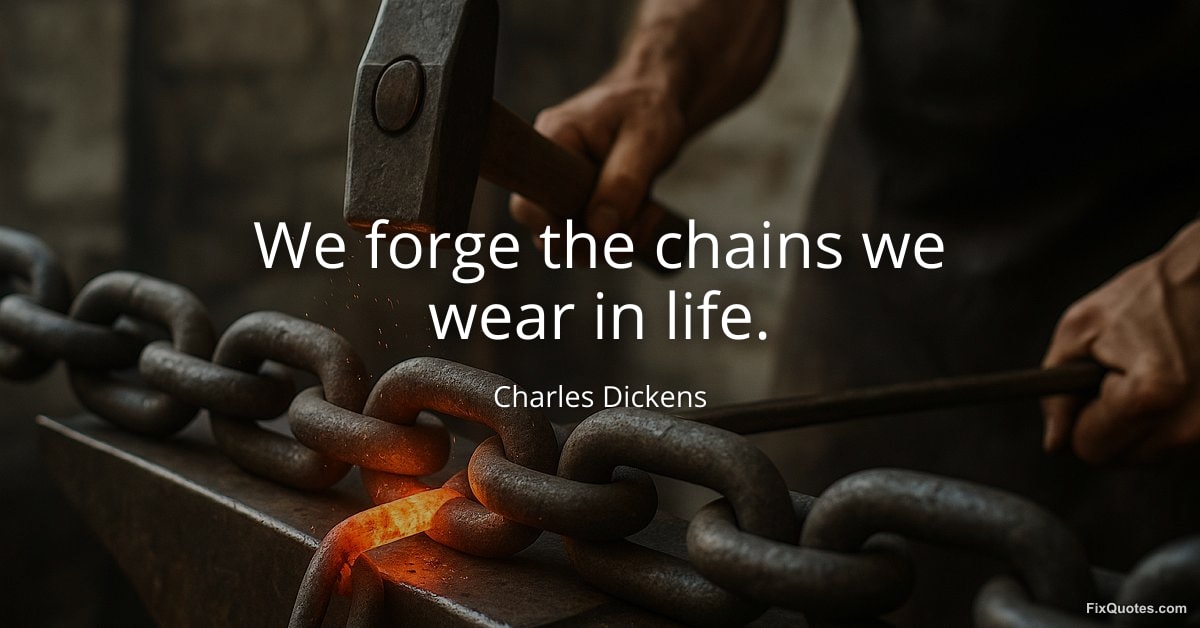
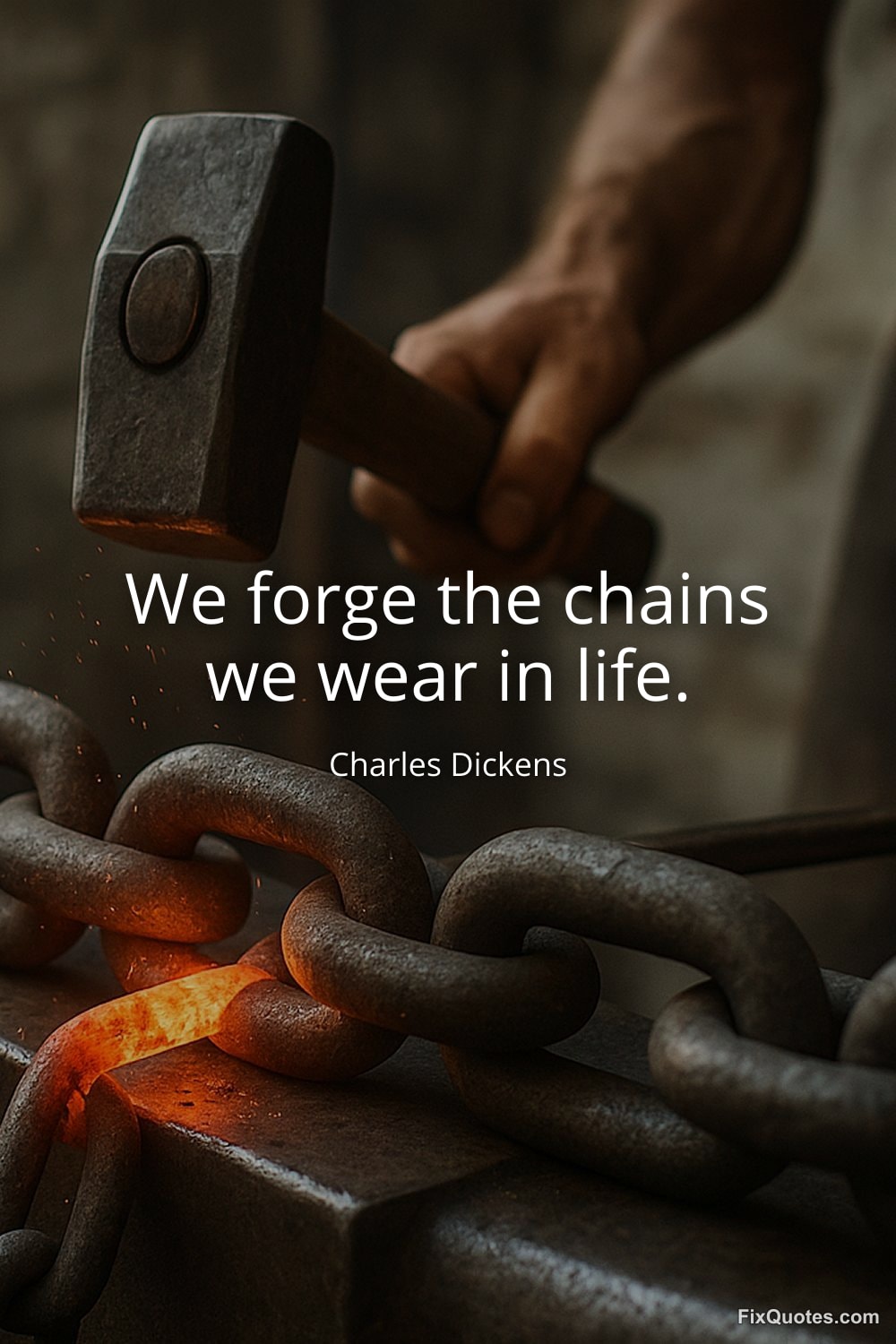
"We forge the chains we wear in life"
About this Quote
Dickens doesn’t just moralize here; he indicts. “We forge the chains we wear in life” lands like a courtroom line because it turns punishment into craftsmanship. Chains aren’t discovered, inherited, or imposed by some distant tyrant. They’re hammered out, link by link, by the same hands that later complain about the weight. The phrasing is industrial, almost tactile: forge suggests heat, effort, repetition. You can feel the labor of self-ruin.
The intent is bracingly unsentimental. Dickens is warning that character isn’t a private matter; it hardens into consequence. The subtext is a critique of the soothing story people tell themselves: that their worst habits are quirks, their compromises are temporary, their small selfishness doesn’t add up to anything. Dickens insists it adds up to a structure, a whole apparatus of limitation. It’s not fate. It’s accrual.
Context matters: the line comes from A Christmas Carol, spoken by Marley’s ghost, a figure literally bound by the material evidence of his own greed. In a Victorian world obsessed with industry, debt, and respectability, Dickens weaponizes the era’s favorite metaphor - production - against its moral complacency. Marley didn’t just exploit the system; he became the system’s logic, internalized, and now he’s shackled to it.
What makes it work is the quiet swap of victimhood for agency. Dickens gives you no villain to blame, only a mirror. The threat isn’t hellfire; it’s habit.
The intent is bracingly unsentimental. Dickens is warning that character isn’t a private matter; it hardens into consequence. The subtext is a critique of the soothing story people tell themselves: that their worst habits are quirks, their compromises are temporary, their small selfishness doesn’t add up to anything. Dickens insists it adds up to a structure, a whole apparatus of limitation. It’s not fate. It’s accrual.
Context matters: the line comes from A Christmas Carol, spoken by Marley’s ghost, a figure literally bound by the material evidence of his own greed. In a Victorian world obsessed with industry, debt, and respectability, Dickens weaponizes the era’s favorite metaphor - production - against its moral complacency. Marley didn’t just exploit the system; he became the system’s logic, internalized, and now he’s shackled to it.
What makes it work is the quiet swap of victimhood for agency. Dickens gives you no villain to blame, only a mirror. The threat isn’t hellfire; it’s habit.
Quote Details
| Topic | Free Will & Fate |
|---|---|
| Source | Unverified source: A Christmas Carol (Charles Dickens, 1843)
Evidence: Stave One; page 30 in the 1843 edition scan at Wikisource (image page 56 in the djvu viewer). The exact wording commonly circulated (“We forge the chains we wear in life”) appears to be a modern paraphrase/condensation. In Dickens’s primary text, Jacob Marley says: “I wear the chain I forged in l... Other candidates (2) Life Lessons of Wisdom & Motivation - Volume III (M.I. Seka, 2014) compilation95.0% ... We forge the chains we wear in life. - Charles Dickens 1812 – 1870; English writer & critic. One is responsible t... Charles Dickens (Charles Dickens) compilation37.5% ing before it associations connected with the friends we have left the scenes we |
| Featured | This quote was our Quote of the Day on September 29, 2025 |
More Quotes by Charles
Add to List