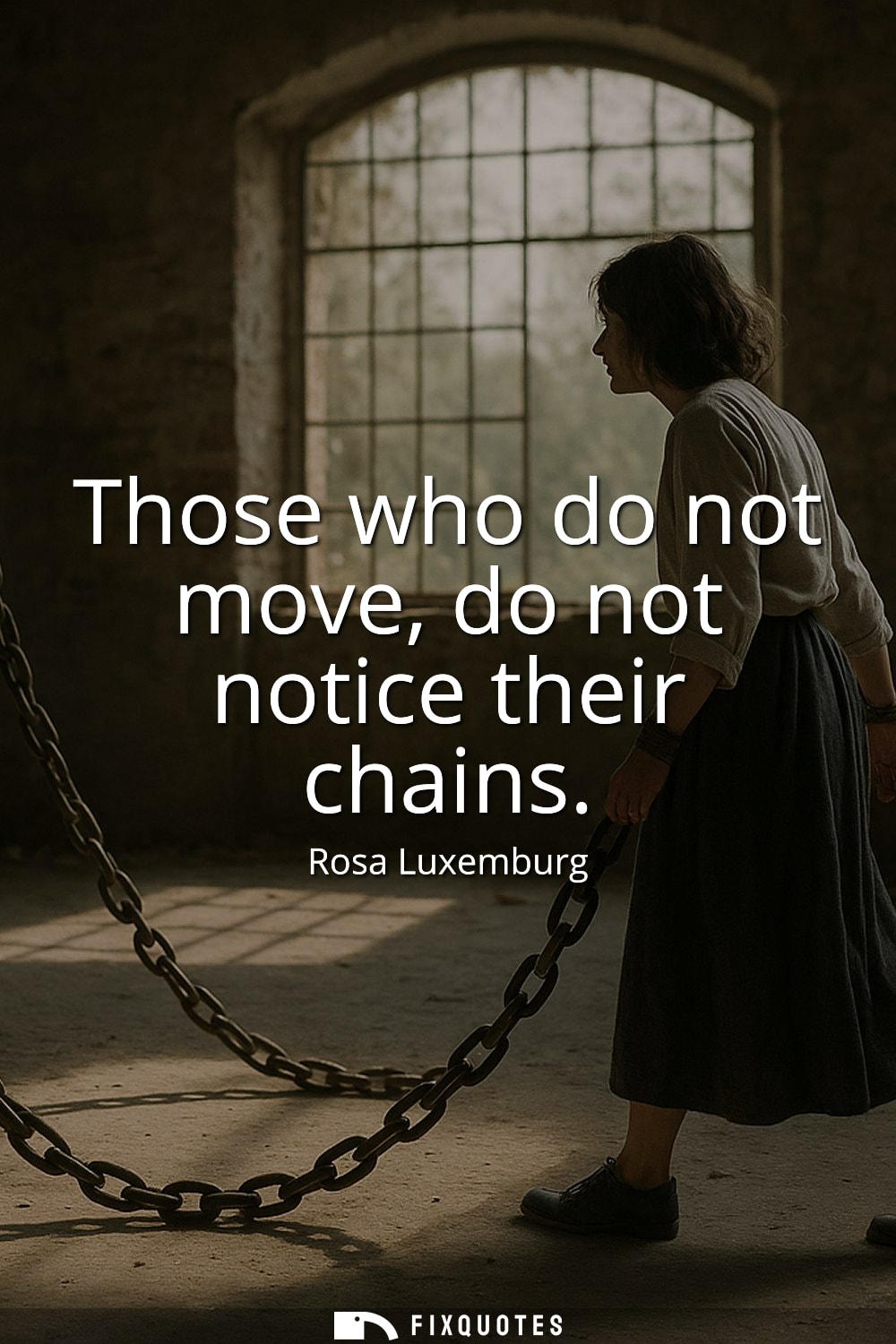
"Those who do not move, do not notice their chains"
About this Quote
Motion is the tell. Luxemburg’s line doesn’t flatter the oppressed with noble suffering; it indicts the everyday numbness that makes oppression feel like weather. The chains aren’t only police batons and prison bars. They’re habit, exhaustion, the small bargains that turn survival into consent. If you never test the limits, you can mistake them for the horizon.
Her intent is agitational in the best sense: to redefine awareness as something you earn through action. In Luxemburg’s political universe, “consciousness” isn’t a private epiphany; it’s produced in the friction of struggle - strikes, organizing, the messy trial-and-error of collective movement. The subtext is sharp: passivity isn’t neutral. Stillness collaborates. You don’t need to love the system to be shaped by it; you just need to stop pushing against it.
Context matters. Luxemburg was writing and organizing at the turn of the 20th century, when European socialism was splitting between reformist patience and revolutionary urgency, and when state violence routinely met labor unrest. She’d seen how parties and unions could be domesticated into institutions that managed discontent instead of confronting power. “Do not move” reads, then, as a warning about politics as posture - the comfortable rhetoric of change without the risk.
The line endures because it’s ruthless and portable. It fits the workplace, the classroom, the algorithmic feed: any space where control is designed to feel normal. Luxemburg’s wager is that liberation begins not with better arguments, but with the first shove against what’s been presented as immovable.
Her intent is agitational in the best sense: to redefine awareness as something you earn through action. In Luxemburg’s political universe, “consciousness” isn’t a private epiphany; it’s produced in the friction of struggle - strikes, organizing, the messy trial-and-error of collective movement. The subtext is sharp: passivity isn’t neutral. Stillness collaborates. You don’t need to love the system to be shaped by it; you just need to stop pushing against it.
Context matters. Luxemburg was writing and organizing at the turn of the 20th century, when European socialism was splitting between reformist patience and revolutionary urgency, and when state violence routinely met labor unrest. She’d seen how parties and unions could be domesticated into institutions that managed discontent instead of confronting power. “Do not move” reads, then, as a warning about politics as posture - the comfortable rhetoric of change without the risk.
The line endures because it’s ruthless and portable. It fits the workplace, the classroom, the algorithmic feed: any space where control is designed to feel normal. Luxemburg’s wager is that liberation begins not with better arguments, but with the first shove against what’s been presented as immovable.
Quote Details
| Topic | Freedom |
|---|---|
| Source | Later attribution: A People’s History of Riots, Protest and the Law (Matt Clement, 2016) modern compilationISBN: 9781137527516 · ID: Tt56DAAAQBAJ
Evidence: ... Those who do not move do not notice their chains ' , declared the Polish / German communist Rosa Luxemburg . By acting for themselves , the activist / protestor / rioter embarks upon the process of losing their illusions about the world ... Other candidates (1) Rosa Luxemburg (Rosa Luxemburg) compilation36.3% italist exploiters we notice more and more often that the priests in their sermo |
| Featured | This quote was our Quote of the Day on September 7, 2025 |
| Cite |
Citation Formats
APA Style (7th ed.)
Luxemburg, Rosa. (2026, January 11). Those who do not move, do not notice their chains. FixQuotes. https://fixquotes.com/quotes/those-who-do-not-move-do-not-notice-their-chains-71376/
Chicago Style
Luxemburg, Rosa. "Those who do not move, do not notice their chains." FixQuotes. January 11, 2026. https://fixquotes.com/quotes/those-who-do-not-move-do-not-notice-their-chains-71376/.
MLA Style (9th ed.)
"Those who do not move, do not notice their chains." FixQuotes, 11 Jan. 2026, https://fixquotes.com/quotes/those-who-do-not-move-do-not-notice-their-chains-71376/. Accessed 1 Apr. 2026.
More Quotes by Rosa
Add to List