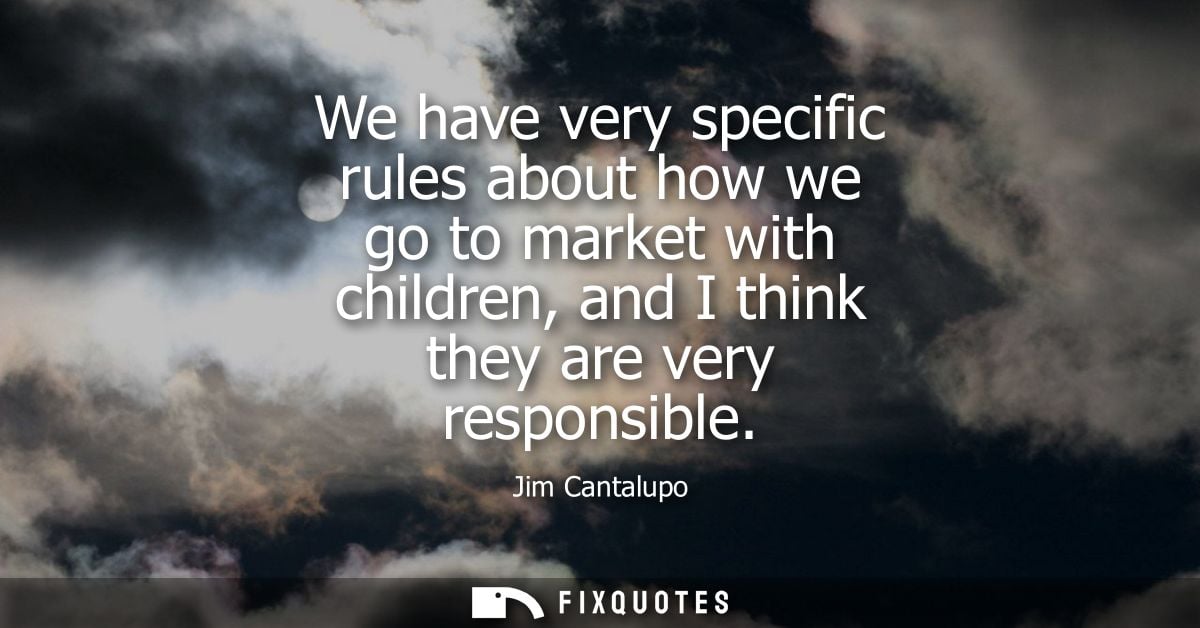
"We have very specific rules about how we go to market with children, and I think they are very responsible"
About this Quote
The line reads like a corporate seatbelt: visible, reassuring, and designed to keep the speaker safe in a crash. “Very specific rules” does two things at once. It implies precision (not vibes, not improvisation) while quietly refusing to name the rules, who enforces them, or what happens when they’re broken. Specificity becomes a rhetorical fog machine: detailed in tone, vague in content.
Cantalupo’s phrasing also performs a subtle moral pivot. Marketing to children is widely understood as ethically combustible, so the sentence doesn’t defend the practice on its merits; it reframes the controversy as a matter of governance. The key word is “responsible,” a term that sounds like ethics but often functions as risk management. Responsibility here is less a commitment to children’s welfare than a claim of institutional self-control: don’t regulate us, we’ve already regulated ourselves.
The context matters. Cantalupo led McDonald’s during an era when childhood obesity, “pester power,” and the influence of food advertising on kids were moving from parental gripe to public-policy argument. His “I think” is telling too: it softens the assertion into personal judgment, making it harder to litigate. It’s not a promise, it’s an opinion.
The subtext is a familiar corporate bargain: let us keep access to a lucrative audience, and we’ll offer procedural ethics in return. The genius of the quote is that it sounds like care while primarily protecting permission.
Cantalupo’s phrasing also performs a subtle moral pivot. Marketing to children is widely understood as ethically combustible, so the sentence doesn’t defend the practice on its merits; it reframes the controversy as a matter of governance. The key word is “responsible,” a term that sounds like ethics but often functions as risk management. Responsibility here is less a commitment to children’s welfare than a claim of institutional self-control: don’t regulate us, we’ve already regulated ourselves.
The context matters. Cantalupo led McDonald’s during an era when childhood obesity, “pester power,” and the influence of food advertising on kids were moving from parental gripe to public-policy argument. His “I think” is telling too: it softens the assertion into personal judgment, making it harder to litigate. It’s not a promise, it’s an opinion.
The subtext is a familiar corporate bargain: let us keep access to a lucrative audience, and we’ll offer procedural ethics in return. The genius of the quote is that it sounds like care while primarily protecting permission.
Quote Details
| Topic | Marketing |
|---|
More Quotes by Jim
Add to List