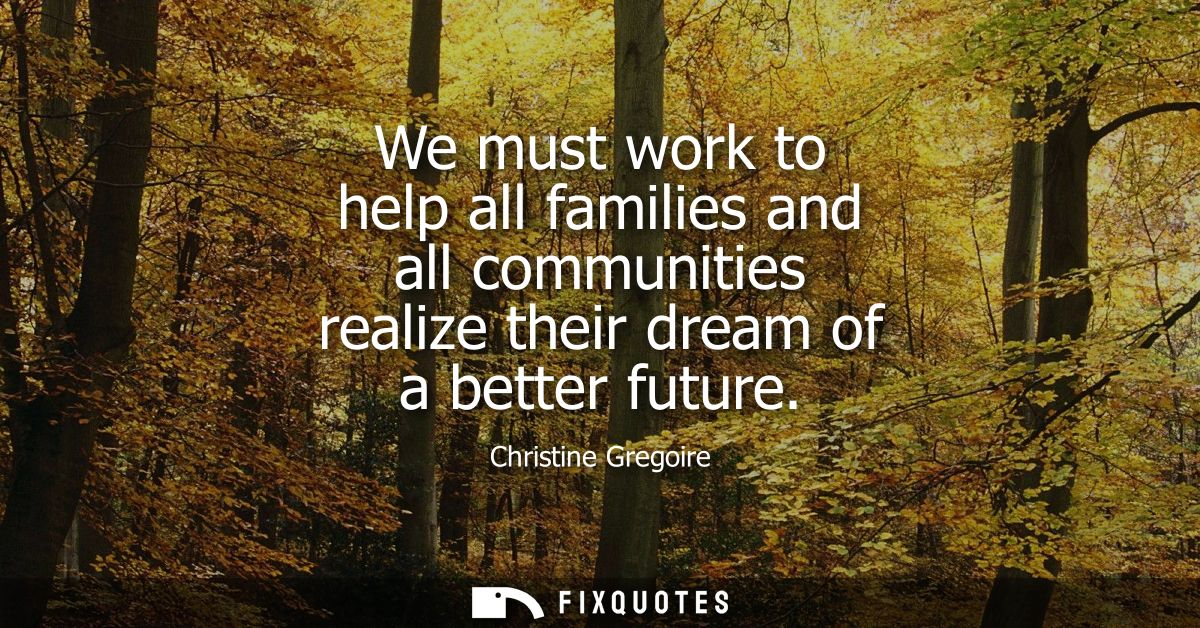
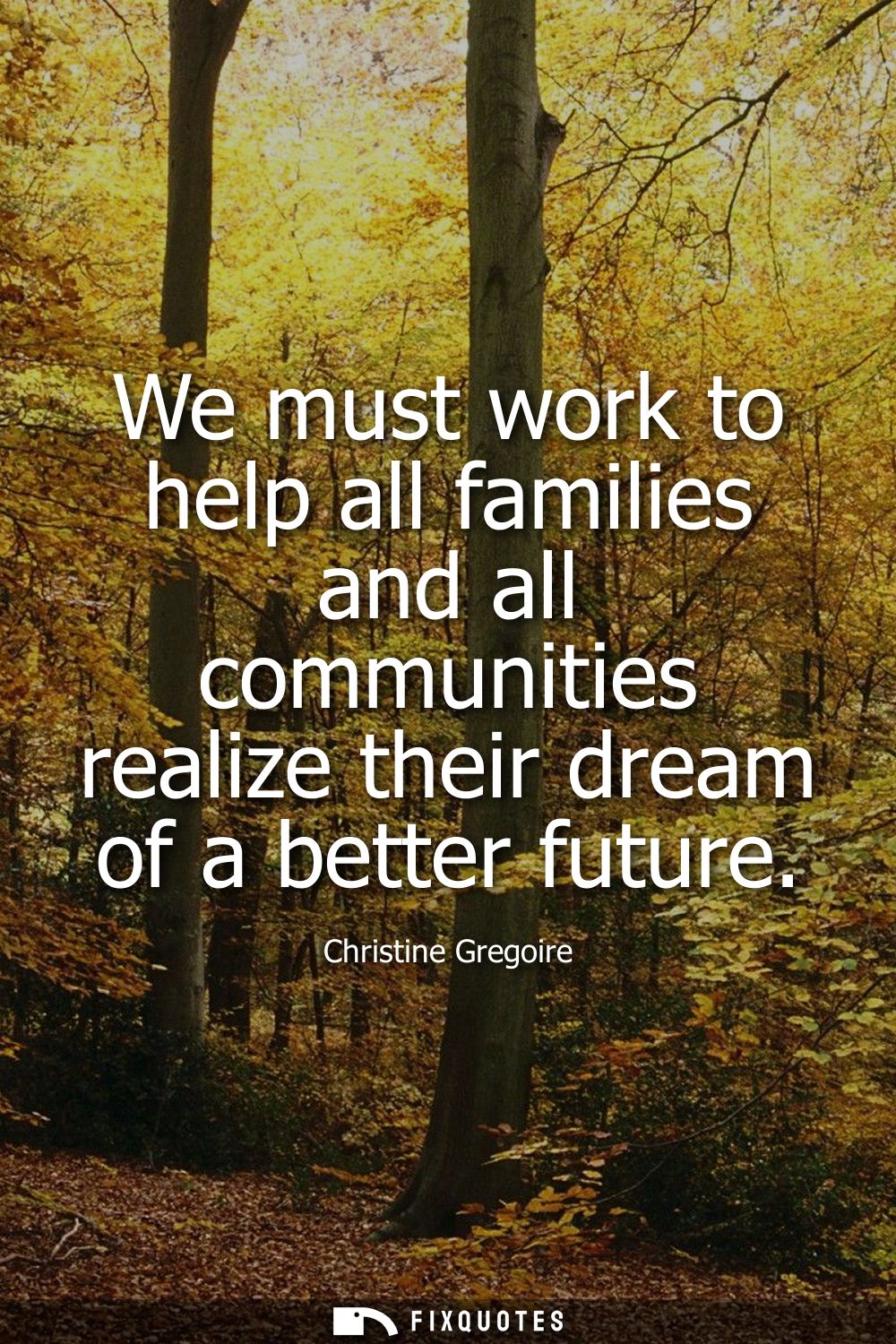
"We must work to help all families and all communities realize their dream of a better future"
About this Quote
The line carries an insistence on collective responsibility and an expansive definition of who belongs. The verbs matter: must and work point to duty and effort, not sentiment. Help signals that opportunity is not evenly distributed, and that government, business, and civil society have active roles to play. By naming all families and all communities, it rejects the habit of designing policy for a narrow slice of the electorate; it asserts that rural towns, urban neighborhoods, tribal nations, immigrants, and long-standing residents are part of a shared project.
Coming from Christine Gregoire, a governor who navigated Washington State through the Great Recession and invested in education, health care, and environmental stewardship, the sentiment is rooted in pragmatic governance. She pushed early learning and K-12 improvements, expanded access to health insurance, and advanced clean water and climate policies, all under the premise that prosperity and well-being are interconnected. The language echoes the American promise, but with an important shift: their dream, not the dream, recognizes that families aspire to different futures. The task is not to impose one path but to remove barriers so diverse paths become possible.
There is also a moral and civic logic at work. Economies thrive when talent is cultivated widely. Communities are resilient when everyone can see a stake in tomorrow. The reference to all underscores equity: not treating everyone the same regardless of starting point, but ensuring that marginalized groups are not left behind by structural disadvantages. It asks leaders to pair growth with inclusion, and citizens to see their fortunes linked.
At a time of polarized politics, the statement reads as a call for common purpose. It frames policy debates around outcomes that matter in daily life: a good school, a stable job, a safe neighborhood, a healthy environment. Work toward those goals is not charity; it is the practical investment that turns hope into a shared, durable future.
Coming from Christine Gregoire, a governor who navigated Washington State through the Great Recession and invested in education, health care, and environmental stewardship, the sentiment is rooted in pragmatic governance. She pushed early learning and K-12 improvements, expanded access to health insurance, and advanced clean water and climate policies, all under the premise that prosperity and well-being are interconnected. The language echoes the American promise, but with an important shift: their dream, not the dream, recognizes that families aspire to different futures. The task is not to impose one path but to remove barriers so diverse paths become possible.
There is also a moral and civic logic at work. Economies thrive when talent is cultivated widely. Communities are resilient when everyone can see a stake in tomorrow. The reference to all underscores equity: not treating everyone the same regardless of starting point, but ensuring that marginalized groups are not left behind by structural disadvantages. It asks leaders to pair growth with inclusion, and citizens to see their fortunes linked.
At a time of polarized politics, the statement reads as a call for common purpose. It frames policy debates around outcomes that matter in daily life: a good school, a stable job, a safe neighborhood, a healthy environment. Work toward those goals is not charity; it is the practical investment that turns hope into a shared, durable future.
Quote Details
| Topic | Hope |
|---|
More Quotes by Christine
Add to List