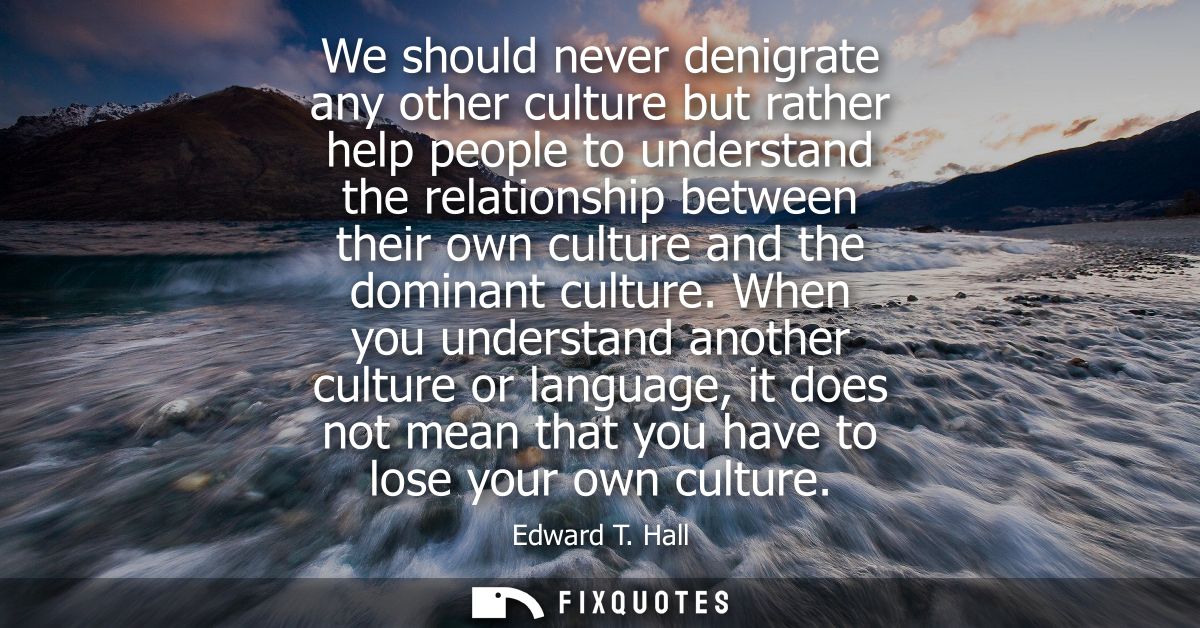
"We should never denigrate any other culture but rather help people to understand the relationship between their own culture and the dominant culture. When you understand another culture or language, it does not mean that you have to lose your own culture"
About this Quote
Hall is smuggling a political warning into the polite language of “understanding.” As an anthropologist of communication, he spent his career showing that culture isn’t decoration; it’s an operating system. So when he says “never denigrate,” he’s not issuing a feel-good plea for tolerance. He’s pointing to a practical failure mode: contempt makes other people’s behavior unreadable, and unreadable behavior quickly gets mislabeled as irrational, lazy, or “backward.”
The sharpest phrase here is “the dominant culture.” Hall names what assimilation talk often hides: there’s a power gradient. Cross-cultural “help” can easily become a one-way conversion program, where the dominant group sets the standards of competence, professionalism, even civility. Hall reframes the task as relational. Don’t treat cultures as sealed boxes or ranked ladders; map the interface between them. That’s classic Hall: context matters, and meaning travels differently depending on who has to do the translating.
The second sentence pushes against a common coercion disguised as opportunity: learn our language, adopt our norms, and you can belong. Hall insists bilingualism and bicultural competence are additive, not subtractive. The subtext is protective as much as it is generous: people can navigate institutions without surrendering identity, and institutions can gain clarity without demanding cultural self-erasure.
Read in the late-20th-century U.S. backdrop of immigration, corporate globalization, and Cold War-era “communication” expertise, the quote lands as a quiet critique of soft power. Understanding is not a synonym for absorption; it’s a demand for reciprocity.
The sharpest phrase here is “the dominant culture.” Hall names what assimilation talk often hides: there’s a power gradient. Cross-cultural “help” can easily become a one-way conversion program, where the dominant group sets the standards of competence, professionalism, even civility. Hall reframes the task as relational. Don’t treat cultures as sealed boxes or ranked ladders; map the interface between them. That’s classic Hall: context matters, and meaning travels differently depending on who has to do the translating.
The second sentence pushes against a common coercion disguised as opportunity: learn our language, adopt our norms, and you can belong. Hall insists bilingualism and bicultural competence are additive, not subtractive. The subtext is protective as much as it is generous: people can navigate institutions without surrendering identity, and institutions can gain clarity without demanding cultural self-erasure.
Read in the late-20th-century U.S. backdrop of immigration, corporate globalization, and Cold War-era “communication” expertise, the quote lands as a quiet critique of soft power. Understanding is not a synonym for absorption; it’s a demand for reciprocity.
Quote Details
| Topic | Respect |
|---|
More Quotes by Edward
Add to List