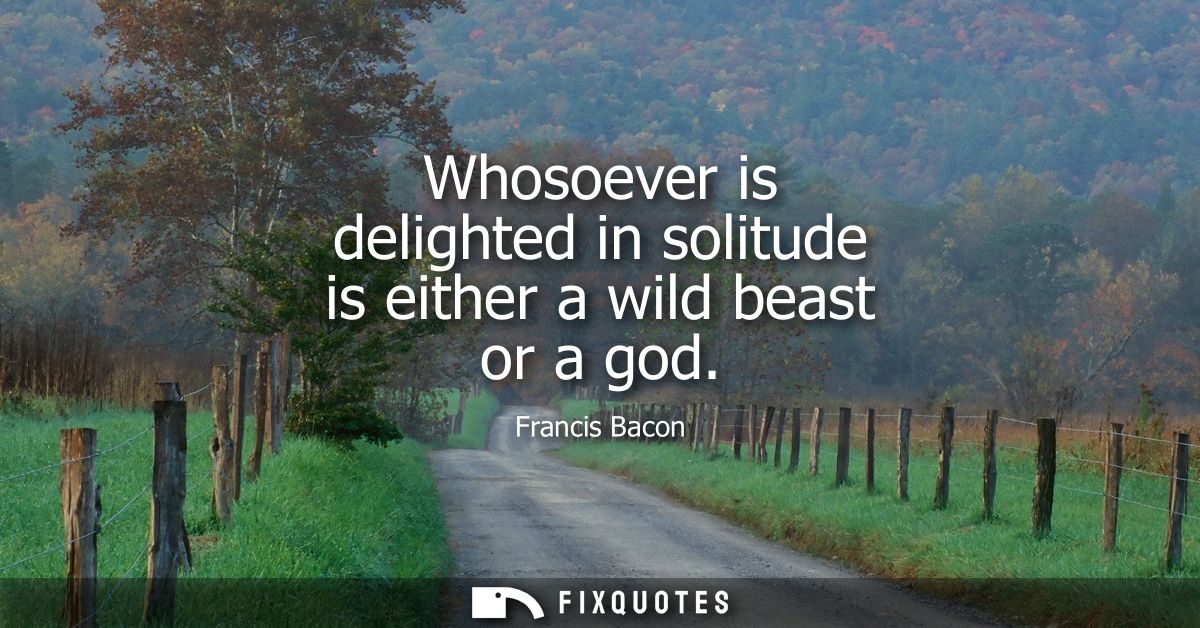
"Whosoever is delighted in solitude is either a wild beast or a god"
About this Quote
Solitude, Bacon suggests, is not a neutral preference but a category error: to truly delight in being alone is to opt out of the human project. The line lands because it flatters and insults in the same breath. It offers two glamorous exits from society - divinity or ferality - then implies that ordinary people have no such excuse. If you enjoy solitude, you are claiming an identity beyond the civic middle: either above the species or beneath it.
The subtext is political as much as psychological. Bacon is writing in a culture where "commonwealth" thinking still frames virtue as participation: service, counsel, court, church, family. In that world, the solitary person is suspect, not romantic. He is unaccountable. He cannot be read, recruited, or corrected. Bacon, a statesman-philosopher with a career built on proximity to power, treats sociability as infrastructure for reason itself. Knowledge is made in conversation, tested in institutions, translated into policy; the recluse short-circuits that circuitry.
The wit is in the brutal taxonomy. "Wild beast" conjures appetite without restraint; "god" conjures self-sufficiency without need. Both are beings who don't negotiate. Bacon isn't denying the value of being alone; he's attacking the idea of being satisfied there. Delight is the tell: it hints at contempt for mutual obligation. In an age anxious about faction, heresy, and rebellion, the solitary figure looks less like a poet and more like a problem.
The subtext is political as much as psychological. Bacon is writing in a culture where "commonwealth" thinking still frames virtue as participation: service, counsel, court, church, family. In that world, the solitary person is suspect, not romantic. He is unaccountable. He cannot be read, recruited, or corrected. Bacon, a statesman-philosopher with a career built on proximity to power, treats sociability as infrastructure for reason itself. Knowledge is made in conversation, tested in institutions, translated into policy; the recluse short-circuits that circuitry.
The wit is in the brutal taxonomy. "Wild beast" conjures appetite without restraint; "god" conjures self-sufficiency without need. Both are beings who don't negotiate. Bacon isn't denying the value of being alone; he's attacking the idea of being satisfied there. Delight is the tell: it hints at contempt for mutual obligation. In an age anxious about faction, heresy, and rebellion, the solitary figure looks less like a poet and more like a problem.
Quote Details
| Topic | Wisdom |
|---|---|
| Source | Help us find the source |
More Quotes by Francis
Add to List