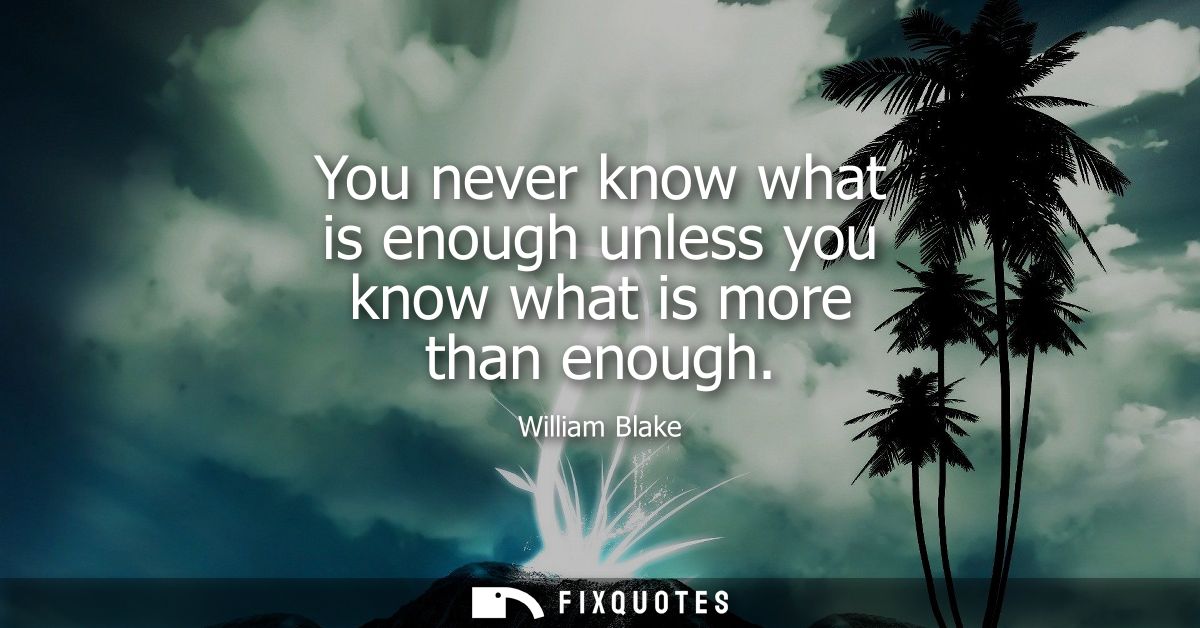
"You never know what is enough unless you know what is more than enough"
About this Quote
Blake’s line is a dare dressed up as homespun wisdom: you don’t discover “enough” through moderation, you discover it by trespassing past the boundary and feeling the consequences. It’s not a sermon for restraint; it’s an argument for extremity as a way of knowing. That’s classic Blake - suspicious of tidy moral arithmetic, convinced that the soul learns by collision, not by compliance.
The intent is epistemic as much as ethical. “Enough” sounds like a stable, reasonable category, the kind societies invoke to keep people legible: enough ambition, enough desire, enough speech, enough dissent. Blake implies that this category is usually inherited, not earned. Only by encountering “more than enough” - excess, saturation, the point where pleasure curdles or effort turns to harm - do you get real knowledge of limits. The subtext is anti-prudential: respectability often mistakes fear for virtue, and calls it temperance.
In context, Blake is a poet of contraries, writing against the Enlightenment’s faith in measured reason and against religious piety that treated human appetite as a defect. He wants the reader to see how institutions domesticate experience by defining the acceptable range in advance. The line works because it compresses a whole romantic philosophy into a paradox: the boundary is visible only after you cross it. It’s thrilling, unsettling, and politically pointed - an endorsement of experimentation that can sound liberating, or dangerously permissive, depending on who’s being asked to stay within “enough.”
The intent is epistemic as much as ethical. “Enough” sounds like a stable, reasonable category, the kind societies invoke to keep people legible: enough ambition, enough desire, enough speech, enough dissent. Blake implies that this category is usually inherited, not earned. Only by encountering “more than enough” - excess, saturation, the point where pleasure curdles or effort turns to harm - do you get real knowledge of limits. The subtext is anti-prudential: respectability often mistakes fear for virtue, and calls it temperance.
In context, Blake is a poet of contraries, writing against the Enlightenment’s faith in measured reason and against religious piety that treated human appetite as a defect. He wants the reader to see how institutions domesticate experience by defining the acceptable range in advance. The line works because it compresses a whole romantic philosophy into a paradox: the boundary is visible only after you cross it. It’s thrilling, unsettling, and politically pointed - an endorsement of experimentation that can sound liberating, or dangerously permissive, depending on who’s being asked to stay within “enough.”
Quote Details
| Topic | Wisdom |
|---|---|
| Source | The Marriage of Heaven and Hell — 'Proverbs of Hell' (proverb), William Blake, c.1790–1793. |
More Quotes by William
Add to List