
Marilyn Monroe Biography Quotes 40 Report mistakes
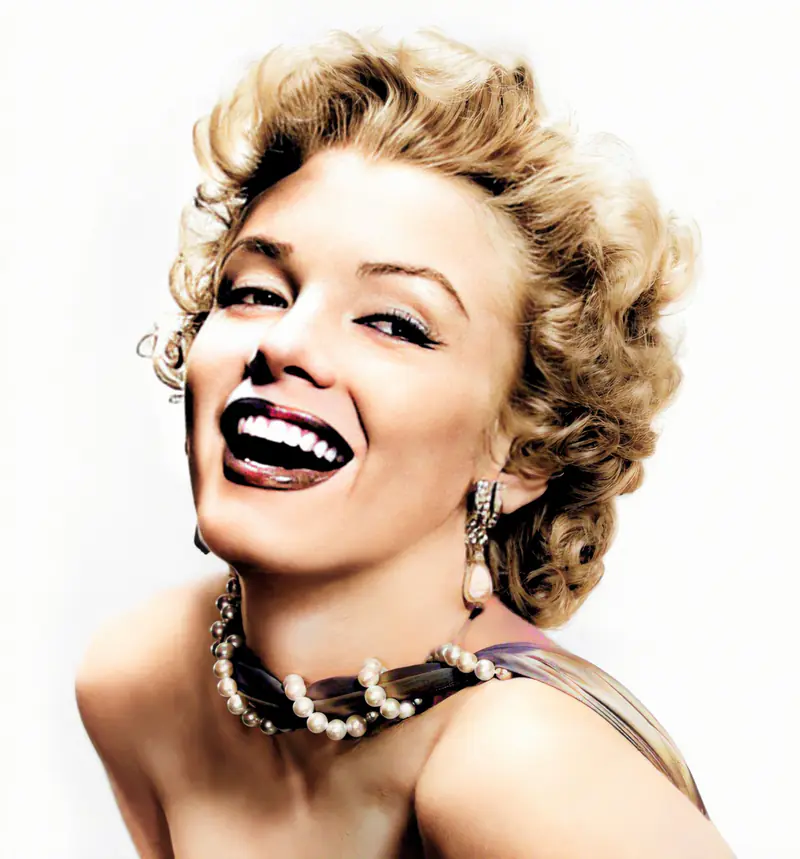
| 40 Quotes | |
| Born as | Norma Jeane Mortenson |
| Occup. | Actress |
| From | USA |
| Born | June 1, 1926 Los Angeles, California, United States |
| Died | August 5, 1962 Brentwood, Los Angeles, California, United States |
| Aged | 36 years |
Marilyn Monroe was born Norma Jeane Mortenson on June 1, 1926, in Los Angeles, California, in an America shaken by the aftershocks of World War I and sliding toward Depression. Her mother, Gladys Baker, worked in film-cutting and other studio-adjacent jobs, close enough to Hollywood to see its glow but not its security. Paternity remained uncertain, and Gladys struggled with mental illness; Norma Jeane spent much of her childhood moving between foster homes and the Los Angeles Orphans Home in Van Nuys. Instability became her earliest teacher: she learned to read rooms quickly, to charm adults, and to treat affection as something that could be offered or withdrawn without warning.
Those years left a dual imprint - an intense craving for safety and a wary intelligence about power. She later recounted episodes of exploitation and felt the humiliations of poverty in a city built to sell dreams. The result was not only vulnerability but a kind of private determination: if the world insisted she be an object, she would become the object that could not be ignored. The name "Marilyn Monroe" would eventually serve as armor for a girl who had too often been unprotected.
Education and Formative Influences
Her formal schooling was irregular, interrupted by placements and work, yet she was observant, book-hungry, and sensitive to performance. In 1942 she married James Dougherty, a merchant mariner, partly to avoid returning to an orphanage; during World War II she worked at the Radioplane munitions plant in Van Nuys, where a military photographer helped launch her modeling career. The pinup economy of wartime America taught her the grammar of the camera - lighting, angles, the difference between being seen and being understood - and she began acting classes and studio training in the late 1940s, treating craft as a route out of disposability.
Career, Major Works, and Turning Points
Signed first to 20th Century-Fox and later also courted by other studios, Monroe moved from bit parts to stardom through a string of early-1950s films, including Niagara (1953), Gentlemen Prefer Blondes (1953), and How to Marry a Millionaire (1953), which crystallized her image as both comic and combustible. Yet the same image became a trap: studios underpaid her, typecast her, and disciplined her for lateness and anxiety even as they profited from her magnetism. She fought back by forming Marilyn Monroe Productions in 1955, a rare act of leverage for a female star, and sought credibility through serious study at Lee Strasberg's Actors Studio in New York. The apex of her screen artistry arrived with The Seven Year Itch (1955), Bus Stop (1956), Some Like It Hot (1959), and The Misfits (1961), even as her private life - marriages to Joe DiMaggio and playwright Arthur Miller, miscarriages, insomnia, dependence on prescribed sedatives, and recurrent depression - intensified under the glare of celebrity. She died on August 5, 1962, in Los Angeles, from a barbiturate overdose ruled probable suicide, an ending that sealed her as both icon and cautionary tale.
Philosophy, Style, and Themes
Monroe's public style was an engineering of innocence: breathy delivery, playful timing, and a body language that alternated between invitation and recoil. She made the "dumb blonde" persona into a critique of those who underestimated her, using comedy as camouflage for a sharper perception. When she insisted, "I don't mind making jokes, but I don't want to look like one". , she was describing the tightrope she walked daily - needing humor to survive and fearing the humiliation of being reduced to it. Her best performances reveal an actress playing two scenes at once: the one the men think they're watching, and the one the woman knows is happening.
Her inner life was shaped by a lifelong argument between appetite and tenderness, exhibition and privacy. She could be frank about the body and still hunger for moral seriousness, refusing to apologize for desire while mourning what desire cost her. "Sex is a part of nature. I go along with nature". reads not as bravado but as self-defense in a culture that profited from eroticism while punishing the erotic woman. And her most adult insight may be her clearest: "Fame will go by and, so long, I've had you, fame... but that's not where I live". That sentence exposes a psychological strategy - separating the marketplace's Marilyn from the private Norma Jeane - and also the tragedy that the separation was never fully honored by the world around her.
Legacy and Influence
Monroe endures as a central myth of 20th-century America: the orphaned girl who mastered the camera, the comic siren who pursued craft, the laborer in a studio system who tried to bargain as an equal. Her image remains endlessly reproduced, but her influence is deeper than pop iconography - she helped redefine screen sexuality as performance with intelligence behind it, and her fight for better roles prefigured later battles over agency, pay, and ownership. In cinema history she stands as both a radiant talent and a case study in how fame, mental health, and institutional exploitation can intertwine; in cultural memory she remains, paradoxically, the most famous woman who kept insisting she was more than what fame could see.
Our collection contains 40 quotes who is written by Marilyn, under the main topics: Witty One-Liners - Truth - Love - Parenting - Work Ethic.
Other people realated to Marilyn: Billy Wilder (Director), Brigitte Bardot (Actress), Joe DiMaggio (Athlete), Walter Reisch (Scientist), Norman Mailer (Novelist), Shelley Winters (Actress), Jayne Mansfield (Actress), Joyce Carol Oates (Novelist), Sterling Hayden (Actor), Anita Loos (Writer)
Frequently Asked Questions
- What is Marilyn Monroe's net worth? At the time of her death, her estate was valued at $1.6 million.
- How did Marilyn Monroe's son die? Marilyn Monroe did not have a son.
- How did Marilyn Monroe die? Marilyn Monroe died of an overdose of barbiturates.
- Who was Marilyn Monroe's children? Marilyn Monroe had no children.
- How old was Marilyn Monroe? She became 36 years old
Source / external links