
Augusto Pinochet Biography Quotes 5 Report mistakes
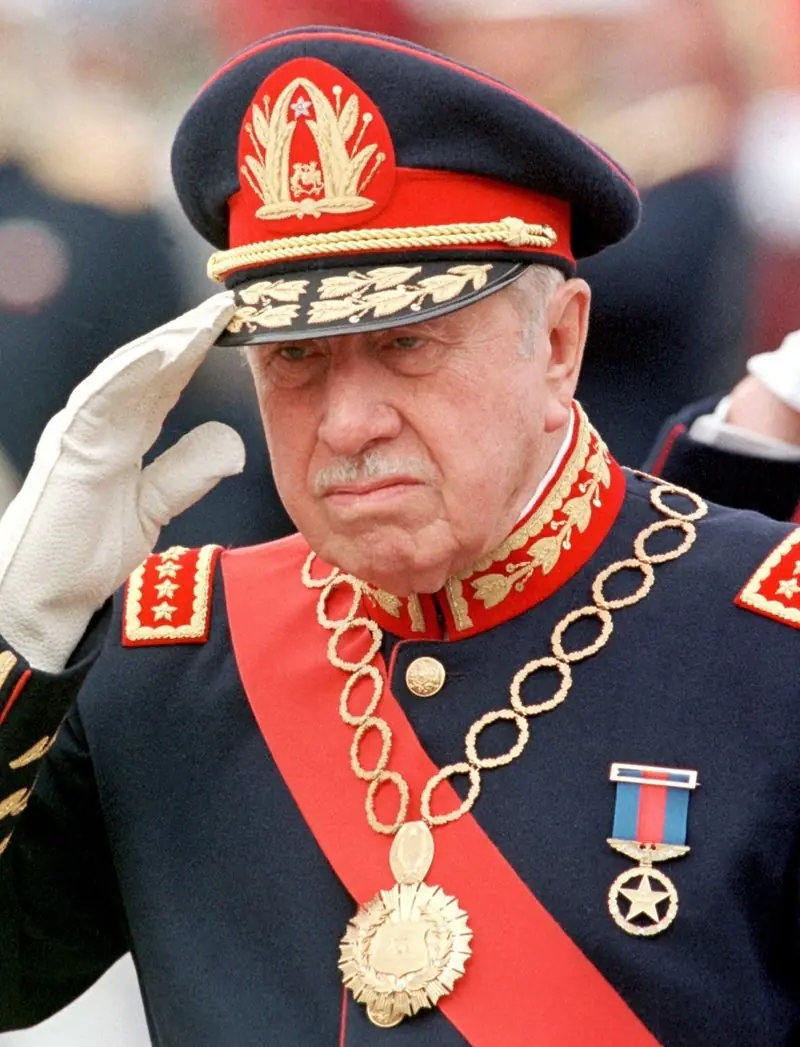
| 5 Quotes | |
| Born as | Augusto José Ramón Pinochet Ugarte |
| Occup. | Soldier |
| From | Chile |
| Born | November 25, 1915 Valparaíso, Chile |
| Died | December 10, 2006 Santiago, Chile |
| Aged | 91 years |
Augusto Jose Ramon Pinochet Ugarte was born on November 25, 1915, in Valparaiso, Chile, to Augusto Pinochet Vera and Avelina Ugarte Martinez. Raised in a middle-class household, he pursued a military career early, entering the Military School of the Libertador Bernardo O Higgins in Santiago. Commissioned into the infantry in the 1930s, he served in various northern garrisons and later attended the War Academy, where he developed an interest in geopolitics and authored technical works on the subject. In 1943 he married Lucia Hiriart Rodriguez; the couple had five children. Pinochet was known among peers as methodical and disciplined rather than flamboyant, a profile that helped him navigate the hierarchical culture of the Chilean Army.
Military ascent
Through the 1950s and 1960s, Pinochet rose steadily, holding command and staff positions that built his reputation as a reliable, orthodox officer. He taught at the War Academy and returned to field commands, experiences that cultivated his image as both a theorist and a practitioner. In the turbulent early 1970s, Chile experienced growing political polarization under President Salvador Allende, whose Popular Unity government faced economic turmoil and street conflict. After the failed tank uprising known as the Tanquetazo in June 1973, the respected commander-in-chief, General Carlos Prats, came under pressure and resigned in August. Allende appointed Pinochet commander-in-chief of the Army on August 23, 1973, perceiving him as loyal and apolitical. Within weeks, Chile would undergo a dramatic rupture.
The 1973 coup and consolidation
On September 11, 1973, a military coup overthrew Allende, who died during the assault on La Moneda palace. The junta that seized power comprised the heads of the branches of the armed forces: General Augusto Pinochet (Army), Admiral Jose Toribio Merino (Navy), General Gustavo Leigh (Air Force), and General Cesar Mendoza (Carabineros, the national police). Pinochet quickly emerged as the dominant figure. He dissolved Congress, suspended the constitution, banned leftist parties, and imposed strict censorship. Leigh, who initially had strong influence, later clashed with Pinochet over the depth and direction of the regime and was replaced in 1978 by General Fernando Matthei as Air Force commander. The junta centralized authority around Pinochet, who became the unquestioned leader by the mid-1970s.
Repression, security apparatus, and Operation Condor
The regime established a sprawling security apparatus to eradicate Marxist and perceived subversive influence. The Directorate of National Intelligence (DINA), led by Manuel Contreras, became the principal organ of repression, running clandestine detention centers such as Villa Grimaldi and collaborating with extremist networks. DINA worked with secretive enclaves like Colonia Dignidad, a sect led by Paul Schafer, which served as a logistics and detention hub. In 1977, amid international criticism, DINA was dissolved and replaced by the National Information Center (CNI), which continued internal security operations.
Chile joined Operation Condor, a transnational network among South American military regimes that targeted exiles and opposition figures. High-profile assassinations included former army commander Carlos Prats and his wife, Sofia Cuthbert, killed by a car bomb in Buenos Aires in 1974, and former ambassador Orlando Letelier, murdered with Ronni Moffitt in a 1976 car bombing in Washington, D.C., in an operation involving DINA operative Michael Townley and anti-Castro exiles. Domestic and international human rights organizations, the Catholic Churchs Vicaria de la Solidaridad under Cardinal Raul Silva Henriquez, and later the National Commission for Truth and Reconciliation (the Rettig Commission), documented widespread abuses. The Rettig Commission in 1991 identified more than 2, 000 victims of execution or disappearance; the Valech Commission in 2004 recorded tens of thousands of torture survivors. These findings defined the regimes human cost.
Economic policy and the Chicago Boys
Parallel to political repression, the regime directed a drastic economic transformation. Economists trained at the University of Chicago and the Pontifical Catholic University of Chile, nicknamed the Chicago Boys, advocated liberalization, privatization, and fiscal discipline. Key figures included Sergio de Castro, who served as finance minister in the late 1970s; Jose Pinera, who oversaw labor and mining reforms and created a private, defined-contribution pension system (AFP) in 1981; and, later, Hernan Buchi, who guided stabilization and reform in the mid-1980s. Influenced by advice associated with Milton Friedman and Arnold Harberger, the government undertook shock therapy measures in 1975, slashing public spending and removing price controls.
The reforms initially deepened recession and unemployment, then produced strong growth in the late 1970s, followed by a severe 1982 debt crisis that exposed vulnerabilities in the financial sector. The state re-entered parts of the economy to rescue banks before reprivatizing them. By the late 1980s, Chile had a more open economy with diversified exports, but persistent inequality and labor repression drew criticism. Supporters credited Pinochet with laying foundations for later growth; critics argued the social costs and authoritarian context undermined legitimacy.
The 1980 Constitution and political engineering
To institutionalize military rule, the regime convened a commission of jurists and advisers, with conservative intellectual Jaime Guzman a central architect, to draft a new constitution. Approved in a 1980 plebiscite widely criticized for lack of safeguards, the constitution restructured the political system, created a powerful presidency, established a National Security Council with military influence, and included appointed senators. It set an eight-year transitional period, after which a single-candidate plebiscite would decide whether Pinochet would continue. This framework was meant to secure continuity of the regime and insulate its policies from future governments.
Challenges, opposition, and the 1988 plebiscite
The mid-1980s brought escalating opposition. Civil society coalitions, labor strikes, and protests challenged the regime, while parties coalesced into the Concertacion coalition. Security scandals, including the 1985 Caso Degollados murders of three dissidents, cost the regime political capital and led to the resignation of General Cesar Mendoza as head of the Carabineros. In 1986, the Manuel Rodriguez Patriotic Front attempted to assassinate Pinochet in an ambush; he survived, and the regime responded with intensified repression.
As the 1988 plebiscite approached, government ministers like Hernan Buchi emphasized stability and continuity, while opposition figures such as Patricio Aylwin and Ricardo Lagos led an increasingly effective No campaign. On October 5, 1988, Chileans voted No, rejecting Pinochets continuation in power. Air Force commander Fernando Matthei publicly acknowledged the results, underscoring divisions within the regime. Negotiations set the stage for competitive elections under the 1980 constitution.
Commander-in-chief, senator-for-life, and legal reckoning
Pinochet remained army commander-in-chief until March 1998, exerting influence over the transition. Patricio Aylwin, inaugurated in 1990, initiated truth and reconciliation efforts while balancing civilian-military relations. The army, navy under Jose Toribio Merino, and other services guarded their prerogatives; Jaime Guzman, a key civilian ally of the military regime and founder of the UDI party, was assassinated in 1991 by leftist militants, an event that hardened conservative positions.
Upon retiring from the army, Pinochet became a senator-for-life, as allowed by the 1980 constitution. Later that year, in October 1998, he was arrested in London on a Spanish warrant issued by Judge Baltasar Garzon, invoking universal jurisdiction for crimes including torture. The British legal saga, with decisions by the House of Lords and ultimate intervention by Home Secretary Jack Straw, marked a watershed in international human rights law. Supporters, including former British Prime Minister Margaret Thatcher, publicly defended him, while victims groups pressed for accountability. In March 2000, he was released on medical grounds and returned to Chile.
In Chile, Judge Juan Guzman Tapia led investigations into cases such as the Caravan of Death, a 1973 military operation that executed political prisoners after the coup. Courts gradually narrowed Pinochets immunity; medical assessments and legal arguments over his fitness to stand trial produced cycles of indictment, house arrest, and suspension. In 2004, revelations involving Riggs Bank uncovered secret accounts and alleged tax evasion and illicit enrichment, broadening judicial scrutiny to financial wrongdoing and involving members of his family, including Lucia Hiriart.
Death and legacy
Pinochet died in Santiago on December 10, 2006, following heart complications. He never received a definitive criminal conviction, though he faced multiple indictments. The government, led at the time by President Michelle Bachelet, whose father, Air Force General Alberto Bachelet, had been detained and died in custody in 1974, denied him a state funeral; the army conducted a military ceremony. His death prompted polarized reactions: thousands mourned a leader they credited with saving Chile from Marxism and modernizing the economy, while many others marked the passing of a ruler they held responsible for torture, disappearance, and the dismantling of democracy.
Pinochets legacy remains one of the most contested in modern Latin American history. The institutional architecture created under his rule constrained the early democratic period; over time, reforms reduced military tutelage and eliminated features such as appointed senators. Economically, Chile sustained market-oriented policies but expanded social protections and poverty reduction programs under elected governments. The long arc of legal accountability continued after his death, with ongoing prosecutions of former security officials such as Manuel Contreras and others tied to DINA and CNI, and continuing efforts to identify the disappeared. The story of Pinochet is inseparable from the lives of the people around him and those who opposed him: allies in the armed forces like Merino and Matthei, civilian ideologues like Jaime Guzman, victims such as Orlando Letelier and Ronni Moffitt, and political leaders from Salvador Allende to Patricio Aylwin. Each helps illuminate how one generals ascent altered Chile and how Chile, over decades, worked to reassert democracy and reckon with its past.
Our collection contains 5 quotes who is written by Augusto, under the main topics: Witty One-Liners - Freedom - Military & Soldier - War - God.
Other people realated to Augusto: Jorge Luis Borges (Poet), Henry A. Kissinger (Statesman), Fernando Flores (Politician)
Source / external links