
Christian Lous Lange Biography Quotes 35 Report mistakes
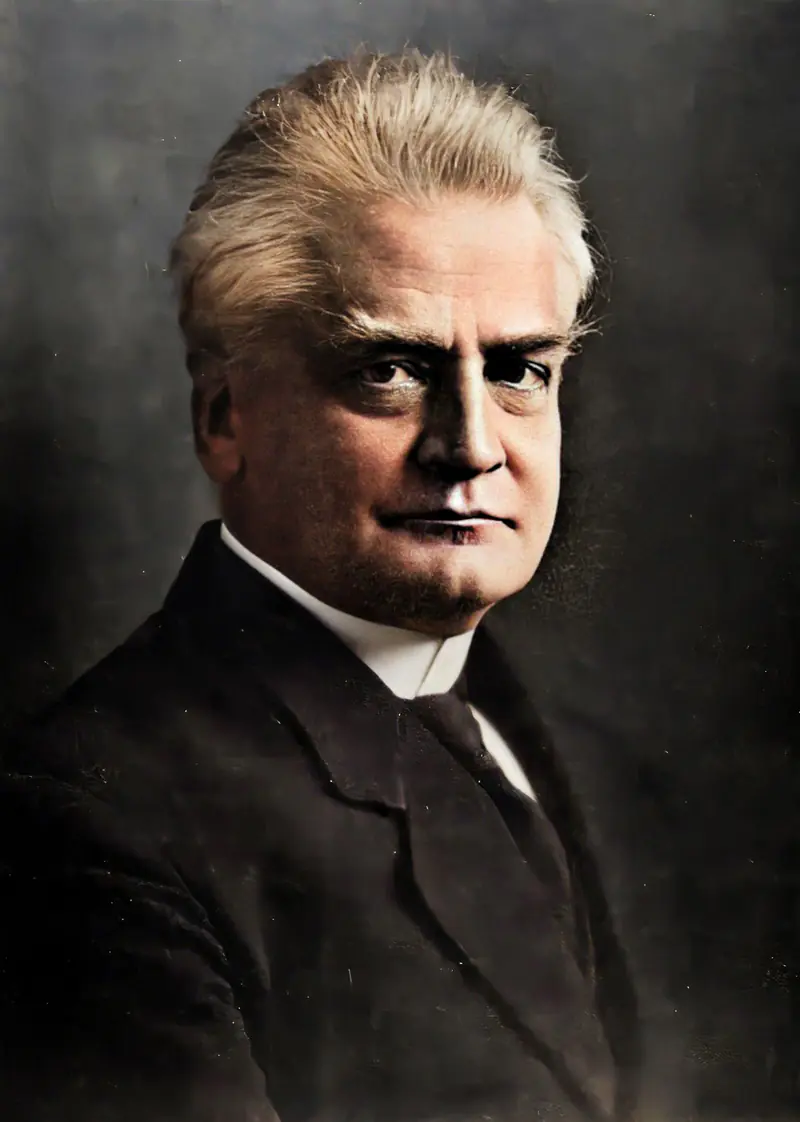
| 35 Quotes | |
| Occup. | Politician |
| From | Norway |
| Born | September 17, 1869 Stavanger, Norway |
| Died | December 11, 1938 Oslo, Norway |
| Cause | Natural Causes |
| Aged | 69 years |
Christian Lous Lange was born on September 17, 1869, in Norway, into a society that had recently remade itself. Norway was still in union with Sweden, yet it was building a distinctive parliamentary culture, a modern press, and a civic nationalism that sat uneasily beside older loyalties to crown and border. Lange grew up amid this tension between the local and the international - a tension that would later become the governing problem of his public life.
He was not formed as a politician in the narrow, electoral sense so much as as a political organizer of ideas: a patient builder of associations, briefs, and arguments intended to make peace practical. That temperament - disciplined, cautious with rhetoric, ambitious in scope - reflected a small-state sensibility. Norway could not impose its will by force; it had to persuade, cooperate, and bind stronger powers to rules. Lange absorbed that lesson early, and he carried it into every institution he touched.
Education and Formative Influences
Lange studied in a period when European intellectual life was saturated with faith in progress and dread of its costs: industrial acceleration, mass politics, and imperial competition. The new social sciences, the liberal internationalist tradition, and a Scandinavian moral seriousness about law and public duty all fed him. By the 1890s he was drawn toward the peace movement not as utopian protest but as a field in which documentation, public opinion, and institutional design could restrain the drift toward war.
Career, Major Works, and Turning Points
Lange became a central Norwegian architect of organized internationalism, working through the Norwegian Nobel Institute and the wider peace movement, and later serving as a secretary-general of the Inter-Parliamentary Union, the premier pre-UN forum linking legislators across borders. He wrote widely on the evolution of the state system, nationalism, and the mechanics of war prevention, producing studies that treated diplomacy as a social phenomenon rather than a chess match of great powers. World War I confirmed his darkest premises while hardening his method: after 1918 he pushed for structures that could survive disappointment - arbitration norms, parliamentary networks, and a public language that made cross-border obligation feel as legitimate as patriotism. In 1921 he shared the Nobel Peace Prize, recognition not only of personal influence but of the institutional approach he embodied: peace as continuous work rather than a single treaty moment.
Philosophy, Style, and Themes
Lange wrote like an organizer of consent. He distrusted intoxicating slogans, preferring the cumulative force of evidence, comparison, and historical analogy. His imagination was moral, but his reasoning was sociological: internationalism, for him, had to be grounded in how humans actually live - trade, migration, communication, interdependence - not merely in sermons. That is why he defined his creed with almost constitutional precision: "Internationalism is a community theory of society which is founded on economic, spiritual, and biological facts. It maintains that respect for a healthy development of human society and of world civilization requires that mankind be organized internationally". The phrase "organized internationally" captures his psychology - a desire to domesticate danger through procedure, to replace heroic improvisation with durable habits.
His most persistent theme was the mismatch between inherited political forms and modern realities. He saw the territorial state not as a villain but as an emotionally protected inheritance, wrapped in devotion and tradition, and therefore hard to reform without backlash. Yet he insisted that modernity was already dissolving its self-sufficiency: "Today we stand on a bridge leading from the territorial state to the world community. Politically, we are still governed by the concept of the territorial state; economically and technically, we live under the auspices of worldwide communications and worldwide markets". This was not mere description; it was an anxiety. The bridge image reveals a mind attuned to transition, where missteps become catastrophes. Hence his warning that militarism is a mental framework, not just weapons: "Militarism is basically a way of thinking, a certain interpretation of the function of the state; this manner of thinking is, moreover, revealed by its outer forms: by armaments and state organization". To change policy, Lange believed, one had to change the underlying story states tell about themselves.
Legacy and Influence
Lange died on December 11, 1938, as Europe slid toward a second catastrophe that his entire career had tried to prevent. Yet his influence endured in the infrastructure of liberal internationalism: parliamentary diplomacy, the professional peace movement, and the conviction that public opinion, law, and institutions can shape state behavior even when power politics snarls. He remains a defining Norwegian figure in the long arc from nineteenth-century nationalism to twentieth-century multilateralism - a biographer of the territorial state who, from a small country at Europe's edge, helped teach larger ones to imagine obligation beyond borders.
Our collection contains 35 quotes who is written by Christian, under the main topics: Ethics & Morality - Wisdom - Deep - Freedom - Hope.
Source / external links