
Emile Zola Biography Quotes 13 Report mistakes
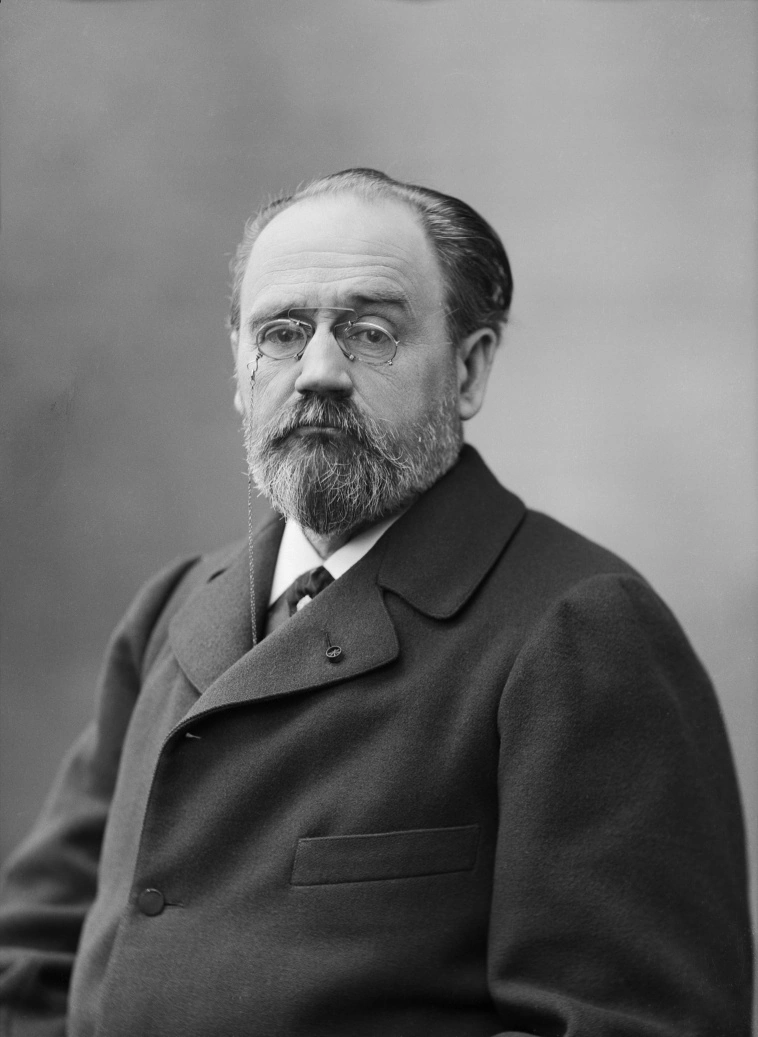
Attr: Nadar, Public Domain
| 13 Quotes | |
| Born as | Emile Edouard Charles Antoine Zola |
| Native name | Émile Zola |
| Occup. | Novelist |
| From | France |
| Born | April 2, 1840 Paris, France |
| Died | September 29, 1902 Paris, France |
| Cause | carbon monoxide poisoning |
| Aged | 62 years |
| Cite | |
Citation Formats
APA Style (7th ed.)
Emile zola biography, facts and quotes. (2026, February 11). FixQuotes. https://fixquotes.com/authors/emile-zola/
Chicago Style
"Emile Zola biography, facts and quotes." FixQuotes. February 11, 2026. https://fixquotes.com/authors/emile-zola/.
MLA Style (9th ed.)
"Emile Zola biography, facts and quotes." FixQuotes, 11 Feb. 2026, https://fixquotes.com/authors/emile-zola/. Accessed 31 Mar. 2026.
Early Life and Background
Emile Edouard Charles Antoine Zola was born on April 2, 1840, in Paris, into a family whose fortunes rose and then abruptly narrowed. His father, Francois Zola, an Italian-born engineer, won attention for ambitious hydraulic and transport projects; his mother, Emilie Aubert, guarded the household after Francois died in 1847, leaving the boy with a mix of pride in technical modernity and an early intimacy with precarity.Much of Zola's boyhood unfolded in Aix-en-Provence, where the clear light and rigid social hierarchies of a provincial town sharpened his observational instincts. He grew up amid the Second Republic's turmoil and the early Second Empire's promises of order, absorbing how political regimes touched ordinary lives through schooling, jobs, rent, and reputation. Those early pressures - the loss of a father, the weight of a determined mother, the humiliations of being short of money - became the emotional grain of his later fiction: a writer alert to how private desires are bruised by public structures.
Education and Formative Influences
Zola attended the College Bourbon in Aix, befriending Paul Cezanne, whose fierce devotion to seeing would later echo in Zola's own drive to render reality without flattery. After moving back to Paris, Zola attempted the baccalaureat and failed, then drifted through underpaid work and hunger before finding a foothold at the publishing house Hachette in the early 1860s. There he learned the machinery of print - how books are sold, reviewed, and marketed - while devouring Balzac and Flaubert and tracking the era's new sciences and social inquiries, all of which encouraged him to treat the modern city as both subject and system.Career, Major Works, and Turning Points
Zola emerged first as a journalist and critic, then as a novelist with a scandalous gift for turning contemporary life into narrative proof. After early works such as Therese Raquin (1867), he launched the Rougon-Macquart cycle (1871-1893), a twenty-novel anatomy of a family under the Second Empire, shaped by heredity, environment, and the pressures of money, sex, labor, and power; key volumes include L'Assommoir (1877), Nana (1880), Germinal (1885), and La Bete humaine (1890). His public life reached a turning point with the Dreyfus Affair: in 1898 he published "J'accuse...!" accusing the state of antisemitic injustice, was convicted of libel, fled to England, and returned in 1899 as the case moved toward eventual exoneration. Zola died in Paris on September 29, 1902, from carbon monoxide poisoning caused by a blocked chimney; suspicion of foul play has lingered, but certainty has not.Philosophy, Style, and Themes
Zola called his approach Naturalism: the novel as a laboratory where characters are tested by conditions they did not choose. His imagination was expansive, but his method was workmanlike, built from notebooks, site visits, and an almost industrial discipline. He believed craft could harness inspiration - “The artist is nothing without the gift, but the gift is nothing without work”. - a sentence that reads as self-command as much as aesthetic doctrine. It explains his relentless production across journalism, criticism, and fiction: he distrusted the romantic myth of effortless genius, and he treated writing as a moral obligation to finish what reality had begun.His themes circle the collision between appetite and circumstance: alcoholism and wage labor, the erotic economy of celebrity, the violence embedded in machines, and the slow cruelty of respectability. The same temperament that insisted on describing the slum, the mine, or the marketplace also insisted on speaking publicly when institutions lied. “If you shut up truth, and bury it underground, it will but grow”. In Zola, truth is not only a proposition but a pressure - something that ferments, returns, and finally demands a witness. That witness is often the writer himself, animated by an ethical impatience with silence and a visceral sympathy that crosses species and class: “The fate of animals is of greater importance to me than the fear of appearing ridiculous; it is indissolubly connected with the fate of men”. The line exposes his inner logic: compassion is not decoration but a diagnostic of civilization, and embarrassment is a small price for clarity.
Legacy and Influence
Zola helped redefine what the modern novel could do: not merely entertain or moralize, but document, argue, and anatomize a society in motion. Naturalism spread beyond France into European and American realism, influencing writers who turned to industry, urban poverty, and institutional power as legitimate epic material. His Dreyfus intervention became a template for the engaged intellectual, a reminder that a novelist's authority can be put at risk for public justice. The Rougon-Macquart books remain central not because they are comfortable, but because they force readers to see how history enters the body - through work, hunger, desire, and the stories a nation tells itself when it prefers not to look.Our collection contains 13 quotes written by Emile, under the main topics: Witty One-Liners - Motivational - Ethics & Morality - Truth - Wisdom.
Other people related to Emile: Edouard Manet (Artist), Paul Muni (Actor), Maria Schell (Actress), Norman Reilly Raine (Screenwriter)
Emile Zola Famous Works
- 1898 J'accuse…! (Essay)
- 1893 Le Docteur Pascal (Novel)
- 1892 La Débâcle (Novel)
- 1891 L'Argent (Novel)
- 1890 La Bête humaine (Novel)
- 1888 Le Rêve (Novel)
- 1887 La Terre (Novel)
- 1886 L'Œuvre (Novel)
- 1885 Germinal (Novel)
- 1884 La Joie de vivre (Novel)
- 1883 Au Bonheur des Dames (Novel)
- 1882 Pot-Bouille (Novel)
- 1880 Nana (Novel)
- 1877 L'Assommoir (Novel)
- 1876 Son Excellence Eugène Rougon (Novel)
- 1875 La Faute de l'Abbé Mouret (Novel)
- 1874 La Conquête de Plassans (Novel)
- 1873 Le Ventre de Paris (Novel)
- 1871 La Curée (Novel)
- 1871 La Fortune des Rougon (Novel)
- 1867 Thérèse Raquin (Novel)
Source / external links
- The National Archives (UK): Zola: Emile (1840–1902): French Novelist (authority/records summary)
- Penguin Random House: Emile Zola (author page)
- Bibliothèque nationale de France (Gallica): Société littéraire des amis d'Émile Zola (partner page)
- Société Littéraire des Amis d’Émile Zola – Les Cahiers naturalistes
- Maison Zola | Musée Dreyfus – Médan
- Encyclopaedia Britannica: Émile Zola
- Wikipedia: Émile Zola