
Harry S. Truman Biography Quotes 59 Report mistakes
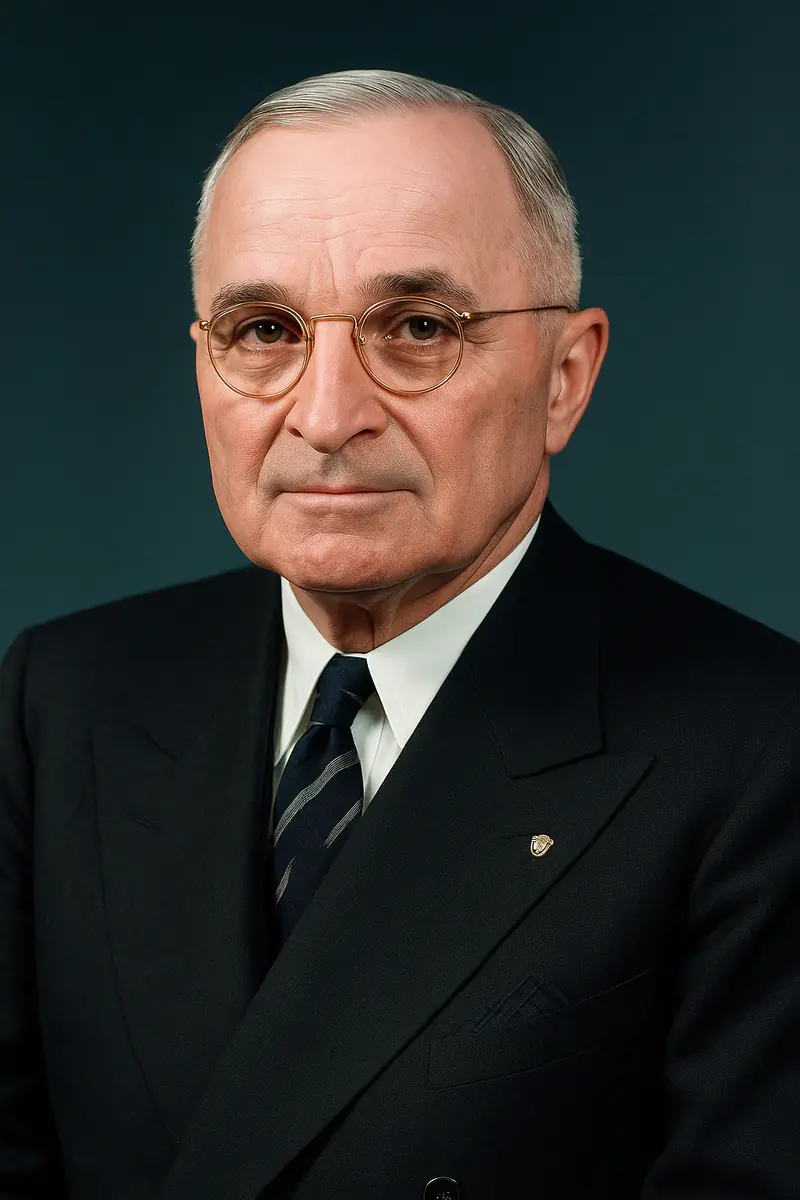
| 59 Quotes | |
| Occup. | President |
| From | USA |
| Spouse | Bess Wallace (1919) |
| Born | May 8, 1884 Lamar, Missouri, USA |
| Died | December 26, 1972 Kansas City, Missouri, USA |
| Aged | 88 years |
Harry S. Truman was born on May 8, 1884, in Lamar, Missouri, and grew up in the small-town world of Independence and the surrounding farms of western Missouri. The son of John Anderson Truman and Martha Ellen Young Truman, he was raised with strong Methodist values and a respect for hard work. Nearsighted from childhood, he wore thick glasses and devoted himself to reading, especially history and biographies, which helped form his precise, plainspoken style. The middle initial S honored both of his grandfathers, Anderson Shipp Truman and Solomon Young, without standing for a single name. After public schooling he graduated from high school in Independence, one of the few presidents without a college degree. He worked a series of modest jobs, including as a bank clerk in Kansas City and as a timekeeper on railroad-related construction, before returning to help run the family farm. He courted Bess Wallace, his childhood acquaintance, for years; they married in 1919 and later welcomed their daughter, Margaret, who became a central presence in his life.
World War I and Early Career
Truman joined the Missouri National Guard and served in the artillery during World War I. In France he commanded Battery D of the 129th Field Artillery in the 35th Division. Known for discipline and loyalty to his men, he earned their respect during difficult operations in the Vosges and the Meuse-Argonne. The experience developed his organizational skills and confidence. After the war he entered business in Kansas City with fellow veteran and friend Eddie Jacobson, opening a haberdashery. The store failed in the postwar recession, but Truman insisted on repaying every debt, a personal ethic that shaped his political reputation.
Rise in Missouri Politics
Encouraged by local allies tied to the Jackson County Democratic organization of Tom Pendergast, Truman ran for office. He was elected county judge for the eastern district of Jackson County in 1922, lost re-election in 1924, and returned as presiding judge in 1926 and 1930. The judge position was administrative, akin to a county commissioner. In those roles he championed road building, improved fiscal management, and oversaw construction and renovation projects, including a courthouse in Independence, cultivating an image of efficiency and honesty despite the broader controversies surrounding the Pendergast machine. His reputation for diligence and clean personal conduct helped him transcend the stigma of machine politics.
Senator from Missouri and the Truman Committee
In 1934 Truman won election to the U.S. Senate as a New Deal Democrat. Initially overshadowed by senior colleagues, he crafted alliances with practical legislators and supported public works, transportation, and wartime preparedness. In 1941 he rose to national prominence as chair of the Senate Special Committee to Investigate the National Defense Program, soon known as the Truman Committee. The committee exposed waste, fraud, and mismanagement in wartime contracts, saving substantial sums while keeping production on schedule. Working with colleagues such as Arthur Vandenberg and James Mead, he refined a style that combined candor with fact-finding. The work showcased his fairness and decisiveness, positioning him for higher responsibilities.
Vice Presidency and Sudden Ascension
In 1944 Democratic leaders, including Robert Hannegan, promoted Truman as a consensus choice for vice president on Franklin D. Roosevelt's fourth-term ticket, replacing Henry A. Wallace. Elected in November, Truman was kept at arm's length from many wartime secrets, including details of the atomic project. On April 12, 1945, after just 82 days as vice president, he became the 33rd president upon Roosevelt's death. He immediately consulted senior figures such as Secretary of War Henry Stimson and Secretary of State Edward Stettinius Jr., relying on advisers and military leaders to gain control of the sprawling wartime agenda.
Ending World War II and the Atomic Decision
Assuming the presidency near the end of World War II, Truman confronted Germany's collapse and the impending invasion of Japan. He attended the Potsdam Conference with Winston Churchill (later replaced by Clement Attlee) and Joseph Stalin, shaping postwar boundaries and demanding Japan's surrender. When Japan resisted, he authorized the use of atomic bombs on Hiroshima and Nagasaki in August 1945, acting on recommendations from civilian and military committees and weighing the prospective costs of invasion. Japan's surrender followed, and General Douglas MacArthur oversaw the occupation and reforms, including a new constitution. Truman also championed the United Nations, supporting the San Francisco conference that produced its charter in 1945.
Rebuilding a Fractured World
As the war ended, new geopolitical tensions emerged. Truman and advisers like George C. Marshall, Dean Acheson, and George Kennan crafted policies to counter Soviet expansion and stabilize war-torn regions. In 1947 he announced the Truman Doctrine to support Greece and Turkey, articulating a broader commitment to resist coercion and uphold self-determination. With Marshall as secretary of state, the administration advanced the European Recovery Program, known as the Marshall Plan, which helped revive Western European economies. Working with congressional leaders including Arthur Vandenberg, Truman embraced a bipartisan approach to foreign policy. He signed the National Security Act of 1947, creating the Department of Defense, the Air Force as a separate service, the Central Intelligence Agency, and the National Security Council, reorganizing the nation's security apparatus for the Cold War. He recognized the new state of Israel in 1948, after consultation with figures such as Chaim Weizmann and over the objections of some advisers concerned about regional stability.
Domestic Policy and the Fair Deal
Truman tried to extend New Deal reforms under the banner of the Fair Deal. He proposed national health insurance, civil rights protections, federal aid to education, and housing initiatives. Many proposals stalled amid a conservative coalition in Congress, but he secured important gains, including the Housing Act of 1949 and expanded Social Security coverage. He confronted a wave of postwar labor strikes in steel, coal, and rail, sometimes taking hard measures to keep essential services running. His veto of the Taft-Hartley Act, a measure limiting union power, was overridden in 1947. He issued Executive Orders 9980 and 9981 in 1948 to desegregate the federal workforce and the armed forces, acting after his Committee on Civil Rights called for an end to segregation. The push prompted a walkout by southern Democrats and the Dixiecrat campaign of Strom Thurmond, but it set a new federal course on civil rights.
The 1948 Campaign and an Upset Victory
Facing low approval ratings and a fractious party, Truman launched an energetic whistle-stop campaign across the country in 1948. He challenged the Republican-controlled Congress and ran against what he called its inaction, while Thomas E. Dewey ran a cautious race. Truman's plain speaking and retail politicking resonated with many voters. He won one of the greatest upsets in American political history, symbolized by the famous erroneous headline, "Dewey Defeats Truman". Alben Barkley became his vice president for the second term.
Cold War Crises and the Korean War
The emerging Cold War required constant decisions. Truman backed the Berlin Airlift of 1948, 1949 to sustain West Berlin after a Soviet blockade, and he helped form the North Atlantic Treaty Organization in 1949. That same year saw the Soviet atomic test and the communist victory in China, developments that fed domestic criticism led by figures such as Senator Joseph McCarthy. In June 1950, North Korea invaded South Korea. Acting through the United Nations, Truman committed U.S. forces to repel the invasion. Early success near the Pusan Perimeter and the Inchon landing gave way to a major Chinese intervention. When General Douglas MacArthur publicly challenged administration policy, Truman relieved him in 1951, appointing Matthew Ridgway to command. The decision affirmed civilian control over the military but was deeply controversial. The war settled into stalemate; an armistice would be concluded after Truman left office.
Challenges, Scandals, and Constitutional Limits
Truman's presidency faced economic inflation, procurement controversies, and tax scandals that touched the Internal Revenue Service and some appointees, including concerns about the influence of his military aide, General Harry Vaughan. In 1952, during a nationwide labor dispute, he ordered the seizure of steel mills to avert a strike; the Supreme Court ruled against him in Youngstown Sheet & Tube Co. v. Sawyer, asserting limits on executive power. He also authorized the development of the hydrogen bomb in 1950 as the nuclear arms race accelerated. The 22nd Amendment, limiting presidents to two elected terms, was ratified in 1951; it did not apply to him, but public fatigue and a poor showing against Estes Kefauver in the 1952 New Hampshire primary led him to step aside. The Democratic nomination went to Adlai Stevenson, and Dwight D. Eisenhower won the presidency.
Final Years and Public Service
Returning to Independence in 1953, Truman and Bess sought a quieter life. He declined most corporate offers, believing they would commercialize the presidency, and instead devoted himself to organizing his papers and establishing the Harry S. Truman Presidential Library and Museum, which opened in 1957. He wrote a two-volume memoir in the mid-1950s that combined personal candor with defense of his policies. Congress later passed the Former Presidents Act of 1958, providing pensions and staff support, in part inspired by his modest circumstances. He stayed in contact with successors and allies; in 1965 President Lyndon B. Johnson traveled to Independence to sign the Medicare law at the library, honoring Truman's long-standing advocacy of national health insurance by presenting Medicare cards to Harry and Bess. He remained engaged with visitors, scholars, and local citizens, continuing his habit of plain talk.
Character and Legacy
Truman's public persona was straightforward and unadorned: he kept a sign on his Oval Office desk that read, "The buck stops here". Supporters admired his decisiveness and integrity; critics challenged aspects of his foreign policy and his handling of labor and security issues. He helped build the architecture of the postwar world through the Marshall Plan, NATO, and the reorganization of national security institutions. At home he pressed civil rights into the federal agenda and sought, with mixed success, to expand the social safety net. His choices at the end of World War II and during the early Cold War shaped global politics for decades, while his dismissal of MacArthur reaffirmed constitutional principles.
Death and Commemoration
Harry S. Truman died on December 26, 1972, in Missouri at the age of 88. He was laid to rest in the courtyard of his presidential library in Independence, where Bess joined him later. Remembered by contemporaries such as Dean Acheson and George C. Marshall for resolve under pressure, and by millions of citizens who heard him whistle-stop across the country, Truman left a legacy of plain speaking, accountability, and a durable strategic framework for American leadership. His life traced a path from farm fields to the Oval Office, where, amid challenge and controversy, he guided the United States through the end of a world war and the uncertain beginning of a new global order.
Our collection contains 59 quotes who is written by Harry, under the main topics: Witty One-Liners - Motivational - Wisdom - Truth - Justice.
Other people realated to Harry: Eleanor Roosevelt (First Lady), Hubert H. Humphrey (Politician), Herbert Hoover (President), Nelson Rockefeller (Vice President), William O. Douglas (Judge), Dean Rusk (Diplomat), Henry L. Stimson (Statesman), Emanuel Celler (Politician), Bess Truman (First Lady), Ike Skelton (Politician)
Frequently Asked Questions
- Bess Truman: His wife; U.S. First Lady, 1945–1953
- USS Harry S Truman: Nimitz-class aircraft carrier (CVN-75), commissioned 1998
- Harry S Truman books: Memoirs: Year of Decisions; Years of Trial and Hope; Mr. Citizen
- Harry S Truman political Party: Democratic Party
- How old was Harry S. Truman? He became 88 years old
Harry S. Truman Famous Works
- 1960 Mr. Citizen (Memoir)
- 1953 Farewell Address to the Nation (Speech)
- 1949 Inaugural Address, January 20, 1949 (Speech)
- 1947 Special Message to the Congress on Greece and Turkey (The Truman Doctrine) (Speech)
- 1947 Special Message to the Congress on Civil Rights (Speech)
- 1945 Statement by the President on the Bombing of Hiroshima (Speech)
Source / external links