
Indira Gandhi Biography Quotes 18 Report mistakes
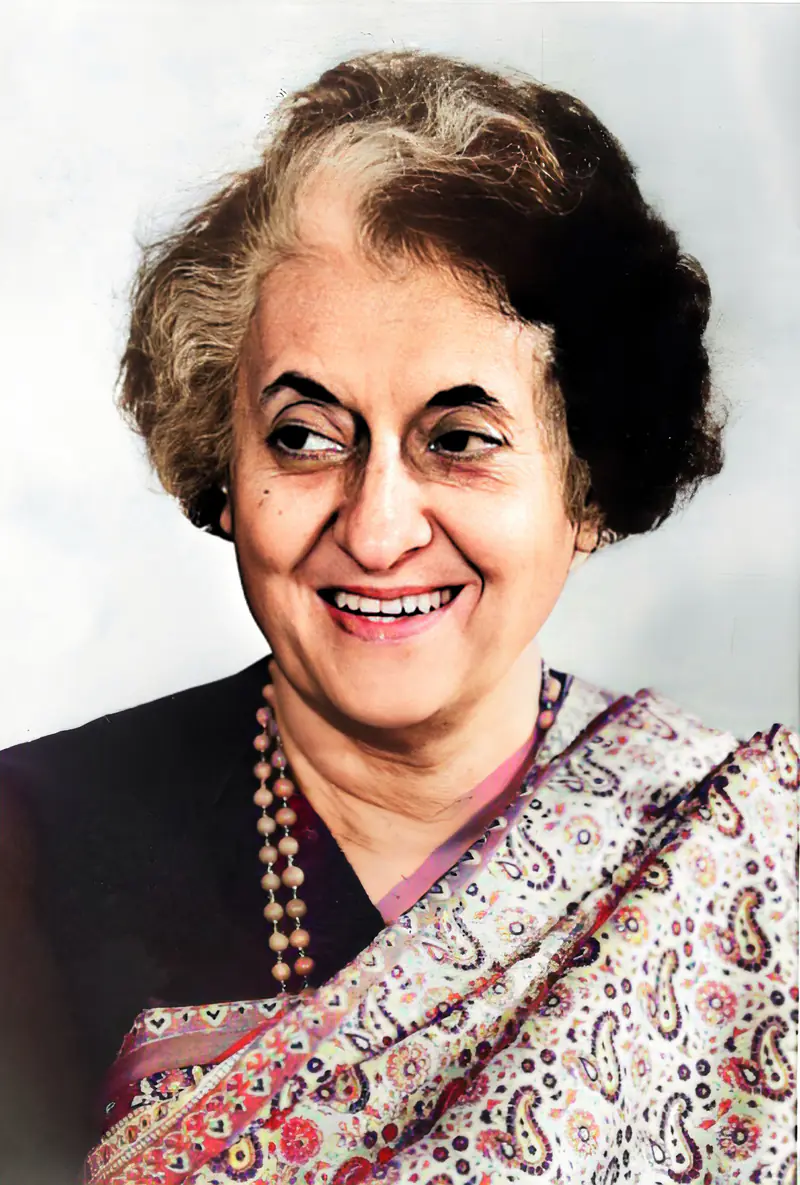
| 18 Quotes | |
| Born as | Indira Priyadarshini Gandhi |
| Occup. | Statesman |
| From | India |
| Born | November 19, 1917 Allahabad, United Provinces, British India |
| Died | October 31, 1984 New Delhi, India |
| Cause | Assassination |
| Aged | 66 years |
Indira Priyadarshini Gandhi was born on November 19, 1917, in Allahabad (now Prayagraj), in British-ruled India, the only child of Jawaharlal Nehru and Kamala Nehru. Her family home, Anand Bhavan, was a hub of political activity, frequently visited by leaders of the Indian National Congress. She grew up amidst the ferment of the independence movement and in close contact with figures such as Mahatma Gandhi. Her father, a leading nationalist who would become independent India's first prime minister, was often imprisoned, and her mother's ill health created long stretches of responsibility and solitude for the young Indira. These influences fostered in her a keen political awareness and a sense of discipline.
As a child, she organized a small group called the Vanar Sena (Monkey Brigade) to assist the freedom movement through symbolic acts of protest and volunteer work. The example set by her parents, and the constant flow of activists through her home, shaped her identity long before she held public office. She experienced the costs of political commitment firsthand, including surveillance and disruption by colonial authorities.
Education and Formation
Indira's formal education was eclectic and often interrupted by political upheaval and her mother's illness. She studied at schools in India and abroad, including brief periods at institutions in Switzerland and England, time at Rabindranath Tagore's Visva-Bharati in Santiniketan, and later at Somerville College, University of Oxford. Though her academic trajectory did not take a conventional course, exposure to different cultures and intellectual traditions influenced her cosmopolitan outlook and her appreciation for literature, history, and the arts.
During her years abroad, she became familiar with European political currents and the rise of fascism, strengthening her belief in democratic and anti-colonial ideals. The death of her mother in 1936 had a profound impact, and she increasingly took on family responsibilities while remaining engaged with the Congress movement. In 1938 she joined the Indian National Congress, signaling a more formal commitment to politics.
From Independence to Party Leadership
Indira married Feroze Gandhi in 1942, during the Quit India movement. Feroze, a committed activist and later a journalist and parliamentarian, shared her political concerns. The couple had two sons, Rajiv and Sanjay. After independence in 1947, Indira served as an aide and confidante to her father, Prime Minister Jawaharlal Nehru, overseeing his household at Teen Murti Bhavan and hosting visiting dignitaries. These years at the heart of government provided an apprenticeship in statecraft and international affairs.
She rose steadily within the Congress party, joining its working committee and becoming party president in 1959. Known for her administrative ability and unflappable demeanor, she also had a reputation for decisiveness that sometimes unsettled senior colleagues. After Nehru's death in 1964, she was appointed Minister of Information and Broadcasting in the government of Lal Bahadur Shastri. Shastri's sudden death in January 1966 set off a leadership contest. Backed by party power brokers such as K. Kamaraj, Indira Gandhi became prime minister, succeeding interim leader Gulzarilal Nanda and defeating Morarji Desai.
First Tenure as Prime Minister
Indira Gandhi's early premiership was shaped by economic challenges and intra-party rivalries. The 1967 general election reduced Congress's majority and emboldened a conservative faction known as the Syndicate. She responded by articulating a left-of-center agenda that foregrounded social justice and state-led development. In 1969 she championed the nationalization of major banks to direct credit toward small industry and agriculture, a move that sharpened her split with the Syndicate and ultimately fractured the Congress into separate factions.
Positioning herself as a tribune of the poor with the slogan Garibi Hatao (Eradicate Poverty), she went to the polls in 1971 and won a landslide. Her economic policies expanded the public sector and accelerated rural development initiatives linked to the Green Revolution, building on earlier efforts to increase food production. Supporters credited her with enhancing self-reliance; critics argued that state controls entrenched inefficiencies and centralized power in the executive.
War, Diplomacy, and Nuclear Policy
Indira Gandhi's leadership during the 1971 crisis in East Pakistan (present-day Bangladesh) was a defining episode. Facing a humanitarian disaster as millions of refugees fled to India, she pursued a diplomatic campaign in world capitals while strengthening India's defense posture. Relations with the United States, under President Richard Nixon and adviser Henry Kissinger, were strained, but she secured strategic support through the 1971 Treaty of Peace, Friendship and Cooperation with the Soviet Union, led by Leonid Brezhnev. The ensuing war in December 1971 resulted in the creation of Bangladesh, with Sheikh Mujibur Rahman emerging as its leader.
In July 1972 she met Pakistan's Zulfikar Ali Bhutto in Shimla, producing the Simla Agreement, which established principles for bilateral dispute resolution and the conversion of the ceasefire line in Kashmir into the Line of Control. In 1974, under her direction, India conducted its first nuclear test, codenamed Smiling Buddha, declaring a peaceful nuclear explosion while signaling technological capability and strategic autonomy.
The Emergency
In June 1975, after the Allahabad High Court found her guilty of electoral malpractice in her 1971 parliamentary campaign and invalidated her seat, political tensions escalated. Amid protests led by Jayaprakash Narayan and opposition figures such as Morarji Desai, Atal Bihari Vajpayee, and L. K. Advani, she advised the president, Fakhruddin Ali Ahmed, to declare a state of Emergency on June 25-26, 1975. The Emergency suspended civil liberties, imposed press censorship, and authorized widespread detentions under preventive laws. Her 20-point program aimed to curb inflation, improve production, and accelerate social welfare measures, but the period became synonymous with authoritarian excess.
Sanjay Gandhi, her younger son, emerged as an influential, unofficial power center, controversially associated with slum clearances and coercive family planning campaigns. While some economic indicators improved and certain administrative reforms proceeded, the democratic cost was severe. Internationally, the Emergency tarnished India's image as the world's largest democracy and hardened domestic opposition to her rule.
Defeat, Rebuilding, and Return to Office
In 1977, confident of public support, Indira Gandhi called elections. The electorate delivered a decisive verdict against her, and the Janata Party coalition formed India's first non-Congress government under Morarji Desai. Indira lost her own seat, faced legal cases, and was briefly imprisoned. The Janata coalition, however, struggled with internal divisions among leaders including Charan Singh and Jagjivan Ram. By 1978-79, she had reorganized her faction as Congress (I), won a by-election from Chikmagalur, and steadily rebuilt her political base.
In 1980 she returned to power after the Janata experiment collapsed. Her elder son, Rajiv Gandhi, a commercial pilot with a reputation for moderation, entered politics after the death of Sanjay Gandhi in a plane crash that same year. Indira's new cabinet included seasoned administrators and future national figures such as P. V. Narasimha Rao and I. K. Gujral, reflecting her ability to blend loyalty with talent.
Second Premiership and Turbulence
Indira Gandhi's second tenure confronted complex challenges. Economic management sought to revive growth and expand the public sector's role while cautiously opening space for technology and infrastructure upgrades. She presided over the 1982 Asian Games in New Delhi, a showcase of national ambition. On the world stage, she hosted the 1983 Non-Aligned Movement summit, reaffirming India's leadership among postcolonial nations and advocating a more equitable international order.
Domestic unrest intensified, particularly in Punjab, where militancy and sectarian violence grew alongside political grievances. After failed negotiations, the government ordered Operation Blue Star in June 1984 to flush armed militants from the Golden Temple complex in Amritsar. The operation achieved its immediate objective but caused heavy casualties and deep trauma, reverberating across the Sikh community and the nation. In the northeast, agitation over immigration and political rights surged in Assam, highlighting the strains of governance in a diverse federal democracy.
Assassination and Aftermath
On October 31, 1984, Indira Gandhi was assassinated at her New Delhi residence by two of her security personnel, Satwant Singh and Beant Singh, in the aftermath of Operation Blue Star. Her death was followed by horrific anti-Sikh riots in several parts of India, a national tragedy that exposed the fragility of communal peace and the dangers of political incitement. She was succeeded as prime minister by Rajiv Gandhi, who took office with the support of President Giani Zail Singh and subsequently led the Congress to a sweeping electoral victory later that year.
Leadership Style and Legacy
Indira Gandhi's political persona combined resolve, secrecy, and a focus on centralized authority. Trusted advisers such as P. N. Haksar and P. N. Dhar helped translate her strategic instincts into policy, while her adversaries criticized the personalization of power and the erosion of party democracy. She cultivated a direct rapport with voters, projecting herself as a champion of the poor and an embodiment of national unity. At the same time, the Emergency and episodes of heavy-handed governance remain enduring controversies that define debates about her legacy.
Her achievements include decisive leadership during the Bangladesh crisis, expansion of rural development and food security programs, institutionalization of bank nationalization, and the assertion of strategic autonomy through the nuclear program and non-aligned diplomacy. Set against these are the democratic violations of the Emergency, flawed implementation of urban and population policies, and the escalation of internal conflicts, especially in Punjab.
Indira Gandhi's life traced the arc of modern India: from colonial subjugation to independence, from institution-building to the test of democratic resilience, and from early idealism to the burdens of power. As the daughter of Jawaharlal Nehru, the spouse of Feroze Gandhi, and the mother of Rajiv Gandhi, she stood at the intersection of family, party, and state. Her story is inseparable from the workings of the Indian National Congress, the aspirations of millions mobilized by slogans of social justice, and the unresolved tensions of a vast, diverse republic seeking both order and freedom.
Our collection contains 18 quotes who is written by Indira, under the main topics: Motivational - Justice - Love - Leadership - Freedom.
Other people realated to Indira: John Kenneth Galbraith (Economist), Henry A. Kissinger (Statesman), Daniel Patrick Moynihan (Politician), Peter Jennings (Journalist)
Source / external links