
Mother Teresa Biography Quotes 35 Report mistakes
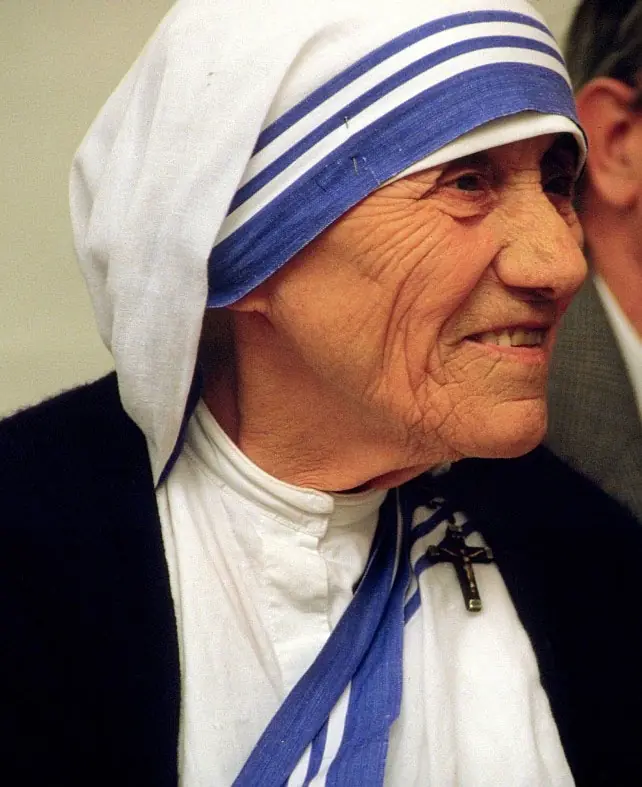
| 35 Quotes | |
| Born as | Agnes Gonxha Bojaxhiu |
| Known as | Saint Teresa of Calcutta |
| Occup. | Leader |
| From | Albania |
| Born | August 26, 1910 Skopje, Ottoman Empire (now North Macedonia) |
| Died | September 5, 1997 Calcutta, India |
| Cause | Cardiac arrest |
| Aged | 87 years |
Agnes Gonxha Bojaxhiu, later known to the world as Mother Teresa, was born in 1910 in Skopje, then part of the Ottoman Empire and today the capital of North Macedonia. She came from an Albanian Catholic family. Her father, Nikolle Bojaxhiu, was a businessman involved in civic affairs, and her mother, Dranafile, was known for charitable works and a deep devotional life that shaped her children. Agnes had an older sister, Aga, and a brother, Lazar. After her father died when she was young, the family faced hardship, and Dranafile's example of prayer and service left a deep impression on Agnes. From adolescence she felt drawn to religious life and missionary work, inspired by accounts from Jesuit missionaries and local parish activities.
Religious Vocation and Formation
At age 18, she left home to join the Sisters of Loreto. After a brief period in Ireland to learn English, she traveled to India, arriving in 1929. She began her novitiate in Darjeeling and took the name Teresa, honoring Therese of Lisieux. She took first vows in 1931 and final vows in 1937 in Calcutta, where she taught at St. Mary's School for girls in Entally, eventually becoming headmistress. In 1946, during a train journey to Darjeeling, she experienced what she later called a "call within a call", an inner conviction that she should leave the convent school to serve the poorest of the poor. With guidance from Archbishop Ferdinand Perier of Calcutta and counsel from Jesuit Father Celeste Van Exem, she sought permission from Church authorities. In 1948 she received dispensation to leave the Loreto order, adopted a simple white sari with a blue border, undertook brief medical training, and began working in Calcutta's slums.
Founding the Missionaries of Charity
Working first among the sick and dying on the streets, in 1950 she founded the Missionaries of Charity, a congregation devoted to caring for "the unwanted, the unloved, the uncared for". She opened Nirmal Hriday, the Kalighat Home for the Dying, and later Shishu Bhavan, a home for children. She established outreach for people with leprosy, mobile clinics, and soup kitchens. Local civic authorities in Calcutta helped provide spaces for some of these early works, and volunteers and co-workers joined her efforts. Young women attracted by her example formed the first sisters of the congregation, and experienced clergy such as Father Van Exem and Archbishop Perier continued to advise her. As the work grew, she trained sisters to maintain a life balanced between prayer and service, emphasizing simplicity, smallness, and direct care.
Expansion and Global Recognition
In the 1960s the Missionaries of Charity began to open houses beyond India, including in Latin America, Africa, Europe, and North America. In 1965 Pope Paul VI placed the congregation under papal jurisdiction, facilitating international growth. Public attention increased after journalist Malcolm Muggeridge's documentary and book introduced her work to a wider audience. She received numerous honors, including the John XXIII Peace Prize and the 1979 Nobel Peace Prize. Even as she met political leaders and popes such as Paul VI and John Paul II, she continued to travel to new foundations, visiting houses in places of war, poverty, or disaster. Her leadership combined an austere personal style with practical organization, delegating responsibilities to regional superiors while keeping a close eye on fidelity to the founding charism.
Spiritual Life and Interior Struggle
Though widely seen as a figure of cheerful charity, her private correspondence, published after her death, revealed long stretches of interior darkness and spiritual dryness. Confessors and spiritual directors encouraged her perseverance, and she interpreted the experience as a way of sharing the abandonment of those she served. This hidden struggle, known to close collaborators in the Church, added a dimension to public understanding of her sanctity and resilience.
Criticism and Debate
Alongside acclaim, her work attracted criticism. Observers and writers, including Christopher Hitchens and physician Aroup Chatterjee, questioned conditions in some homes, medical practices, and her theological positions on abortion and contraception. Others criticized her willingness to accept donations from controversial figures. Supporters replied that her houses were intended as places of shelter and dignity rather than hospitals, that resources were limited, and that her stance was consistent with Catholic teaching. The debates sharpened discussions about humanitarian standards, transparency, and the relationship between faith and social service.
Later Years and Final Months
From the 1980s she faced recurring health problems, including heart issues that required a pacemaker. Despite declining strength, she continued to found new houses and visit existing ones, often accompanied by senior sisters. In 1997 she stepped down as superior general, and Sister Nirmala Joshi was elected to succeed her. Mother Teresa died in Calcutta on September 5, 1997. India honored her with a state funeral, and religious and civic leaders joined thousands of mourners, reflecting the esteem in which she was held across communities and nations.
Legacy and Canonization
After her death, the Missionaries of Charity continued to expand under Sister Nirmala and later leaders, with branches for brothers and priests and a lay movement of co-workers and volunteers. Pope John Paul II beatified her in 2003, and Pope Francis canonized her in 2016 as Saint Teresa of Calcutta. Her legacy includes a global network of homes for the dying, abandoned children, refugees, and those afflicted by disease; a readily recognizable symbol of solidarity with the poor in the white sari with blue stripes; and a sustained conversation about the nature of charity, the ethics of aid, and the demands of faith. People who knew her, from fellow sisters to journalists and heads of state, consistently noted the combination of personal humility and organizational drive that enabled her to lead a worldwide congregation centered on direct, person-to-person care.
Our collection contains 35 quotes who is written by Mother, under the main topics: Love - Faith - Peace - Work - Family.
Other people realated to Mother: Sri Chinmoy (Philosopher), Jerry Brown (Politician)
Mother Teresa Famous Works
- 2007 Mother Teresa: Come Be My Light (Book)
- 1997 No Greater Love (Book)
- 1997 The Joy in Loving: A Guide to Daily Living (Book)
- 1996 In My Own Words (Book)
- 1975 A Gift for God: Prayers and Meditations (Book)
Source / external links