
Rosa Luxemburg Biography Quotes 14 Report mistakes
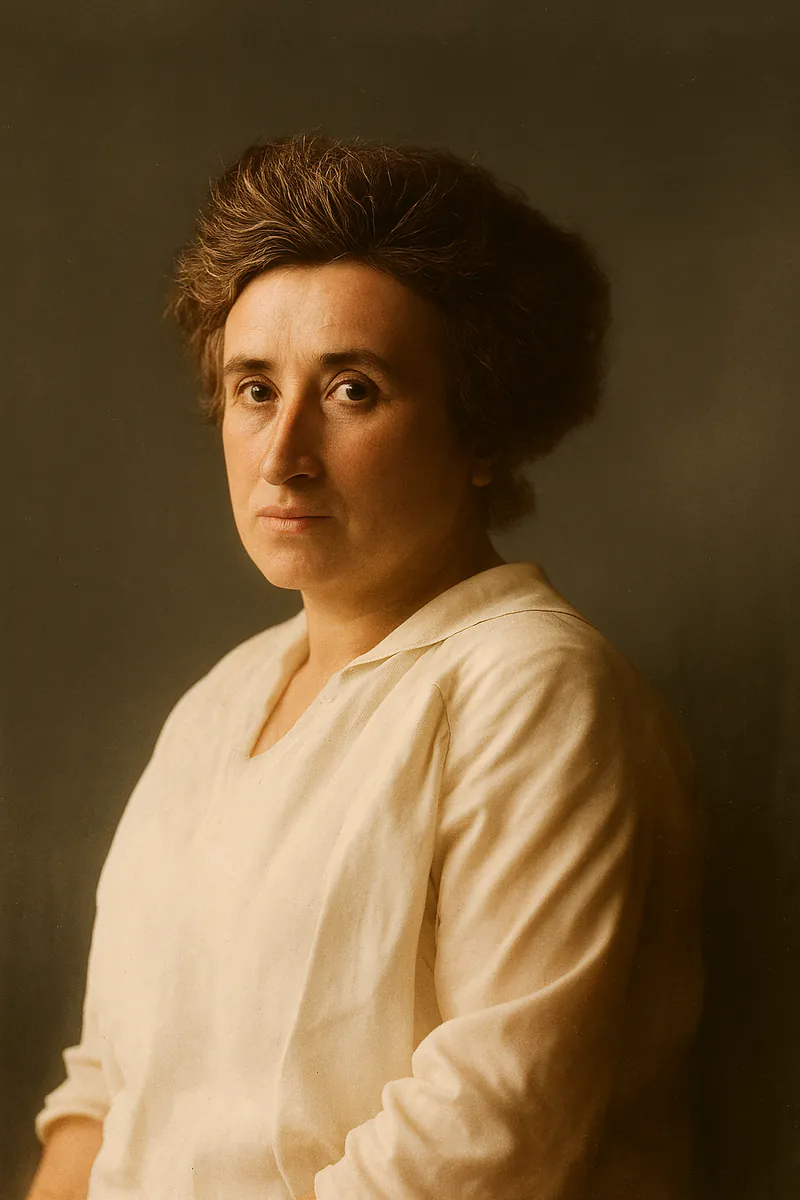
| 14 Quotes | |
| Occup. | Activist |
| From | Russia |
| Born | March 5, 1870 Zamosc, Congress Poland, Russian Empire |
| Died | January 15, 1919 Berlin, Germany |
| Cause | murder (shot by Freikorps) |
| Aged | 48 years |
Rosa Luxemburg was born in 1871 in Zamosc, in the part of Poland ruled by the Russian Empire, and grew up in Warsaw in a Polish Jewish family. A childhood hip ailment left her with a lifelong limp, but it did not curb her drive for learning or political engagement. As a teenager she entered clandestine socialist circles that opposed both tsarist repression and narrow nationalism. Under pressure from the authorities, she left for Switzerland in 1889. In Zurich she joined a cosmopolitan community of exiles, studied philosophy, law, and political economy at the university, and completed a doctorate in 1897 on the industrial development of Poland. Those years shaped her as an internationalist who believed that the workers movement transcended borders and ethnic divisions.
Formation as a Revolutionary
In the early 1890s Luxemburg, together with Leo Jogiches and close comrades, helped found the Social Democracy of the Kingdom of Poland and Lithuania (SDKPiL). Their aim was to fuse Marxist analysis with a struggle that rejected national separatism in favor of a united movement of workers across empires. Her partnership with Jogiches was both political and personal; he was an exacting organizer and confidant throughout her formative years. Luxemburg honed her skills as a polemicist, developing the clarity and sharpness that would later make her a leading voice in European socialism.
Move to Germany and Debates in the SPD
Luxemburg settled in Germany in 1898 and joined the Social Democratic Party (SPD), then the largest socialist party in Europe. She quickly entered the central debates of the movement, challenging Eduard Bernstein's revisionism, which proposed a gradual, parliamentary path to socialism. In her influential work Reform or Revolution she argued that social reforms were necessary but could not substitute for a fundamental social transformation. Early on, she found common ground with leading figures such as August Bebel and Karl Kautsky, although she later broke with Kautsky as he moved toward cautious centrism. She worked closely with Clara Zetkin, advocating for working-class women, and engaged in theoretical exchanges with Anton Pannekoek and others on mass action and party strategy. Teaching economics at the SPD party school in Berlin, she trained a generation of activists to think critically about capitalism's dynamics.
Revolution of 1905 and the Mass Strike
The 1905 upheavals across the Russian Empire provided Luxemburg with a living laboratory for her ideas. After witnessing events in Poland and Russia, she wrote The Mass Strike, the Political Party and the Trade Unions, arguing that mass strikes emerged organically from social tensions and could educate and unite the working class. While insisting on the necessity of political organization, she stressed that spontaneity was a source of revolutionary energy that could not be reduced to orders from above. Her views sparked debate with party leaders who feared chaos, but they established her reputation as a bold strategist who connected theory to practice.
Capital Accumulation, Democracy, and Dissent
On the eve of the First World War, Luxemburg published The Accumulation of Capital (1913), a sweeping and controversial analysis of imperialism and expanded reproduction. She also debated Vladimir Lenin on centralism and national self-determination, endorsing the right of nations to self-rule in principle yet warning that nationalism could fragment the workers movement. While admiring the discipline of Russian revolutionaries, she insisted that socialist democracy had to remain robust within the party and the broader movement.
War, Prison, and the Spartacus League
The outbreak of war in 1914 brought the deepest crisis of European socialism. When the SPD leadership, including figures such as Friedrich Ebert and Philipp Scheidemann, backed war credits, Luxemburg condemned the decision as a betrayal of internationalism. Together with Karl Liebknecht, Clara Zetkin, and Franz Mehring she formed the International Group, later known as the Spartacus League. Under the pen name Junius, she authored The Junius Pamphlet (1915), a powerful indictment of imperialist war and a call for international solidarity. For her antiwar agitation she was imprisoned repeatedly. From prison she continued to write, sustained by an extensive correspondence that revealed both her political steel and her human warmth.
Revolution in Germany and the Founding of the KPD
The German Revolution of 1918 opened a new chapter. Released from prison, Luxemburg threw herself into the struggle to shape the outcome of a collapsing empire. She championed workers councils as organs of democratic power and urged clarity and patience in strategy. With Liebknecht, Zetkin, Mehring, and Paul Levi, she helped found the Communist Party of Germany (KPD) at the end of 1918. Although a revolutionary, she warned against adventurism and cautioned that an uprising unmoored from majority support would be disastrous. The January 1919 street fighting in Berlin, precipitated by conflicts around the dismissal of the radical police chief Emil Eichhorn and fueled by frustration at the pace of change, tested those warnings. The government, with Gustav Noske overseeing military forces, deployed Freikorps units to crush the unrest.
Assassination and Aftermath
On January 15, 1919, Luxemburg and Liebknecht were seized by paramilitary units, beaten, and murdered. Her body was discarded in Berlin's Landwehr Canal. The killings shocked the international left and left a wound in postwar German politics. The subsequent investigations were limited, and the organizers of the violence were largely shielded. Within months, memorials and annual commemorations arose, especially among workers who remembered her as a tireless critic of war and injustice.
Ideas and Legacy
Luxemburg's legacy lies in her synthesis of revolutionary commitment with a deep insistence on democratic freedoms. She argued that the vitality of socialism depended on open debate and the self-activity of the working class. In her reflections on the Russian Revolution, she praised the Bolsheviks for breaking the old order yet warned that the suppression of political freedoms would corrode the new society; her oft-quoted line, "Freedom is always the freedom of the one who thinks differently", captured this conviction. Her critiques of reformism, her theorization of mass strikes, and her analysis of capitalism's global dynamics continued to influence movements and thinkers long after her death. Across decades, from interwar struggles to the upheavals of 1968 and beyond, activists returned to Luxemburg, Liebknecht, Zetkin, and their circle for guidance on how to combine organization with popular initiative. In Germany and internationally, annual demonstrations, scholarship, and new editions of her writings keep alive the memory of a leader who strove to unite rigor, courage, and empathy in the pursuit of human emancipation.
Our collection contains 14 quotes who is written by Rosa, under the main topics: Justice - Leadership - Freedom - Equality.
Frequently Asked Questions
- Rosa Luxemburg height: Not reliably recorded; described as petite (about 150–155 cm).
- What is Rosa Luxemburg famous for: Marxist theorist and revolutionary; co-founded the Spartacus League and the German Communist Party; advocate of mass strikes and socialist democracy.
- Rosa Luxemburg disability: A childhood hip ailment left her with a limp and one leg shorter.
- Rosa Luxemburg books: Reform or Revolution; The Accumulation of Capital; The Mass Strike; The Junius Pamphlet; Introduction to Political Economy.
- Rosa Luxemburg assassination: Killed by Freikorps in Berlin on 15 Jan 1919; her body was thrown into the Landwehr Canal.
- Rosa Luxemburg husband: Gustav Lübeck (marriage of convenience; later divorced).
- How old was Rosa Luxemburg? She became 48 years old
Source / external links