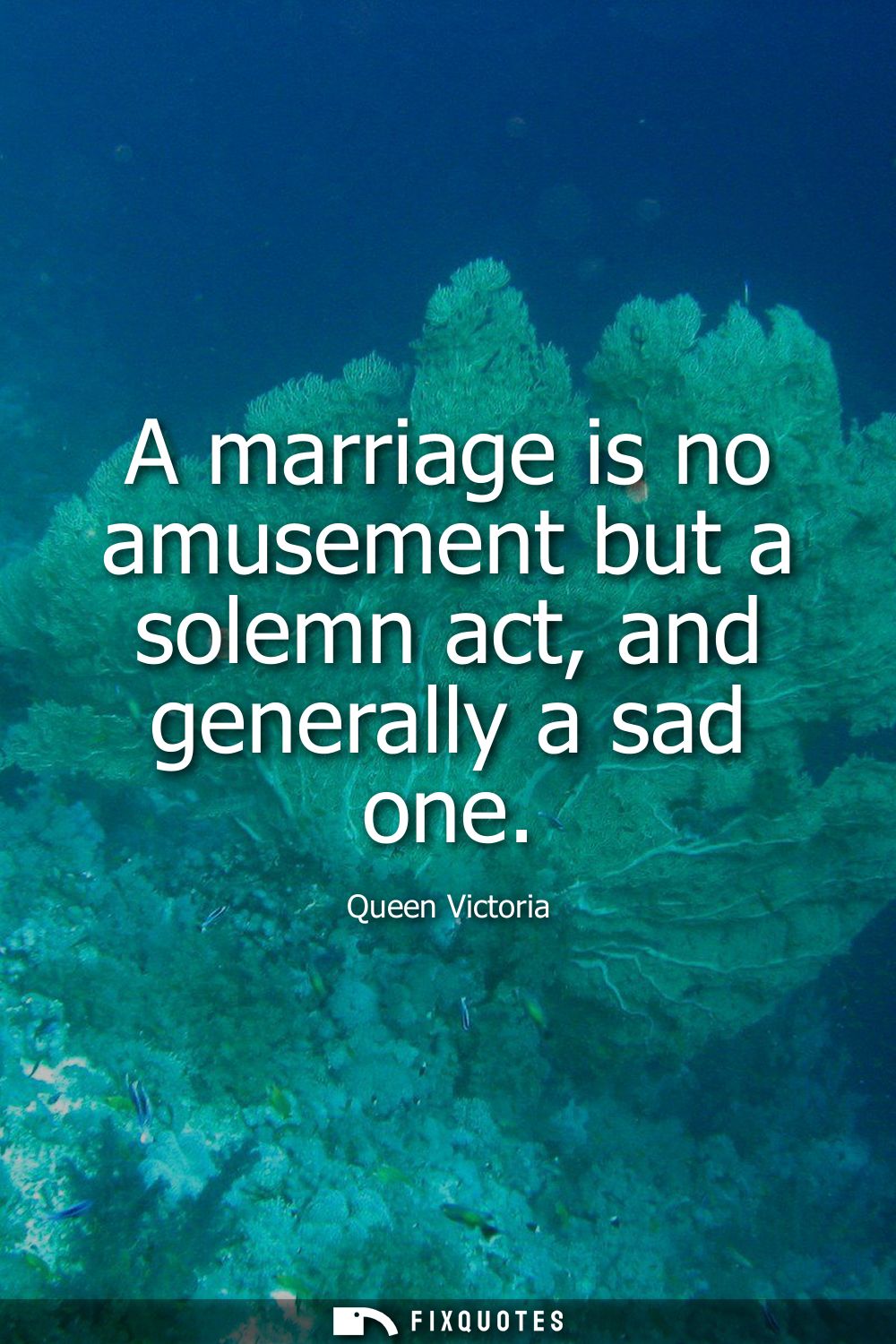
"A marriage is no amusement but a solemn act, and generally a sad one"
About this Quote
Queen Victoria’s assertion that marriage is “no amusement but a solemn act, and generally a sad one” provides a poignant glimpse into the realities and complexities of marriage, particularly within the context of her era. The statement carries an air of gravity, casting aside romanticized notions of marriage as simply a source of personal happiness, pleasure, or entertainment. Instead, marriage is framed as a weighty commitment, bound by duty, responsibility, and often, sacrifice.
The use of the word “solemn” underscores the seriousness with which marriage was approached, especially among royalty and the upper classes in Victorian England. For Victoria, whose marriage to Prince Albert was as much a personal partnership as a political alliance, the institution involved more than love; it entailed bearing the burdens of expectation, public scrutiny, and the continuation of the royal line. This perspective echoes the belief that marriage is a cornerstone of society, where personal desires may be subsumed by familial or social obligations.
Describing marriage as “generally a sad one” suggests an awareness of its inherent challenges. The sadness may arise from the inevitable difficulties faced over a lifetime together: the loss of freedom, the accumulation of trials and disappointments, or even the eventual grief of widowhood. For Victoria, whose deep affection for Albert was coupled with the sorrow of his early death, marriage became a source of profound loss as much as lasting connection. Furthermore, within her time, women often entered marriage with limited autonomy, leading to a sense of resignation or melancholy.
Victoria’s statement thus invites reflection on the multifaceted nature of marriage. Love and companionship might coexist with sadness, sacrifice, and solemnity. Rather than idealizing the union, her words acknowledge both its joys and its burdens, urging a mature appreciation for the complexities entwined in building a shared life.
More details
About the Author