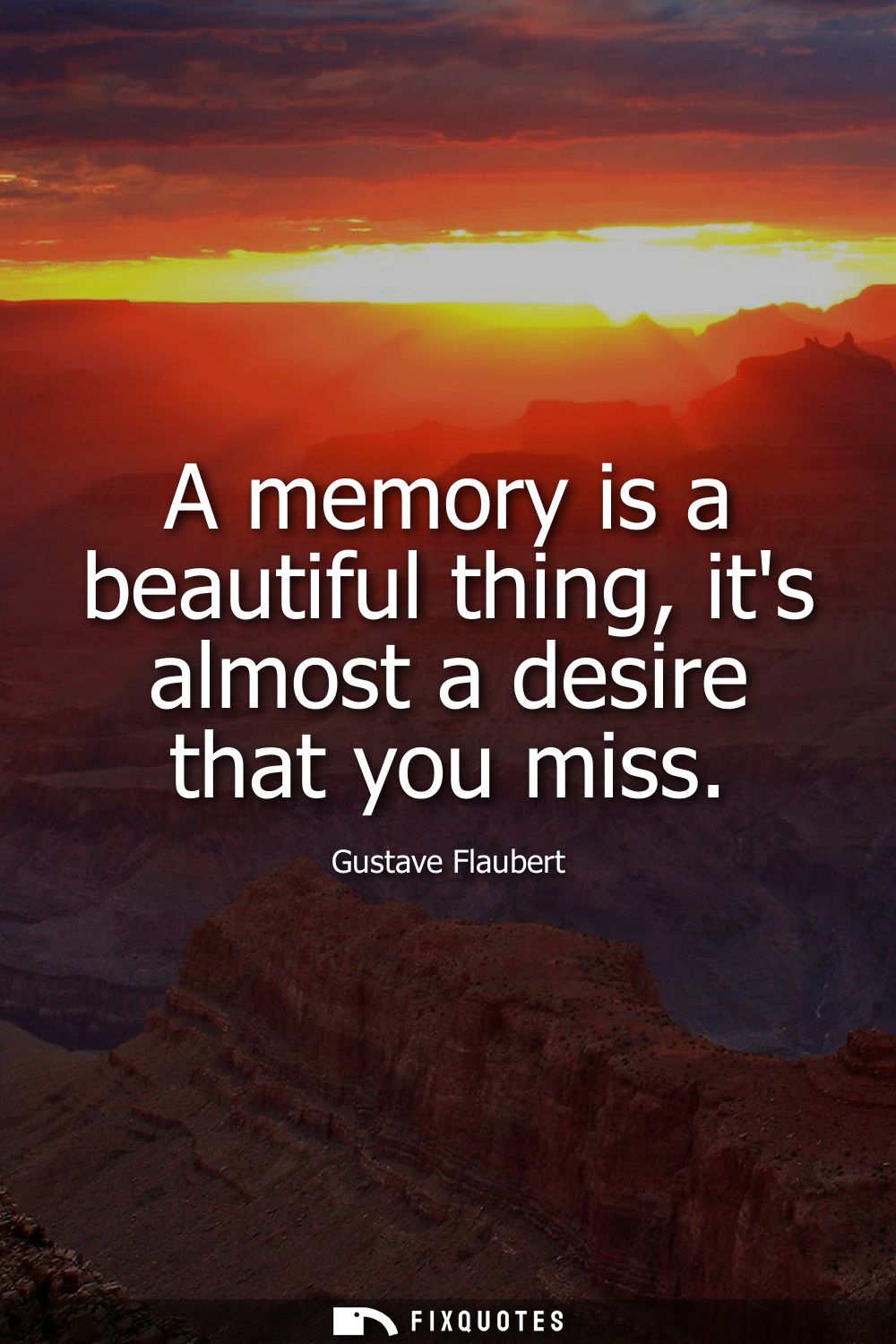
"A memory is a beautiful thing, it's almost a desire that you miss"
About this Quote
Flaubert takes a knife to nostalgia and shows the glittering edge. “A memory is a beautiful thing” starts like a sentimental aphorism, then swerves: it’s “almost a desire that you miss.” The beauty isn’t in the past itself but in the ache it leaves behind. Memory, for Flaubert, is less an archive than a craving - a substitute appetite that keeps feeding on absence.
The line works because it refuses the comforting idea that remembrance is passive. “Almost” is doing heavy labor: memory isn’t desire, but it mimics desire’s bodily logic. It returns unbidden, it fixes on details, it demands replay. And like desire, it is structured around what you don’t have. That final clause, “that you miss,” doubles the lack: you miss the thing, and you miss the wanting of it, the way yearning can feel more vivid than possession. It’s a quiet admission that some emotions are most pleasurable at the point of deprivation.
In Flaubert’s 19th-century world - a culture midwifing modern consumer longing while romanticism curdled into disillusion - this is also a critique of how the self is trained to hunger. His fiction is full of characters who confuse images for life, fantasies for intimacy. The quote distills that psychology: memory beautifies by editing, intensifies by distance, then turns the past into a private commodity you can never quite own again.
The line works because it refuses the comforting idea that remembrance is passive. “Almost” is doing heavy labor: memory isn’t desire, but it mimics desire’s bodily logic. It returns unbidden, it fixes on details, it demands replay. And like desire, it is structured around what you don’t have. That final clause, “that you miss,” doubles the lack: you miss the thing, and you miss the wanting of it, the way yearning can feel more vivid than possession. It’s a quiet admission that some emotions are most pleasurable at the point of deprivation.
In Flaubert’s 19th-century world - a culture midwifing modern consumer longing while romanticism curdled into disillusion - this is also a critique of how the self is trained to hunger. His fiction is full of characters who confuse images for life, fantasies for intimacy. The quote distills that psychology: memory beautifies by editing, intensifies by distance, then turns the past into a private commodity you can never quite own again.
Quote Details
| Topic | Nostalgia |
|---|
More Quotes by Gustave
Add to List