
Gustave Flaubert Biography Quotes 58 Report mistakes
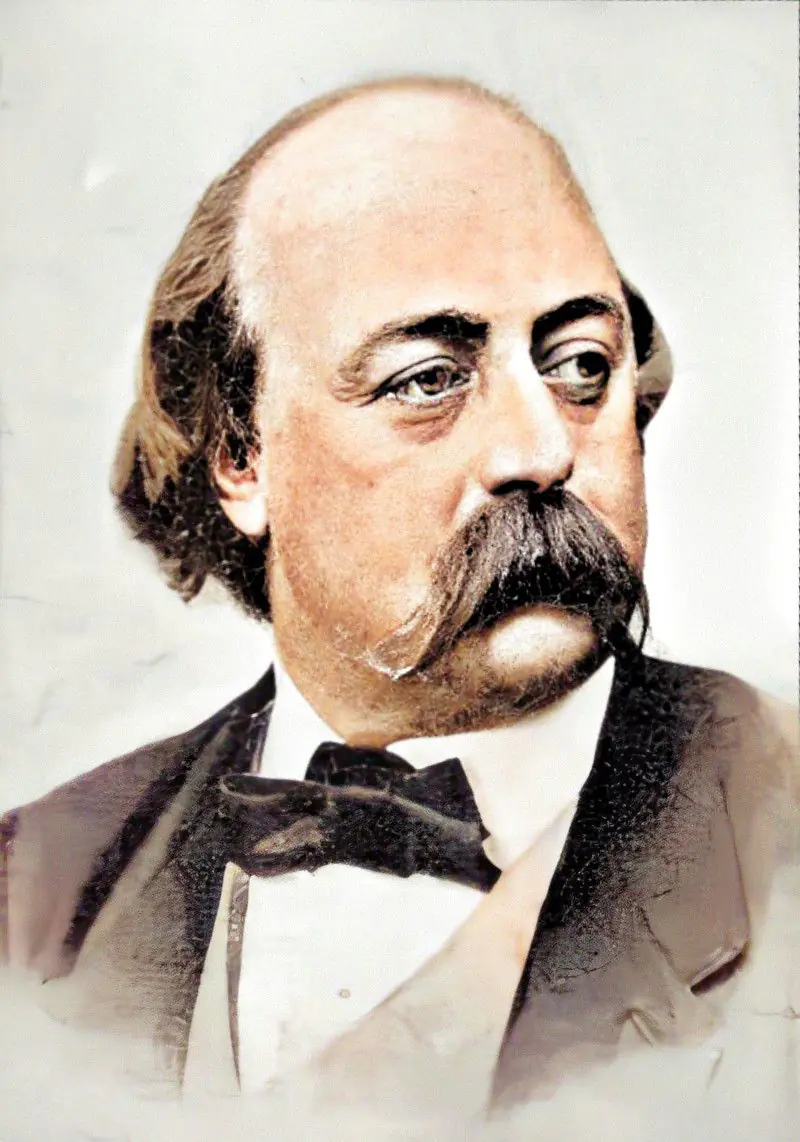
| 58 Quotes | |
| Occup. | Novelist |
| From | France |
| Born | December 12, 1821 |
| Died | May 8, 1880 |
| Aged | 58 years |
Gustave Flaubert was born on 12 December 1821 in Rouen, Normandy, the second son of Achille-Cleophas Flaubert, chief surgeon at the Hotel-Dieu hospital, and Anne-Justine-Caroline Fleuriot. He grew up in the hospital precincts, a childhood spent among wards, corpses, and clinical talk - an early schooling in the body, in pain, and in the gap between lofty language and brute fact. That proximity to suffering did not make him tender-minded; it sharpened his appetite for exact observation and his distrust of sentimental cant, traits that later hardened into an ethic of style.
Normandy in the 1820s and 1830s was both provincial and porous: bourgeois stability, Catholic habit, and the pull of Paris. As a teenager he fell into intense friendships and first loves, notably his lifelong attachment to the older Elisa Schlesinger, whose unattainability became a private template for desire and disappointment. The July Monarchy's complacent materialism, followed by the revolutions rumbling toward 1848, formed the social atmosphere he would anatomize: a world of ambitions without grandeur, phrases without substance.
Education and Formative Influences
Educated at the College Royal de Rouen, Flaubert read voraciously and wrote early fiction, but he was also forming the posture that would define him - a solitary craftsman at war with his own impatience. In 1840 he went to Paris to study law, yet the capital's bustle repelled him; he preferred literature, theater, and long conversations with the brilliant Louis Bouilhet and later Maxime du Camp. After a severe nervous episode in 1844 - often described as epileptic seizures - he abandoned law and returned to the family property at Croisset, outside Rouen, choosing a life organized around writing, travel, and meticulous revision.
Career, Major Works, and Turning Points
Croisset became his workshop and fortress. A formative journey to the Mediterranean and the Near East (1849-1851) with du Camp fed his imagination and later pages of exotic splendor. He broke through with "Madame Bovary" (serialized 1856), whose clinical lyricism and moral ambiguity led to an 1857 obscenity trial; his acquittal turned him into a symbol of literary modernity. He followed with "Salammbo" (1862), "Sentimental Education" (1869), and the austere "Three Tales" (1877), while laboring for years on the unfinished "Bouvard and Pecuchet" (published posthumously 1881), a bleak comedy of knowledge and stupidity. His long affair with the writer Louise Colet, conducted largely by letter, and later financial strain after family losses, deepened his sense that art required monastic sacrifice. He died at Croisset on 8 May 1880.
Philosophy, Style, and Themes
Flaubert's inner life was dominated by a fierce, almost religious ideal of impersonality: the author should be everywhere felt and nowhere seen. Yet this apparent coldness masked a volatile temperament - prone to disgust, ecstasy, and self-laceration - disciplined by the only authority he trusted, the sentence. "The art of writing is the art of discovering what you believe". For him belief was not a doctrine but a residue left by labor: hours of reading aloud, the hunt for le mot juste, and the refusal to let private opinion cheapen the representation of experience. His letters show a man who despised bourgeois platitudes yet feared becoming a mere satirist; style was his way of converting revulsion into form.
His themes return obsessively to the mismatch between longing and reality - romantic dreams colliding with money, routine, and bodily limitation. Emma Bovary does not simply "sin"; she is eaten alive by the language she has swallowed, a library of cliches mistaken for destiny. Flaubert knew that the medium betrays the aspiration: "Language is a cracked kettle on which we beat out tunes for bears to dance to, while all the time we long to move the stars to pity". That metaphor exposes both his pity and his shame: pity for human hunger for the infinite, shame that words - even his - can only approximate it. His irony, therefore, is rarely cruelty for its own sake; it is the moral pressure of precision. And behind the encyclopedic farce of "Bouvard and Pecuchet" lies his suspicion that certainty is a pose - "There is no truth. There is only perception". - a stance that made him a forerunner of modern narrative ambiguity.
Legacy and Influence
Flaubert's influence runs through literary realism into modernism: his free indirect style shaped Henry James, Joyce, Woolf, and countless novelists who learned from him that consciousness can be rendered without authorial preaching. He professionalized the novelist's craft, making revision, rhythm, and structural symmetry central to serious prose. At the same time, his satirical diagnosis of bourgeois language - its slogans, its pieties, its self-regard - remains freshly applicable, which is why "Madame Bovary" and "Sentimental Education" still read like reports from the inside of ordinary desire. His life at Croisset, austere and combustible, stands as a model of the writer who transforms private fever into public form, leaving behind sentences built to outlast the era that provoked them.
Our collection contains 58 quotes who is written by Gustave, under the main topics: Witty One-Liners - Motivational - Ethics & Morality - Wisdom - Truth.
Other people realated to Gustave: Miguel de Cervantes (Novelist), Emile Zola (Novelist), Edmond De Goncourt (Writer), George A. Moore (Novelist), Mario Vargas Llosa (Writer), Louise J. Kaplan (Psychoanalyst), Julian Barnes (Writer), Gustave Moreau (Artist)
Gustave Flaubert Famous Works
- 1877 Three Tales (Novellas)
- 1869 Sentimental Education (Novel)
- 1857 Madame Bovary (Novel)
Source / external links