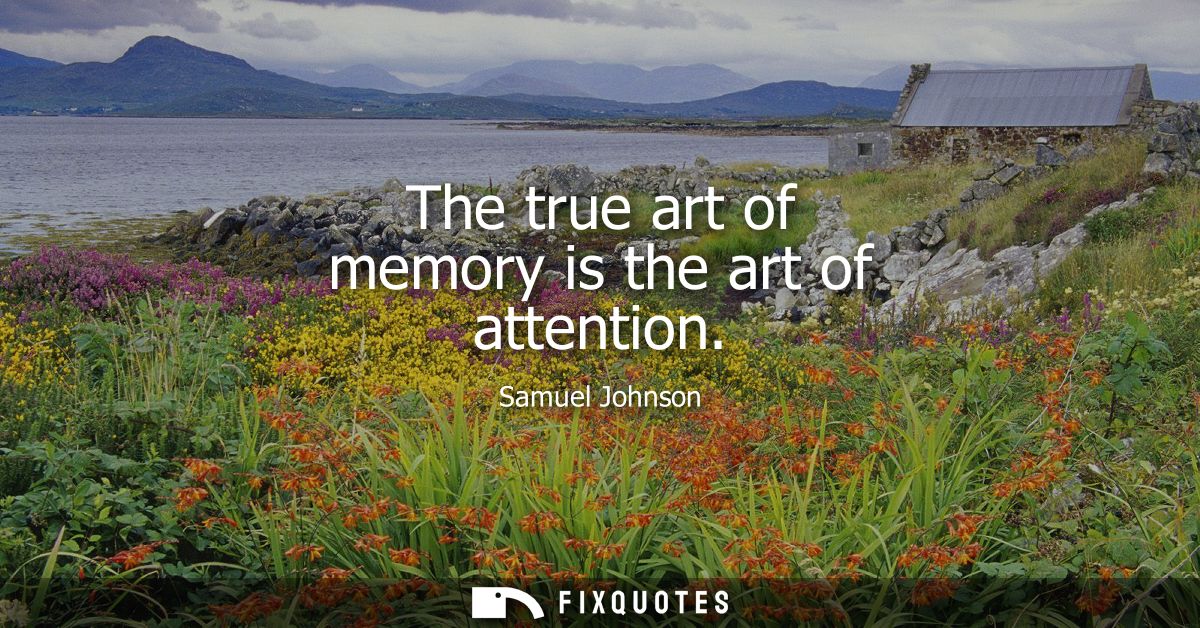
"The true art of memory is the art of attention"
About this Quote
Johnson’s line flatters the mind while quietly scolding it. “Memory” sounds like a gift, a natural endowment you either inherit or you don’t. He swaps that comfortable mythology for a harder virtue: attention. The move is characteristically Johnsonian - moral psychology disguised as plain advice. If you can’t remember, it’s not (only) because your brain is faulty; it’s because you weren’t fully there.
The phrasing matters. “True art” implies there are counterfeit versions: parlor tricks, rote mnemonics, the era’s fascination with systematized “memory arts” promising mastery through technique. Johnson, writing in an Enlightenment culture obsessed with improvement and method, refuses the mechanical solution. Attention is both more basic and more demanding. It asks for discipline, not gimmicks.
Subtext: distraction is a form of disrespect. To forget a person’s words, a book’s argument, or the details of a conversation isn’t merely an error of storage; it can be an error of regard. Johnson, a critic of intellectual laziness and social performance, points at the ethical dimension of cognition: what you attend to is what you value. Memory becomes a ledger of priorities.
The sentence also rehabilitates “attention” as creative labor. Calling it an “art” suggests craft, practice, and taste - something cultivated over time, not switched on by willpower alone. In a moment when modern life treats attention as a resource to be mined and monetized, Johnson’s maxim reads less like a self-help slogan than a warning: if you want a mind that holds, you must first have a mind that notices.
The phrasing matters. “True art” implies there are counterfeit versions: parlor tricks, rote mnemonics, the era’s fascination with systematized “memory arts” promising mastery through technique. Johnson, writing in an Enlightenment culture obsessed with improvement and method, refuses the mechanical solution. Attention is both more basic and more demanding. It asks for discipline, not gimmicks.
Subtext: distraction is a form of disrespect. To forget a person’s words, a book’s argument, or the details of a conversation isn’t merely an error of storage; it can be an error of regard. Johnson, a critic of intellectual laziness and social performance, points at the ethical dimension of cognition: what you attend to is what you value. Memory becomes a ledger of priorities.
The sentence also rehabilitates “attention” as creative labor. Calling it an “art” suggests craft, practice, and taste - something cultivated over time, not switched on by willpower alone. In a moment when modern life treats attention as a resource to be mined and monetized, Johnson’s maxim reads less like a self-help slogan than a warning: if you want a mind that holds, you must first have a mind that notices.
Quote Details
| Topic | Learning |
|---|---|
| Source | Verified source: The Idler, No. 74 (Memory rarely deficient) (Samuel Johnson, 1759)
Evidence:
The true art of memory is the art of attention. (No. 74; in the 1761 collected edition (J. Newbery) it appears on/around pp. 119–123 (vol. 2 in many copies)). Primary-source location: Samuel Johnson, The Idler, No. 74, dated Saturday, September 15, 1759. This essay first appeared in the periodical Universal Chronicle (as The Idler essays originally ran there), and was later reprinted in the first collected book edition: The Idler. In Two Volumes (London: Printed for J. Newbery, 1761). A corroborating scan transcription of the passage also appears on Wikisource in a later collected/edited volume page image, showing the sentence in context. |
| Cite |
Citation Formats
APA Style (7th ed.)
Johnson, Samuel. (2026, February 7). The true art of memory is the art of attention. FixQuotes. https://fixquotes.com/quotes/the-true-art-of-memory-is-the-art-of-attention-33434/
Chicago Style
Johnson, Samuel. "The true art of memory is the art of attention." FixQuotes. February 7, 2026. https://fixquotes.com/quotes/the-true-art-of-memory-is-the-art-of-attention-33434/.
MLA Style (9th ed.)
"The true art of memory is the art of attention." FixQuotes, 7 Feb. 2026, https://fixquotes.com/quotes/the-true-art-of-memory-is-the-art-of-attention-33434/. Accessed 12 Feb. 2026.
More Quotes by Samuel
Add to List