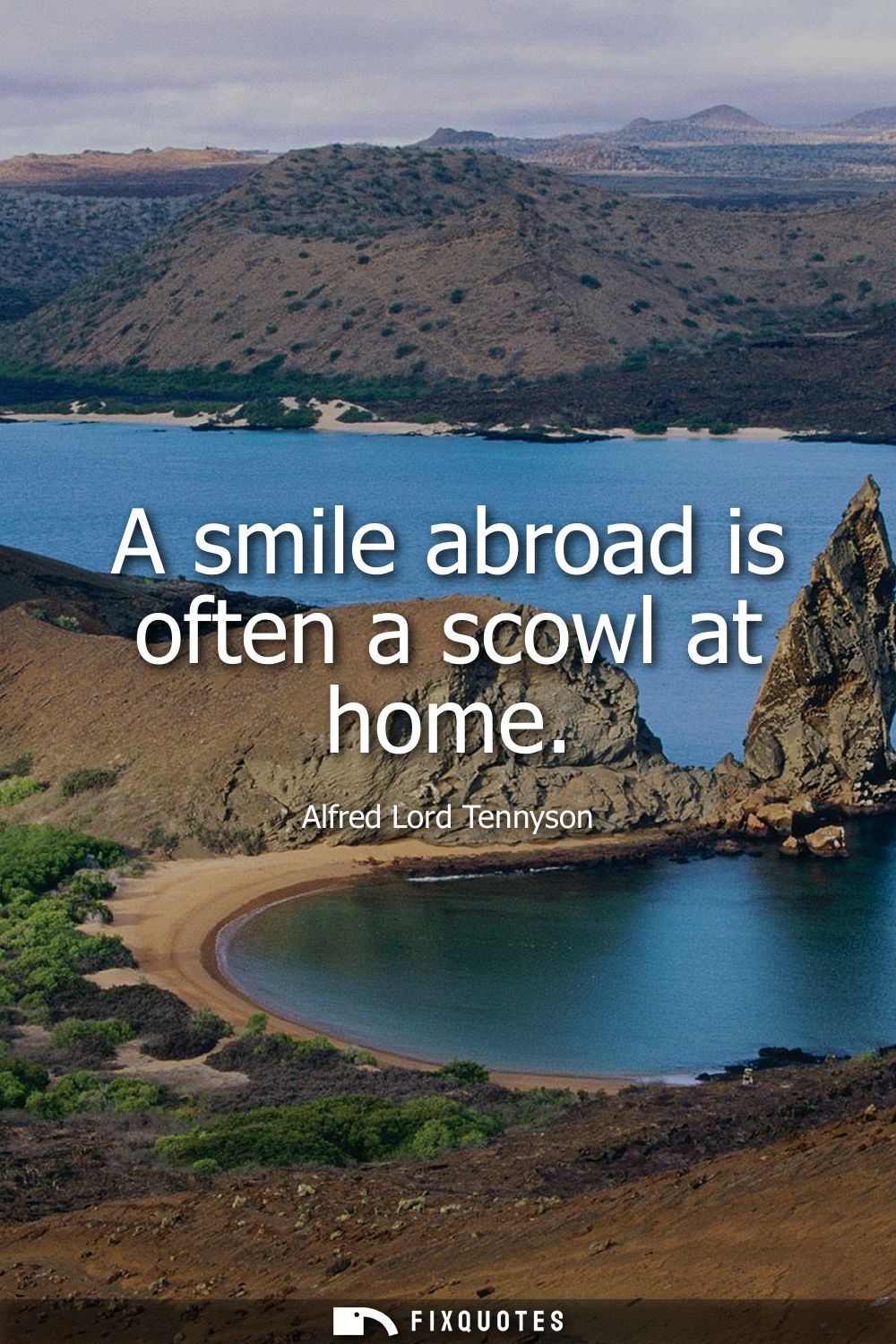
"A smile abroad is often a scowl at home"
About this Quote
Polite charm, Tennyson suggests, is often just bad weather diverted to a safer climate. "A smile abroad is often a scowl at home" works because it turns a genteel social virtue into a kind of emotional outsourcing: we spend our best manners on strangers and our worst tempers on the people who actually live with us. The line is neat, almost proverb-like, but its bite is in the geography. "Abroad" and "home" aren’t only physical spaces; they’re moral zones. Public life becomes a stage where we curate brightness, while domestic life absorbs the unedited draft.
Tennyson writes in a Victorian culture obsessed with respectability, where reputation is both social currency and spiritual proof. That context matters: the smile isn’t innocent; it’s performance under surveillance. A scowl at home, by contrast, implies intimacy twisted into entitlement. The people closest to us become the ones we feel least obliged to persuade, least afraid to disappoint. There’s also class subtext: "abroad" evokes the drawing room, the street, the workplace, the empire of appearances; "home" evokes the private sphere where women, children, and servants often bore the fallout of male strain and public decorum.
The quote’s intent isn’t to condemn smiling; it’s to indict the economy of kindness. It exposes how civility can be a mask that preserves status while quietly taxing the household. Tennyson’s melancholy insight is that virtue can be misallocated: we treat strangers like guests and family like furniture.
Tennyson writes in a Victorian culture obsessed with respectability, where reputation is both social currency and spiritual proof. That context matters: the smile isn’t innocent; it’s performance under surveillance. A scowl at home, by contrast, implies intimacy twisted into entitlement. The people closest to us become the ones we feel least obliged to persuade, least afraid to disappoint. There’s also class subtext: "abroad" evokes the drawing room, the street, the workplace, the empire of appearances; "home" evokes the private sphere where women, children, and servants often bore the fallout of male strain and public decorum.
The quote’s intent isn’t to condemn smiling; it’s to indict the economy of kindness. It exposes how civility can be a mask that preserves status while quietly taxing the household. Tennyson’s melancholy insight is that virtue can be misallocated: we treat strangers like guests and family like furniture.
Quote Details
| Topic | Witty One-Liners |
|---|---|
| Source | Help us find the source |
| Cite |
Citation Formats
APA Style (7th ed.)
Tennyson, Alfred Lord. (2026, January 15). A smile abroad is often a scowl at home. FixQuotes. https://fixquotes.com/quotes/a-smile-abroad-is-often-a-scowl-at-home-16744/
Chicago Style
Tennyson, Alfred Lord. "A smile abroad is often a scowl at home." FixQuotes. January 15, 2026. https://fixquotes.com/quotes/a-smile-abroad-is-often-a-scowl-at-home-16744/.
MLA Style (9th ed.)
"A smile abroad is often a scowl at home." FixQuotes, 15 Jan. 2026, https://fixquotes.com/quotes/a-smile-abroad-is-often-a-scowl-at-home-16744/. Accessed 12 Feb. 2026.
More Quotes by Alfred
Add to List