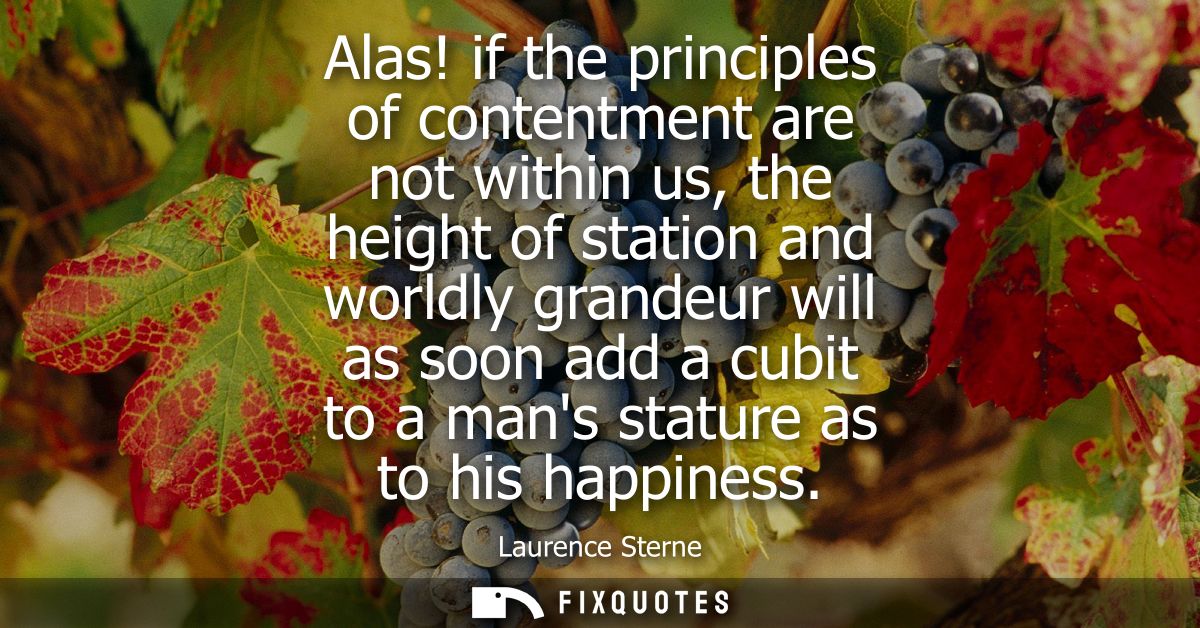
"Alas! if the principles of contentment are not within us, the height of station and worldly grandeur will as soon add a cubit to a man's stature as to his happiness"
About this Quote
Sterne takes a scalpel to the social ladder and shows it doesn’t bleed meaning. The line turns on a sly, almost theatrical lament ("Alas!") that signals what follows isn’t a pious sermon so much as a wink at the audience: we already know how prestige performs, and we keep buying tickets anyway. His central move is a deliberately absurd measurement. Grandeur can no more add to happiness than it can add a cubit to your height. Status is reduced to physics: fixed bones, fixed psyche. The joke lands because it punctures the era’s most expensive illusion - that external elevation produces internal enlargement.
The intent is moral, but the method is satiric. Sterne doesn’t argue that wealth and rank are evil; he implies they’re irrelevant to the core problem. "Principles of contentment" aren’t moods, they’re principles: habits of mind, a practiced inner economy. If those aren’t "within us", then grandeur becomes decorative rather than transformative, a costume that can’t rewrite the actor.
Context matters. Sterne is writing in an 18th-century Britain obsessed with station, patronage, and polite display - a world where being seen correctly could matter as much as being good. As a novelist attuned to vanity and self-deception, he frames happiness not as a reward delivered by society but as a competence, almost a craft. The subtext is bracingly modern: the chase for upgrades is endless because it’s trying to solve an interior problem with exterior tools.
The intent is moral, but the method is satiric. Sterne doesn’t argue that wealth and rank are evil; he implies they’re irrelevant to the core problem. "Principles of contentment" aren’t moods, they’re principles: habits of mind, a practiced inner economy. If those aren’t "within us", then grandeur becomes decorative rather than transformative, a costume that can’t rewrite the actor.
Context matters. Sterne is writing in an 18th-century Britain obsessed with station, patronage, and polite display - a world where being seen correctly could matter as much as being good. As a novelist attuned to vanity and self-deception, he frames happiness not as a reward delivered by society but as a competence, almost a craft. The subtext is bracingly modern: the chase for upgrades is endless because it’s trying to solve an interior problem with exterior tools.
Quote Details
| Topic | Contentment |
|---|---|
| Source | Help us find the source |
More Quotes by Laurence
Add to List