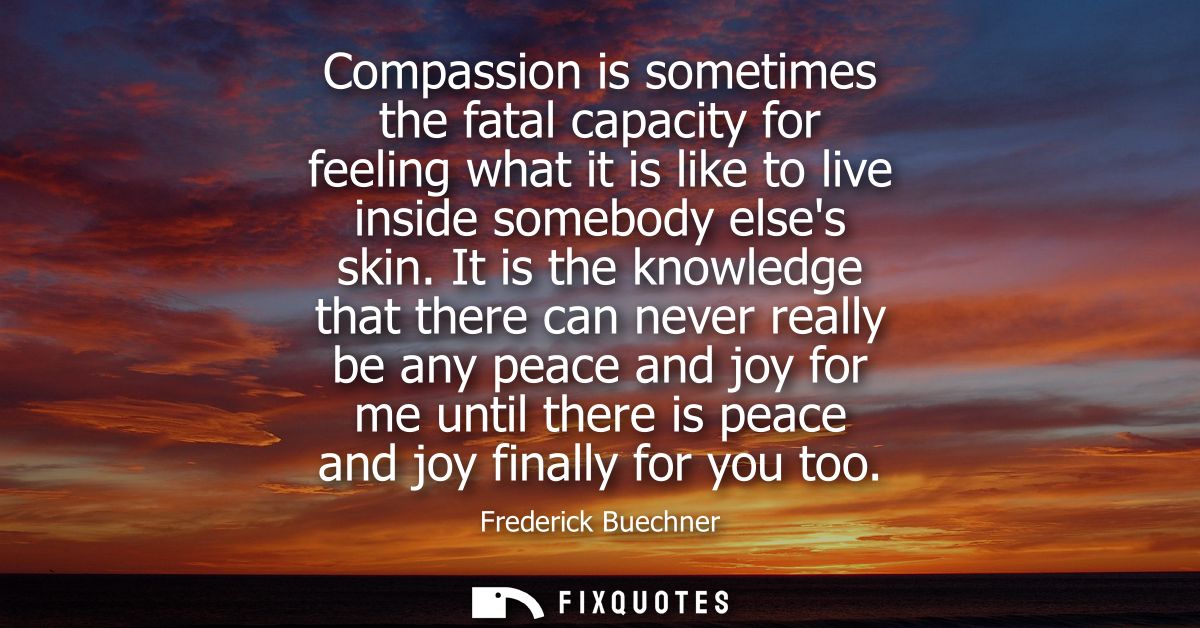
"Compassion is sometimes the fatal capacity for feeling what it is like to live inside somebody else's skin. It is the knowledge that there can never really be any peace and joy for me until there is peace and joy finally for you too"
About this Quote
Compassion, in Buechner's telling, is not the soft-focus virtue people like to wear at church and then take off in the parking lot. It is "fatal" because it kills the most convenient lie in modern life: that your interior weather can stay sunny while other people freeze outside your window. The phrase "inside somebody else's skin" makes empathy tactile and claustrophobic. This isn't abstract concern; it's an invasive proximity that dissolves the clean border between self and other.
As a clergyman writing in an America where religion often gets reduced to personal uplift, Buechner aims at the spiritual consumer. He reframes compassion as a form of holy sabotage. Once you truly feel another person's fear, hunger, humiliation, you lose the right to call your comfort "peace". The subtext is sharp: private salvation, if it ignores public suffering, is counterfeit. His second sentence turns that moral intuition into an almost unbearable interdependence: my joy is structurally incomplete if yours is absent. That's theology smuggled in as psychology.
The rhetoric works because it refuses heroics. Compassion here is not the noble act of helping from a safe distance; it's the destabilizing knowledge that binds you to outcomes you cannot fully control. It also carries a warning: if you want innocence, avoid compassion. If you want truth, accept the cost. In a culture trained to curate boundaries, Buechner describes compassion as the boundary-crossing that changes what "me" even means.
As a clergyman writing in an America where religion often gets reduced to personal uplift, Buechner aims at the spiritual consumer. He reframes compassion as a form of holy sabotage. Once you truly feel another person's fear, hunger, humiliation, you lose the right to call your comfort "peace". The subtext is sharp: private salvation, if it ignores public suffering, is counterfeit. His second sentence turns that moral intuition into an almost unbearable interdependence: my joy is structurally incomplete if yours is absent. That's theology smuggled in as psychology.
The rhetoric works because it refuses heroics. Compassion here is not the noble act of helping from a safe distance; it's the destabilizing knowledge that binds you to outcomes you cannot fully control. It also carries a warning: if you want innocence, avoid compassion. If you want truth, accept the cost. In a culture trained to curate boundaries, Buechner describes compassion as the boundary-crossing that changes what "me" even means.
Quote Details
| Topic | Kindness |
|---|
More Quotes by Frederick
Add to List