
Victor Hugo Biography Quotes 132 Report mistakes
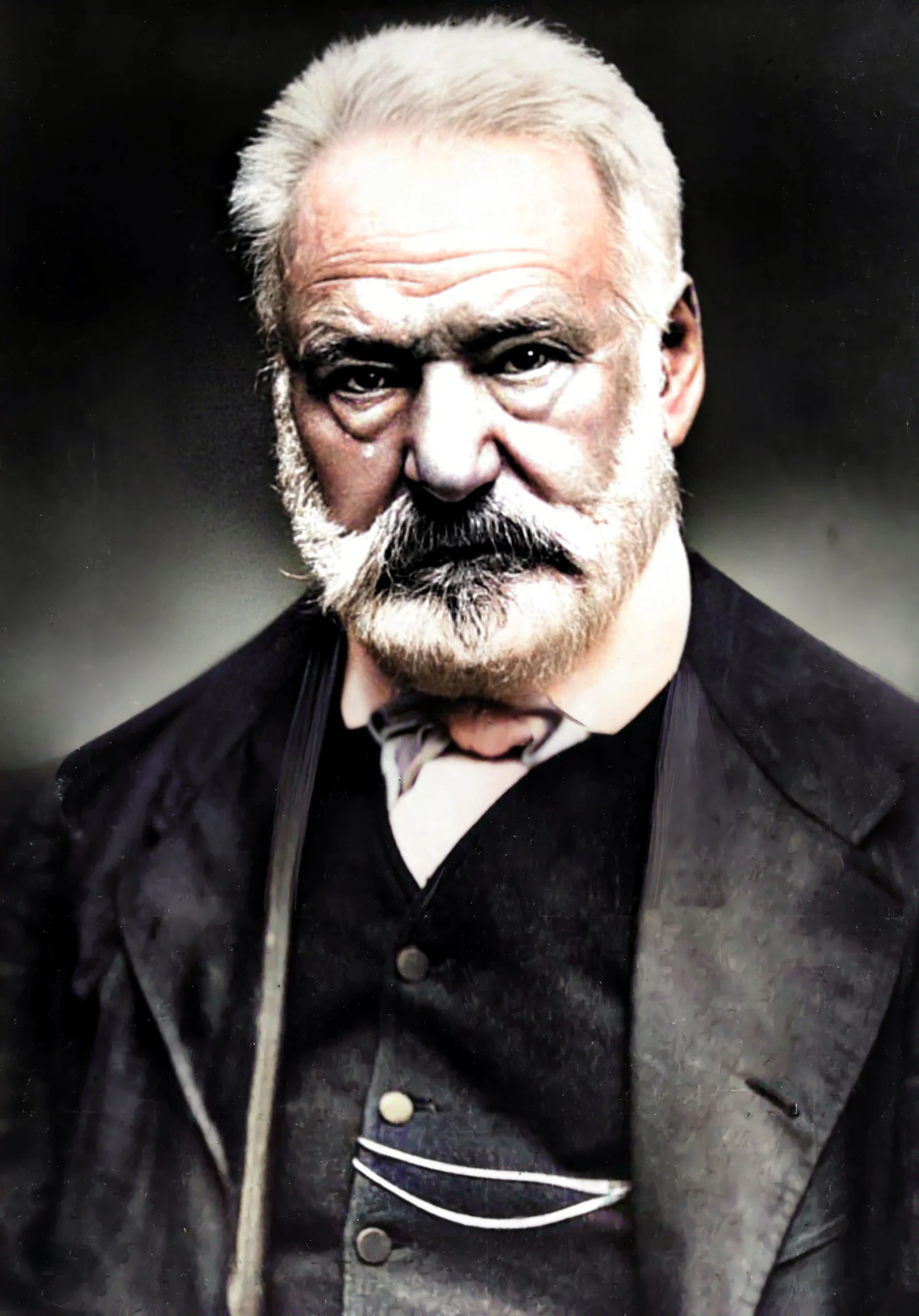
| 132 Quotes | |
| Occup. | Author |
| From | France |
| Born | February 26, 1802 |
| Died | May 22, 1885 |
| Aged | 83 years |
| Cite | |
Citation Formats
APA Style (7th ed.)
Victor hugo biography, facts and quotes. (2026, February 2). FixQuotes. https://fixquotes.com/authors/victor-hugo/
Chicago Style
"Victor Hugo biography, facts and quotes." FixQuotes. February 2, 2026. https://fixquotes.com/authors/victor-hugo/.
MLA Style (9th ed.)
"Victor Hugo biography, facts and quotes." FixQuotes, 2 Feb. 2026, https://fixquotes.com/authors/victor-hugo/. Accessed 1 Apr. 2026.
Early Life and Background
Victor-Marie Hugo was born on 1802-02-26 in Besancon, in eastern France, as the nation was still vibrating from revolution and empire. His father, Joseph-Leopold Hugo, was a Napoleonic general whose postings pulled the family across a continent at war; his mother, Sophie Trebuchet, was politically Royalist, devout, and emotionally decisive in the household. The boy grew up between barracks and salons, absorbing the contradictory pressures of authority and dissent, discipline and imagination.Those pressures became personal early. The family lived for periods in Paris, Naples, and Spain; Hugo saw churches and palaces, poverty and pageantry, and learned that power always has a backstage. His parents separated, and the child formed a fierce attachment to his mother, later idealizing her as a moral center. By adolescence he was writing poetry with the ambition, noted in his notebooks, to be "Chateaubriand or nothing" - a young provincial in the capital aiming at literary sovereignty.
Education and Formative Influences
Hugo was educated in Paris at the Lycee Louis-le-Grand and shaped as much by the city as by classrooms. He read the Bible and the classics, but also the modern writers who were undoing old rules - Chateaubriand, Shakespeare in translation, and the German Romantics. Early prizes for verse and the patronage of Louis XVIII rewarded his youthful Royalism, yet the deeper formation was aesthetic: he came to believe that literature must be large enough to contain the grotesque and the sublime, street slang and cathedral Latin, the crowd and the solitary soul.Career, Major Works, and Turning Points
His first books of poems (Odes et Ballades, 1820s) and the manifesto-like Preface to Cromwell (1827) helped launch French Romanticism; Hernani (1830) turned a theatrical premiere into a cultural battle, and Notre-Dame de Paris (1831) made medieval Paris a living character while arguing for the preservation of Gothic architecture. Private life and public life collided: his marriage to Adele Foucher (1822), his long relationship with Juliette Drouet, and the death of his daughter Leopoldine in 1843 deepened the tragic register of his writing. Politically he moved from establishment figure (peer of France in 1845) to radical moral opponent of repression after 1848; Louis-Napoleon's coup of 1851 drove him into long exile on Jersey and then Guernsey, where he wrote Les Chatiments (1853), Les Contemplations (1856), and the vast social epic Les Miserables (1862). Returning after the fall of the Second Empire, he became a symbolic conscience of the Third Republic; his funeral in Paris in 1885, after his death on 1885-05-22, drew an immense crowd to the Panthaeon.Philosophy, Style, and Themes
Hugo's inner life was a theater of extremes: tenderness and thunder, mystical awe and courtroom indictment. His imagination sought the moral meaning hidden inside spectacle, insisting that the soul is the ultimate landscape: “There is one spectacle grander than the sea, that is the sky; there is one spectacle grander than the sky, that is the interior of the soul”. Grief sharpened this gaze. After Leopoldine's death, the poems of Les Contemplations treat memory as both wound and revelation, while his fiction repeatedly asks how love survives shame, poverty, and time - the psychology behind his conviction that “The greatest happiness of life is the conviction that we are loved; loved for ourselves, or rather, loved in spite of ourselves”. In Hugo, sentiment is not softness but a force that can reorganize a life.His style fuses lyric elevation with journalistic urgency, staging moral arguments as scenes: a candle in a bishop's house, a barricade at dawn, a storm over the sea. He believed civilization is measured by its institutions and their compassion: “He who opens a school door, closes a prison”. That line is not a slogan but a program visible throughout Les Miserables, where education, literacy, and naming oneself are forms of escape. Exile intensified his prophetic tone; he learned to write as if addressing history itself, denouncing tyranny while refusing cynicism, turning individual redemption into an argument for social reform.
Legacy and Influence
Hugo endures as a central architect of modern French literary consciousness: the poet of interior storms, the novelist of the city as moral machine, and the dramatist who broke the old classical frame. Les Miserables and Notre-Dame de Paris have never left popular culture, continually reinterpreted on stage and screen, while his political writings helped shape the nineteenth-century idea of the writer as public witness. His influence reaches from realism to symbolist poetry, from heritage preservation to human-rights rhetoric, because he made art answerable to suffering without surrendering its grandeur.Our collection contains 132 quotes written by Victor, under the main topics: Witty One-Liners - Motivational - Ethics & Morality - Truth - Wisdom.
Other people related to Victor: Alexandre Dumas (Dramatist), Edmond Rostand (Poet), Alfred de Vigny (Poet), Pierre Jean de Beranger (Musician)
Victor Hugo Famous Works
- 1874 Ninety-Three (Novel)
- 1869 The Man Who Laughs (Novel)
- 1866 The Toilers of the Sea (Novel)
- 1862 Les Misérables (Novel)
- 1831 The Hunchback of Notre-Dame (Novel)
- 1829 The Last Day of a Condemned Man (Novella)
- 1826 Bug-Jargal (Novel)
Source / external links