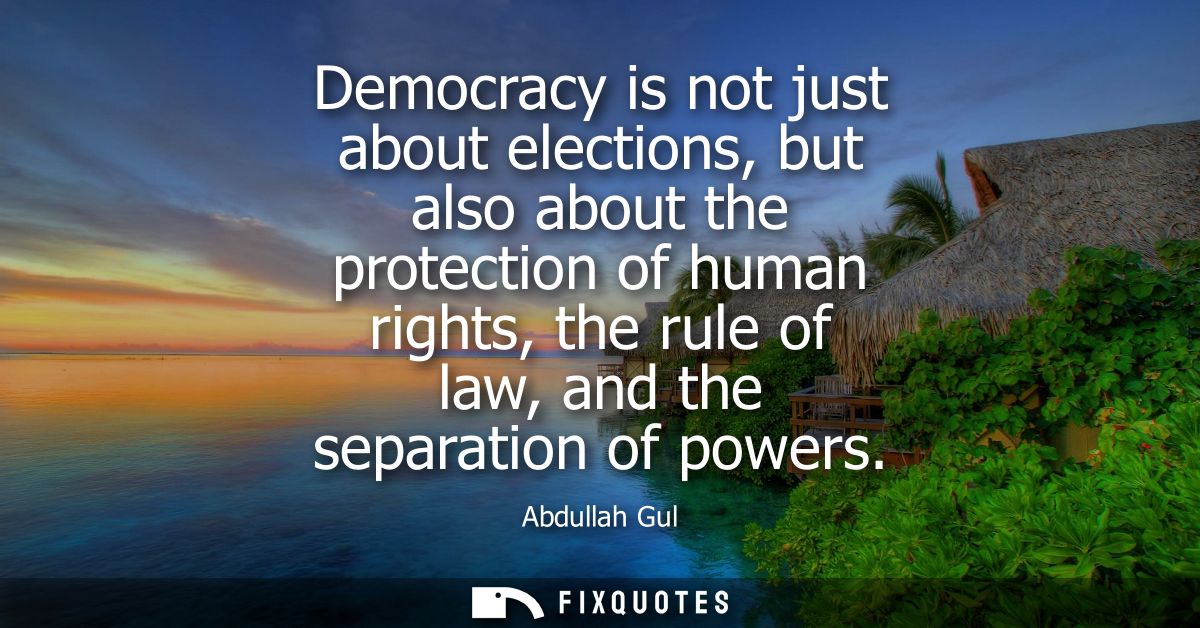
"Democracy is not just about elections, but also about the protection of human rights, the rule of law, and the separation of powers"
About this Quote
Democracy, Abdullah Gul insists, is a system of restraints as much as a ritual of ballots. The line reads like a civics lesson, but its real muscle is political triage: elections alone can legitimize almost anything, including the steady dismantling of the very freedoms that make voting meaningful. By stacking “human rights,” “rule of law,” and “separation of powers” alongside elections, Gul draws a bright boundary against majoritarianism-the idea that a 51 percent win is a blank check.
The phrasing is deliberate in its sequencing. “Not just” is a rebuke aimed at leaders who fetishize turnout while pressuring courts, corralling media, or bending police powers. “Protection” signals anxiety: rights don’t simply exist; they’re defended against the state’s convenience. “Rule of law” is the antiseptic term that smuggles in a harder claim-that laws must bind executives, not serve them. And “separation of powers” is the tell, the most institutional of the trio: democracy depends on friction, on the ability of other branches to say no.
Context matters because Gul speaks as a Turkish president shaped by a country perpetually auditioning for “democratic” legitimacy-at home, for a polarized electorate; abroad, under the glare of EU norms and human-rights scrutiny. It’s also a soft warning from inside a political tradition often tempted by centralized authority: you can win elections and still lose democracy. The intent isn’t poetic; it’s preventative, a compact definition designed to expose the loopholes authoritarians love.
The phrasing is deliberate in its sequencing. “Not just” is a rebuke aimed at leaders who fetishize turnout while pressuring courts, corralling media, or bending police powers. “Protection” signals anxiety: rights don’t simply exist; they’re defended against the state’s convenience. “Rule of law” is the antiseptic term that smuggles in a harder claim-that laws must bind executives, not serve them. And “separation of powers” is the tell, the most institutional of the trio: democracy depends on friction, on the ability of other branches to say no.
Context matters because Gul speaks as a Turkish president shaped by a country perpetually auditioning for “democratic” legitimacy-at home, for a polarized electorate; abroad, under the glare of EU norms and human-rights scrutiny. It’s also a soft warning from inside a political tradition often tempted by centralized authority: you can win elections and still lose democracy. The intent isn’t poetic; it’s preventative, a compact definition designed to expose the loopholes authoritarians love.
Quote Details
| Topic | Human Rights |
|---|
More Quotes by Abdullah
Add to List