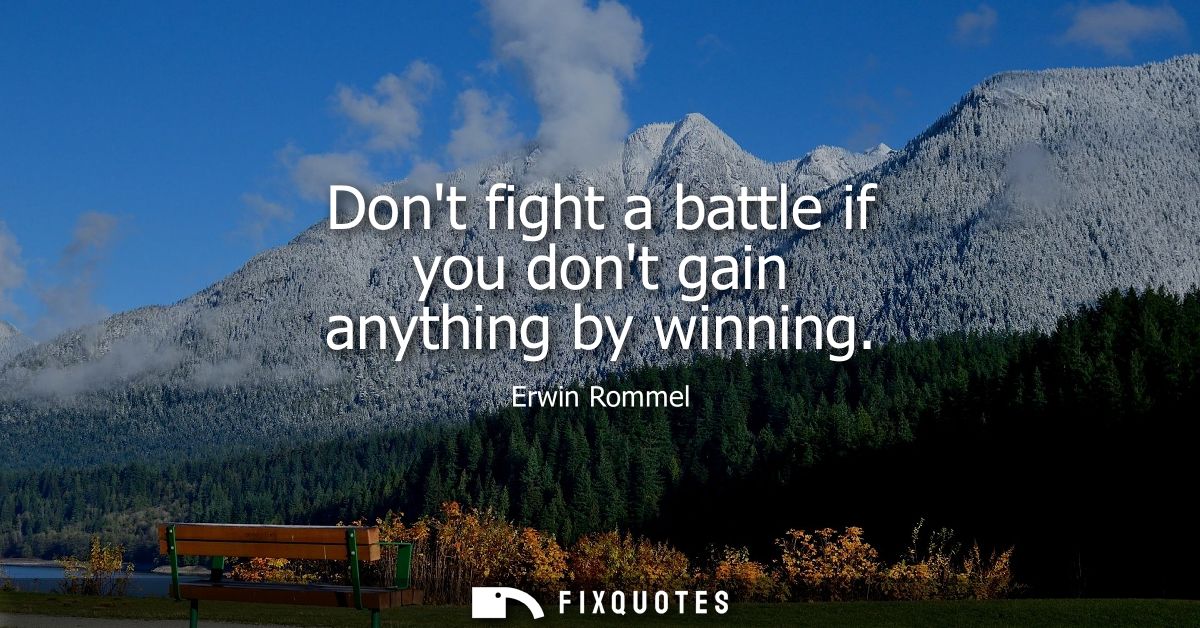
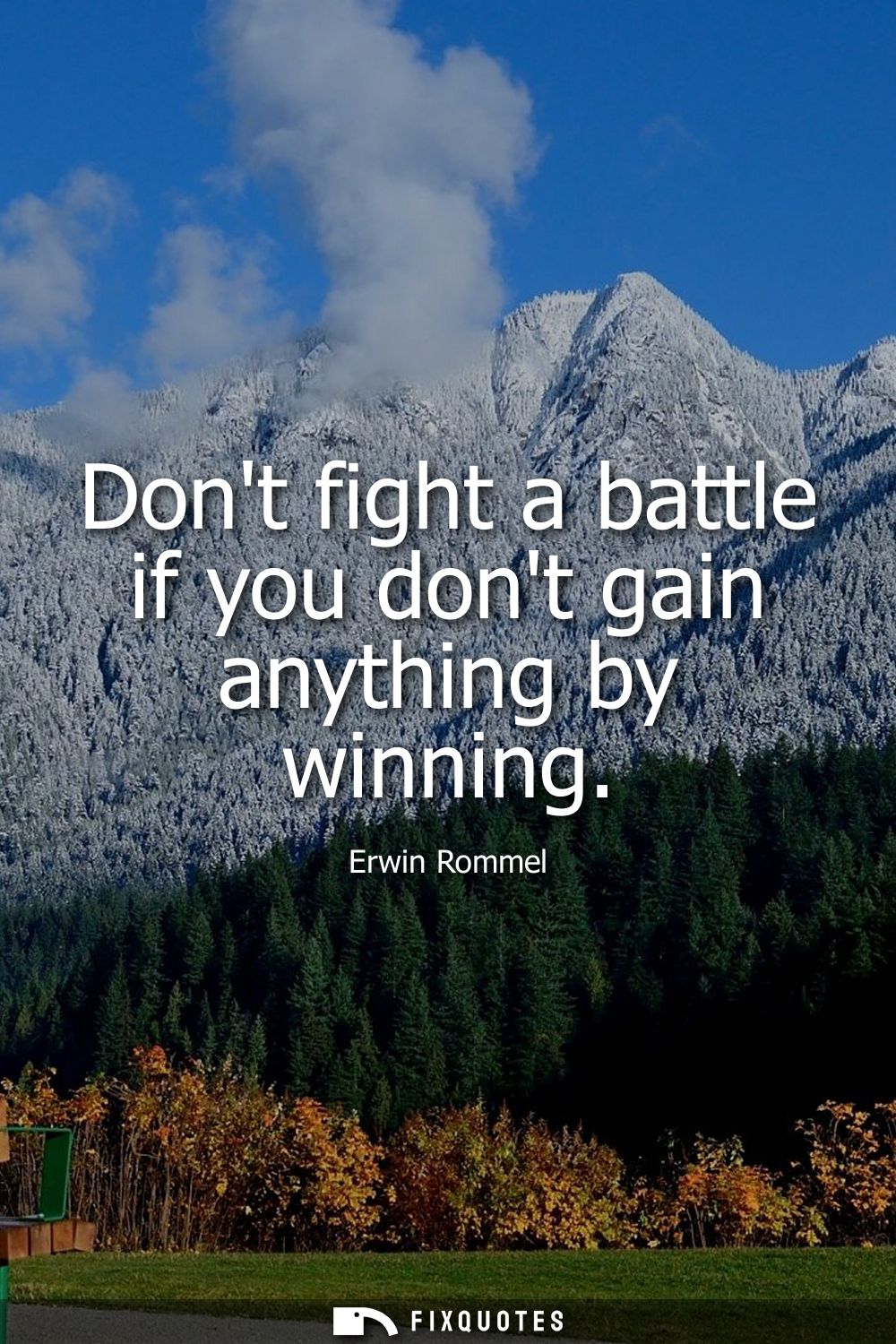
"Don't fight a battle if you don't gain anything by winning"
About this Quote
War strips romance out of decision-making, and Rommel’s line does it with a surgeon’s economy. “Don’t fight a battle if you don’t gain anything by winning” isn’t a plea for mercy; it’s a rebuke to vanity. The premise is brutally transactional: victory is not automatically virtue. If the outcome doesn’t change your strategic position, protect your forces, or reshape the political endgame, then “winning” is just an expensive way to feel competent.
The intent reads like a field commander talking to leaders who confuse motion with progress. Rommel’s career, especially in North Africa, was defined by speed, improvisation, and the constant arithmetic of fuel, supply lines, and exhaustion. In that environment, a battle could be “won” and still be a loss if it drained irreplaceable men and materiel, exposed flanks, or delayed a retreat you should’ve started yesterday. His aphorism pushes the idea that strategy is about outcomes, not theater.
The subtext is also a warning about ego: generals, like politicians, can get addicted to decisive moments because they photograph well. Rommel’s sentence punctures the mythology of the “glorious engagement” and replaces it with a colder ethic - conserve strength for the fights that actually decide something. It’s a doctrine that extends beyond armies: in bureaucracies, in culture wars, in personal feuds, you can “win” an argument and still lose time, allies, and optionality. Rommel’s realism insists that the real metric isn’t triumph; it’s leverage.
The intent reads like a field commander talking to leaders who confuse motion with progress. Rommel’s career, especially in North Africa, was defined by speed, improvisation, and the constant arithmetic of fuel, supply lines, and exhaustion. In that environment, a battle could be “won” and still be a loss if it drained irreplaceable men and materiel, exposed flanks, or delayed a retreat you should’ve started yesterday. His aphorism pushes the idea that strategy is about outcomes, not theater.
The subtext is also a warning about ego: generals, like politicians, can get addicted to decisive moments because they photograph well. Rommel’s sentence punctures the mythology of the “glorious engagement” and replaces it with a colder ethic - conserve strength for the fights that actually decide something. It’s a doctrine that extends beyond armies: in bureaucracies, in culture wars, in personal feuds, you can “win” an argument and still lose time, allies, and optionality. Rommel’s realism insists that the real metric isn’t triumph; it’s leverage.
Quote Details
| Topic | Decision-Making |
|---|---|
| Source | Help us find the source |
| Cite |
Citation Formats
APA Style (7th ed.)
Rommel, Erwin. (2026, January 15). Don't fight a battle if you don't gain anything by winning. FixQuotes. https://fixquotes.com/quotes/dont-fight-a-battle-if-you-dont-gain-anything-by-45780/
Chicago Style
Rommel, Erwin. "Don't fight a battle if you don't gain anything by winning." FixQuotes. January 15, 2026. https://fixquotes.com/quotes/dont-fight-a-battle-if-you-dont-gain-anything-by-45780/.
MLA Style (9th ed.)
"Don't fight a battle if you don't gain anything by winning." FixQuotes, 15 Jan. 2026, https://fixquotes.com/quotes/dont-fight-a-battle-if-you-dont-gain-anything-by-45780/. Accessed 2 Apr. 2026.
More Quotes by Erwin
Add to List