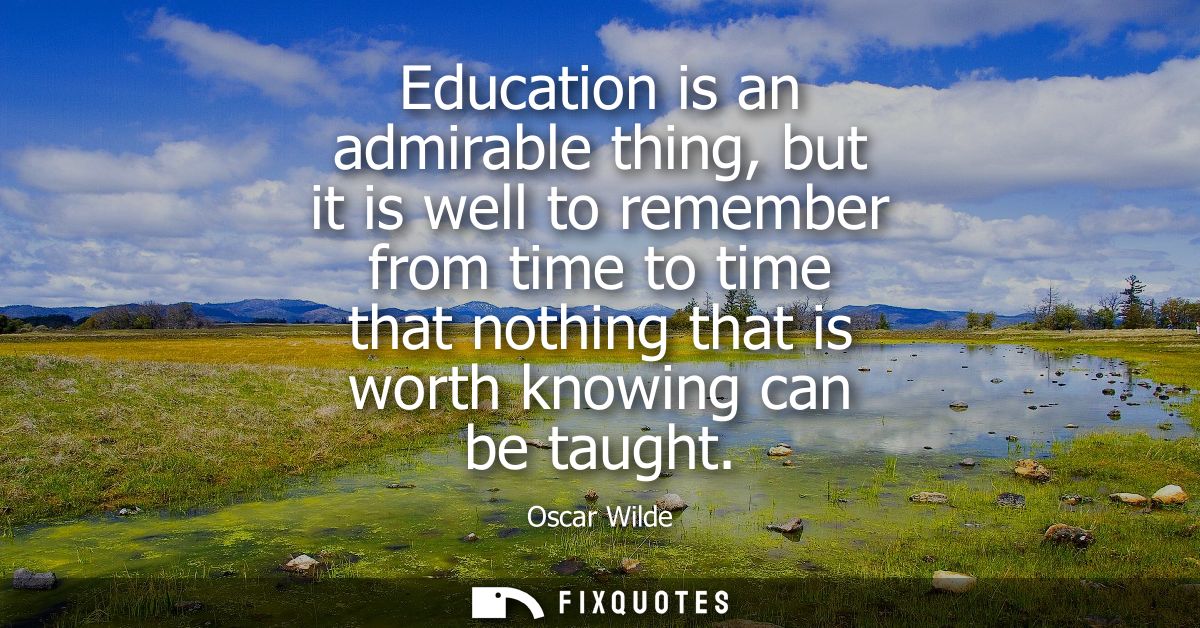
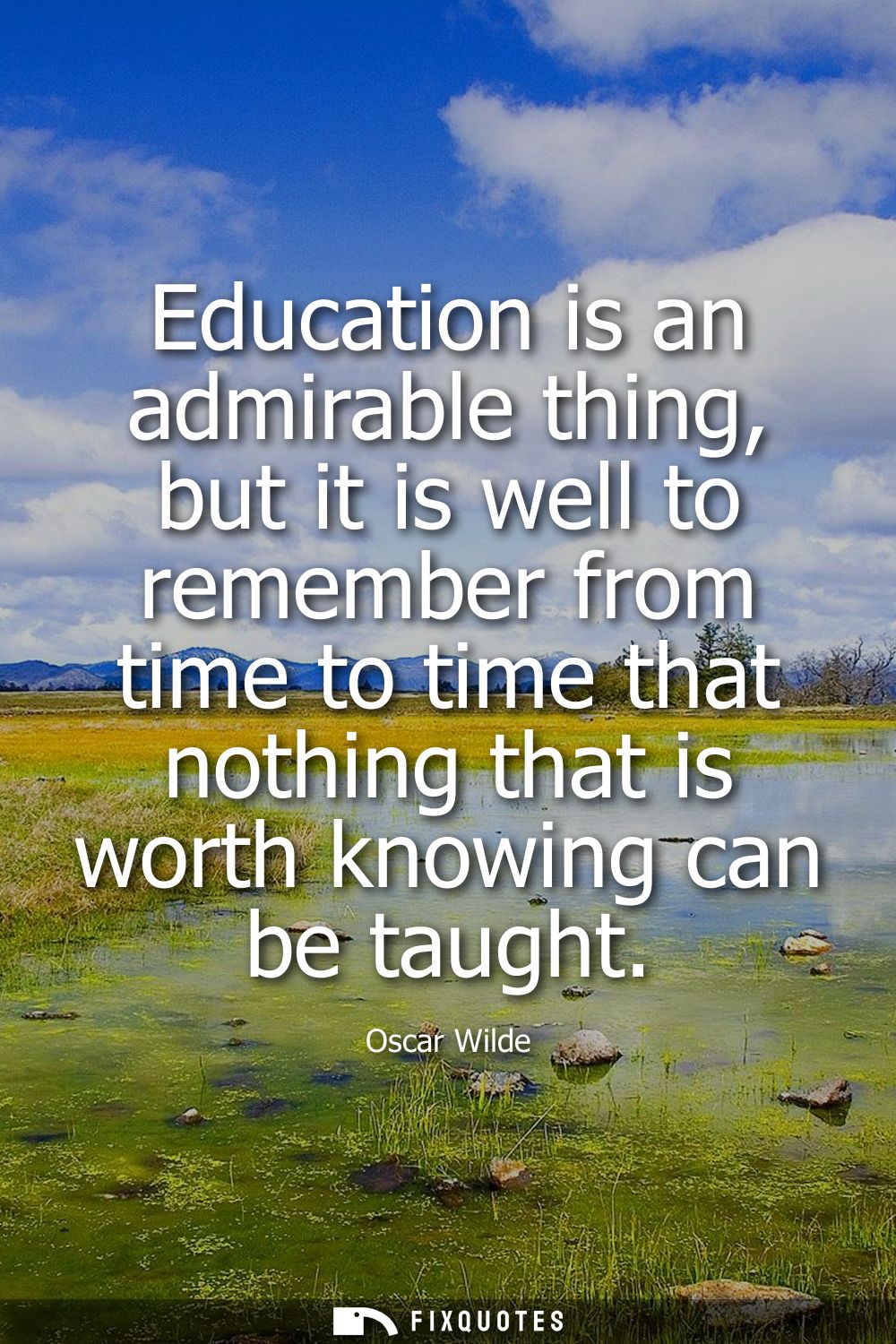
"Education is an admirable thing, but it is well to remember from time to time that nothing that is worth knowing can be taught"
About this Quote
The subtext is classic Wildean inversion: the most valuable forms of knowledge are precisely the ones that refuse to behave like curriculum. Character, taste, desire, moral judgment, the ability to see through hypocrisy - these arrive through experience, failure, intimacy, boredom, scandal. You can be instructed in Latin; you cannot be instructed into wisdom. By framing it as something to remember "from time to time", Wilde also mocks the periodic amnesia that polite society practices: we know education has blind spots, we just prefer not to say it at dinner.
Context matters. Wilde lived inside elite educational systems and also became their most notorious refutation: brilliant, credentialed, and ultimately destroyed by the same moral machinery that education was supposed to refine. The jab lands because it refuses the era's comforting equation of schooling with virtue. It's not anti-intellectual. It's anti-complacent, a reminder that real knowing doesn't arrive as information but as transformation - and transformation can't be assigned.
Quote Details
| Topic | Knowledge |
|---|---|
| Source | Verified source: Intentions (Oscar Wilde, 1891)
Evidence: Education is an admirable thing, but it is well to remember from time to time that nothing that is worth knowing can be taught. (Essay/dialogue: "The Critic as Artist" (appears in Part II of the dialogue)). Verifiable in Oscar Wilde’s own text within the dialogue essay "The Critic as Artist" in the 1891 collection Intentions. In the Project Gutenberg transcription, it appears in the passage beginning “Don’t degrade me into the position of giving you useful information.” ([m.gutenberg.org](https://m.gutenberg.org/files/887/887-h/887-h.htm)) However, this may not be the *first* publication of the line: multiple bibliographic references report it was first published (anonymously) as one of Wilde’s epigrams in "A Few Maxims for the Instruction of the Over-Educated" in the Saturday Review dated November 17, 1894. ([quotationize.com](https://quotationize.com/education-is-an-admirable-thing-meaning-by-oscar-wilde/?utm_source=openai)) I was not able (in this search pass) to open a scanned image/PDF of the November 17, 1894 Saturday Review page to extract a fully primary, page-verified quotation with page number. So: the earliest *fully verified primary text I can quote directly from a primary source available here* is in Intentions (1891), but I cannot confirm from scans whether an earlier periodical printing exists; the claims about the 1894 Saturday Review appearance look plausible but remain unverified at the page-image level in this run. Other candidates (1) Why Art Cannot Be Taught (James Elkins, 2001) compilation96.5% ... Oscar Wilde says the same thing , a bit less ponderously : " Education is an admirable thing , but it is well to ... |
| Cite |
Citation Formats
APA Style (7th ed.)
Wilde, Oscar. (2026, February 15). Education is an admirable thing, but it is well to remember from time to time that nothing that is worth knowing can be taught. FixQuotes. https://fixquotes.com/quotes/education-is-an-admirable-thing-but-it-is-well-to-32560/
Chicago Style
Wilde, Oscar. "Education is an admirable thing, but it is well to remember from time to time that nothing that is worth knowing can be taught." FixQuotes. February 15, 2026. https://fixquotes.com/quotes/education-is-an-admirable-thing-but-it-is-well-to-32560/.
MLA Style (9th ed.)
"Education is an admirable thing, but it is well to remember from time to time that nothing that is worth knowing can be taught." FixQuotes, 15 Feb. 2026, https://fixquotes.com/quotes/education-is-an-admirable-thing-but-it-is-well-to-32560/. Accessed 2 Apr. 2026.