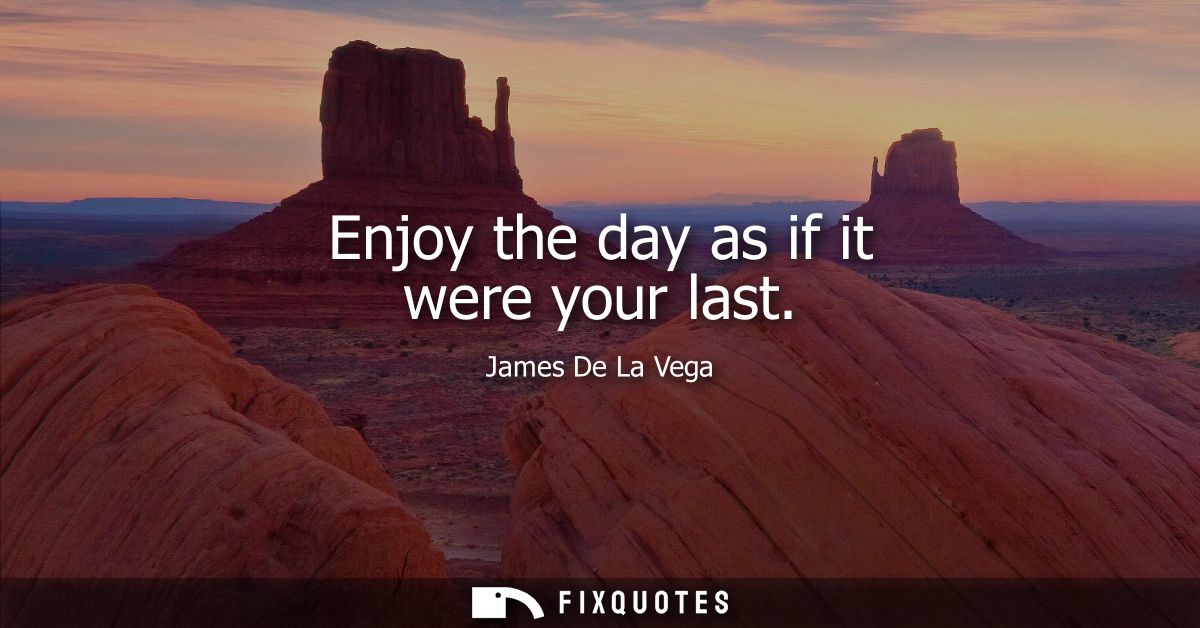
"Enjoy the day as if it were your last"
About this Quote
A line like "Enjoy the day as if it were your last" sounds like a souvenir-store slogan until you put it back in James De La Vega's hands: an artist who built a reputation on street-level aphorisms, public-facing reminders that life is both fragile and, right now, stubbornly available. In that context, the quote isn’t trying to be profound; it’s trying to be usable. It’s the kind of sentence you can carry past a bodega, read on a wall, and feel nudged into presence without needing a self-help seminar to translate it.
The intent is less "seize the day" than "stop outsourcing your life to later". De La Vega’s subtext often lives in cities where later is a luxury. When tomorrow is uncertain - because of money, health, violence, immigration status, burnout - exhortations to wait for the right moment become a polite form of denial. "As if it were your last" weaponizes that uncertainty, flipping anxiety into permission: call your mother, take the walk, make the thing, forgive the person, quit postponing your own existence.
It also carries a sly critique of modern distraction. Enjoyment here isn’t consumption; it’s attention. The line implicitly argues that most days are lost not to tragedy but to autopilot: scrolling, grinding, numbing out. By borrowing the rhetoric of finality, De La Vega creates urgency without melodrama. The sentence works because it’s blunt, portable, and a little accusatory - a street artist’s way of saying: the clock is ticking, and you already know it.
The intent is less "seize the day" than "stop outsourcing your life to later". De La Vega’s subtext often lives in cities where later is a luxury. When tomorrow is uncertain - because of money, health, violence, immigration status, burnout - exhortations to wait for the right moment become a polite form of denial. "As if it were your last" weaponizes that uncertainty, flipping anxiety into permission: call your mother, take the walk, make the thing, forgive the person, quit postponing your own existence.
It also carries a sly critique of modern distraction. Enjoyment here isn’t consumption; it’s attention. The line implicitly argues that most days are lost not to tragedy but to autopilot: scrolling, grinding, numbing out. By borrowing the rhetoric of finality, De La Vega creates urgency without melodrama. The sentence works because it’s blunt, portable, and a little accusatory - a street artist’s way of saying: the clock is ticking, and you already know it.
Quote Details
| Topic | Live in the Moment |
|---|
More Quotes by James
Add to List