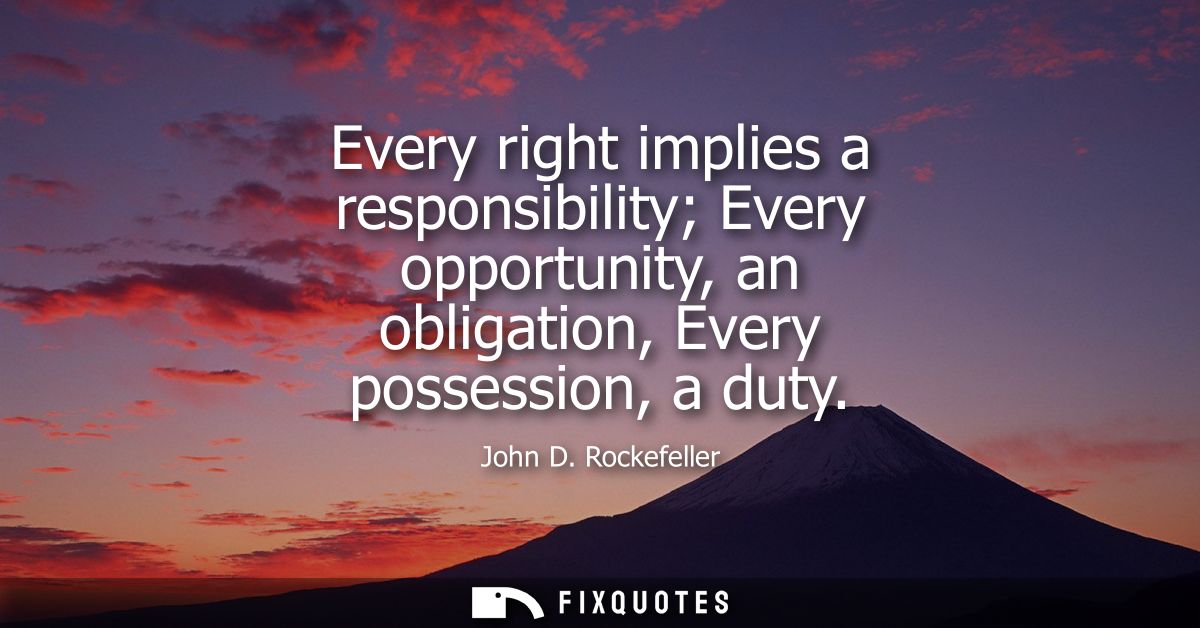
"Every right implies a responsibility; Every opportunity, an obligation, Every possession, a duty"
About this Quote
Rockefeller’s line reads like a moral checksum for capitalism: whatever you claim, you owe. The rhythm is sermon-like, built on paired terms that escalate from the abstract to the intimate - right, opportunity, possession - each tethered to a heavier word: responsibility, obligation, duty. It’s not just aphoristic neatness; it’s reputational engineering. By making wealth sound like a burden borne on behalf of society, he reframes accumulation as stewardship rather than conquest.
The intent is double-edged. On its face, it’s a civic-minded ethic that rejects entitlement culture: rights aren’t freebies; they come with upkeep. Underneath, it’s an argument for elite legitimacy. If the rich are “dutiful,” then their power can be treated as functional, even necessary - less a problem to solve than a tool to trust. That’s a familiar move in American business mythology: inequality becomes tolerable when it’s narrated as service.
Context matters. Rockefeller rose in the era of monopoly, labor unrest, and a dawning antitrust state. Standard Oil wasn’t criticized for lacking a conscience; it was criticized for having too much control. This quote answers that charge without conceding anything concrete. It offers ethics in the abstract - a voluntary code, not a demand for regulation, redistribution, or worker power. In that way, it’s also a quiet boundary-setting: the obligations of wealth are real, but the wealthy get to define them.
As cultural rhetoric, it works because it marries piety to property. Duty becomes the halo that lets possession keep its crown.
The intent is double-edged. On its face, it’s a civic-minded ethic that rejects entitlement culture: rights aren’t freebies; they come with upkeep. Underneath, it’s an argument for elite legitimacy. If the rich are “dutiful,” then their power can be treated as functional, even necessary - less a problem to solve than a tool to trust. That’s a familiar move in American business mythology: inequality becomes tolerable when it’s narrated as service.
Context matters. Rockefeller rose in the era of monopoly, labor unrest, and a dawning antitrust state. Standard Oil wasn’t criticized for lacking a conscience; it was criticized for having too much control. This quote answers that charge without conceding anything concrete. It offers ethics in the abstract - a voluntary code, not a demand for regulation, redistribution, or worker power. In that way, it’s also a quiet boundary-setting: the obligations of wealth are real, but the wealthy get to define them.
As cultural rhetoric, it works because it marries piety to property. Duty becomes the halo that lets possession keep its crown.
Quote Details
| Topic | Ethics & Morality |
|---|
More Quotes by John
Add to List