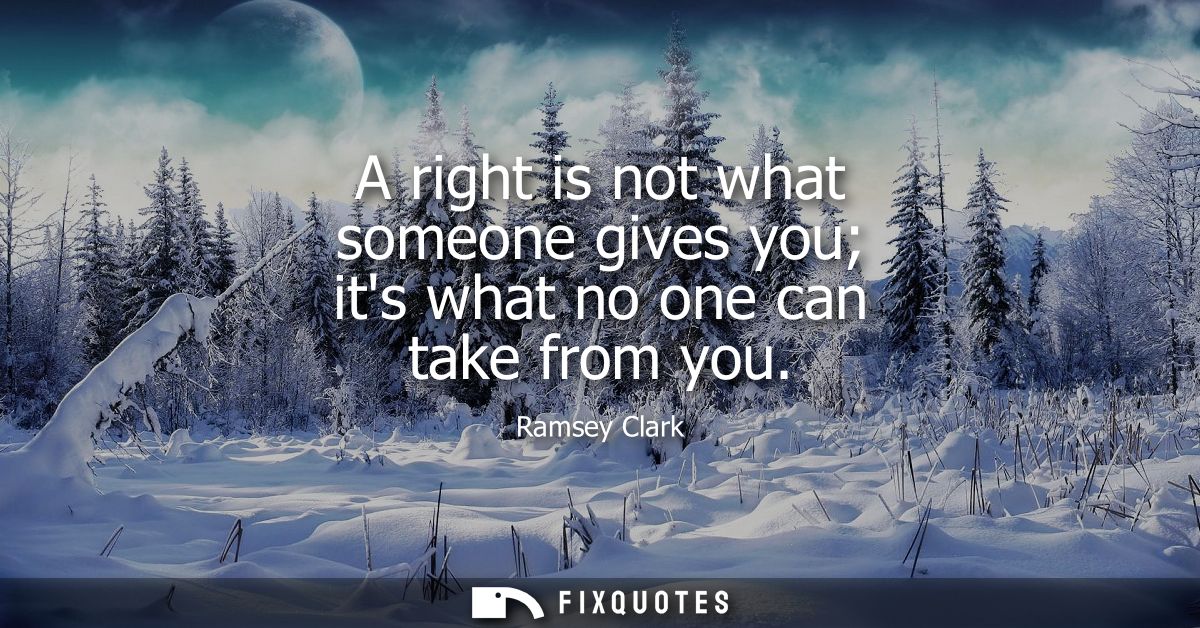
"A right is not what someone gives you; it's what no one can take from you"
About this Quote
The line hits like a legal brief rewritten as a street slogan: rights don’t arrive as gifts, they exist as limits on power. Ramsey Clark, a former U.S. attorney general who spent much of his later career indicting American overreach, is deliberately yanking “rights” away from the warm, civic language of benevolence and returning it to its adversarial core. The point isn’t inspirational; it’s corrective.
“A right is not what someone gives you” targets the soft corruption of gratitude. When rights are framed as something the state (or any authority) “grants,” citizenship quietly turns into a customer relationship: comply, and you’ll be rewarded; dissent, and the perks disappear. Clark’s phrasing exposes how easily that logic launders coercion into generosity.
“It’s what no one can take from you” is the sharper knife. It’s not a claim about how the world actually behaves (history is a museum of stolen rights); it’s a demand about how legitimacy is supposed to work. The sentence treats rights as a constraint that must survive changes in mood, leadership, and fear. That insistence matters most in the moments when rights are most politically inconvenient: wartime, moral panics, “law and order” crackdowns, surveillance booms.
The subtext is a warning about rhetorical traps. Governments love calling rollbacks “temporary,” “reasonable,” or “necessary.” Clark’s definition refuses the sliding scale. If it can be taken away on command, it was never functioning as a right in the first place - it was permission wearing a constitutional costume.
“A right is not what someone gives you” targets the soft corruption of gratitude. When rights are framed as something the state (or any authority) “grants,” citizenship quietly turns into a customer relationship: comply, and you’ll be rewarded; dissent, and the perks disappear. Clark’s phrasing exposes how easily that logic launders coercion into generosity.
“It’s what no one can take from you” is the sharper knife. It’s not a claim about how the world actually behaves (history is a museum of stolen rights); it’s a demand about how legitimacy is supposed to work. The sentence treats rights as a constraint that must survive changes in mood, leadership, and fear. That insistence matters most in the moments when rights are most politically inconvenient: wartime, moral panics, “law and order” crackdowns, surveillance booms.
The subtext is a warning about rhetorical traps. Governments love calling rollbacks “temporary,” “reasonable,” or “necessary.” Clark’s definition refuses the sliding scale. If it can be taken away on command, it was never functioning as a right in the first place - it was permission wearing a constitutional costume.
Quote Details
| Topic | Human Rights |
|---|
More Quotes by Ramsey
Add to List