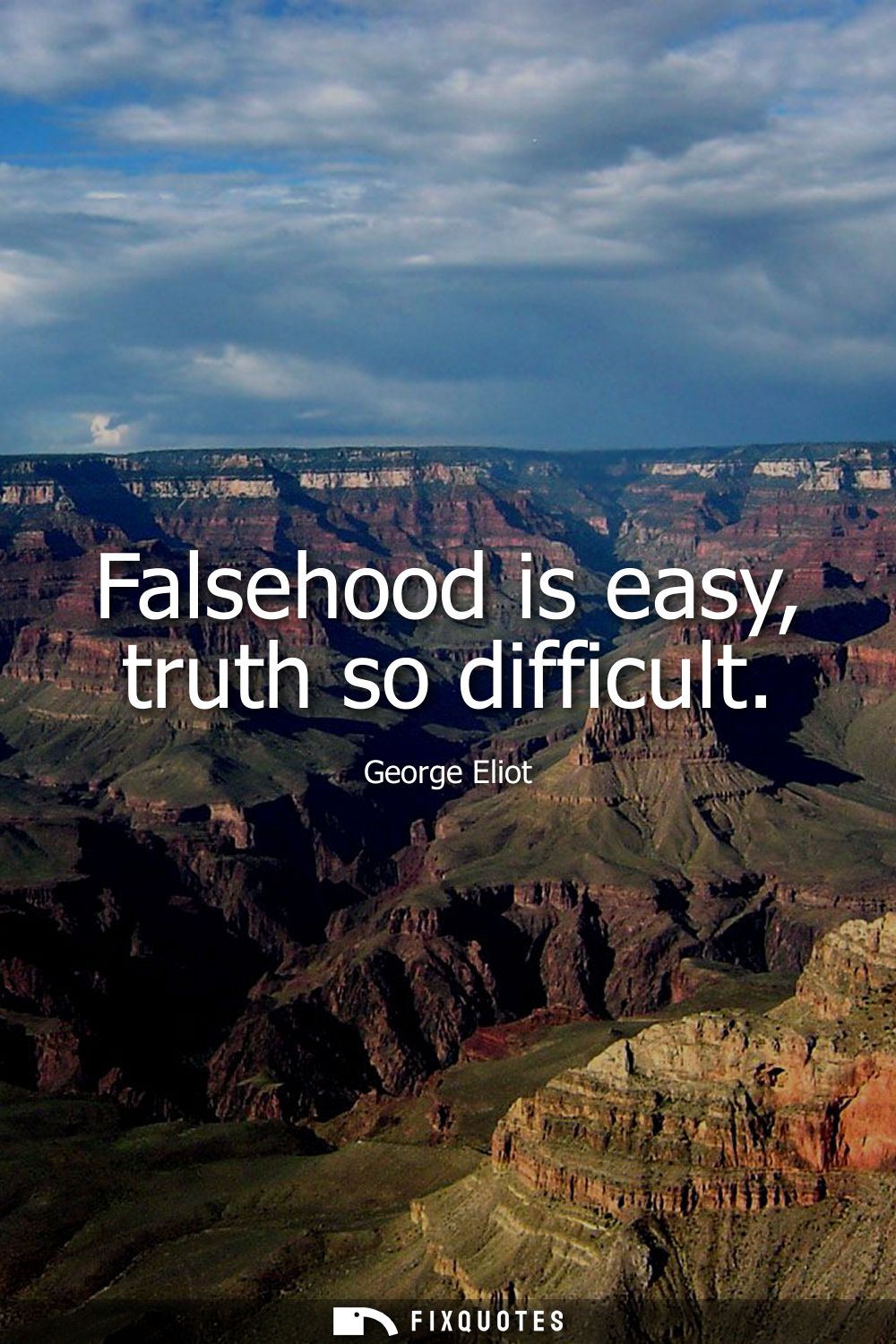
"Falsehood is easy, truth so difficult"
About this Quote
Falsehood offers shortcuts. It trims away inconvenient detail, protects pride, and can be tailored to what others want to hear. Truth, by contrast, is heavy with particulars and consequence; it requires exactness of memory, steadiness of conscience, and the courage to be seen. Lies feel effortless because they serve desire and fear; truth costs effort because it binds us to reality and to the responsibility that reality imposes.
George Eliot embeds this insight in the moral and social texture of Adam Bede. The story turns on evasions that seem small at first and then accumulate into tragedy, particularly around Hetty Sorrel, whose reluctance to speak plainly about her situation leads to concealment, flight, and catastrophe. The community around her, with its quick judgments and harsh penalties for female transgression, makes candor perilous; society itself helps make truth difficult. Yet Eliot also shows that, despite the pain it brings, confession opens the possibility of sympathy and repair. Dinah Morris’s patient attention does not erase consequences, but it creates a space in which reality can be faced rather than fled. That is the ethical core of Eliot’s realism: to look steadily at ordinary lives, to resist the melodramatic simplifications that make characters flatter, motives tidier, and outcomes neater than they really are.
The sentence also names the daily labor of sincerity. Self-deception is the most seductive falsehood, the inner story that lets us think better of ourselves than our actions warrant. To tell the truth, even inwardly, demands a patient inventory of motives and effects, and a willingness to be implicated. Eliot’s art models that patience. She makes the reader work through complexity, because moral knowledge is not a quick discovery but a slow recognition. The line stands as a reminder that ease and accuracy rarely travel together, and that the hard path of truth is the only one that leads anywhere worth going.
George Eliot embeds this insight in the moral and social texture of Adam Bede. The story turns on evasions that seem small at first and then accumulate into tragedy, particularly around Hetty Sorrel, whose reluctance to speak plainly about her situation leads to concealment, flight, and catastrophe. The community around her, with its quick judgments and harsh penalties for female transgression, makes candor perilous; society itself helps make truth difficult. Yet Eliot also shows that, despite the pain it brings, confession opens the possibility of sympathy and repair. Dinah Morris’s patient attention does not erase consequences, but it creates a space in which reality can be faced rather than fled. That is the ethical core of Eliot’s realism: to look steadily at ordinary lives, to resist the melodramatic simplifications that make characters flatter, motives tidier, and outcomes neater than they really are.
The sentence also names the daily labor of sincerity. Self-deception is the most seductive falsehood, the inner story that lets us think better of ourselves than our actions warrant. To tell the truth, even inwardly, demands a patient inventory of motives and effects, and a willingness to be implicated. Eliot’s art models that patience. She makes the reader work through complexity, because moral knowledge is not a quick discovery but a slow recognition. The line stands as a reminder that ease and accuracy rarely travel together, and that the hard path of truth is the only one that leads anywhere worth going.
Quote Details
| Topic | Truth |
|---|
More Quotes by George
Add to List