
George Eliot Biography Quotes 101 Report mistakes
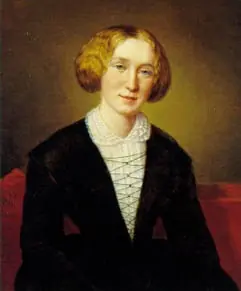
| 101 Quotes | |
| Occup. | Author |
| From | United Kingdom |
| Born | November 22, 1819 |
| Died | December 22, 1880 |
| Aged | 61 years |
Mary Ann Evans, later known as George Eliot, was born on 22 November 1819 at South Farm on the Arbury Hall estate near Nuneaton, Warwickshire, into the practical, improvement-minded world of provincial England. Her father, Robert Evans, was an estate manager and surveyor; her mother, Christiana, died when Mary Ann was in her teens, leaving a household shaped by duty, Methodist sobriety, and the quiet stratifications of class. That early intimacy with farm labor, tenant farmers, and small-town reputations became the grain of her fiction, where moral drama is rarely abstract and where the pressure of a community can be as decisive as any single villain.
In temperament she was inward, intense, and unusually receptive to the hidden lives of others. The Midlands of her childhood, later transmuted into the "midland" world of her novels, offered her a double education: sympathy for ordinary people and a clear-eyed sense of how custom polices desire. Those early years trained her to observe how affection, money, religion, and gossip bind a neighborhood together - and how easily they can tighten into a noose.
Education and Formative Influences
Evans was educated at schools in Attleborough and Coventry, including Mrs. Wallington's and later the evangelical atmosphere of the Misses Franklin in Coventry, where she excelled in languages and music while absorbing serious religious feeling. After her mother's death, she returned home to manage domestic responsibilities, but intellectual expansion continued through voracious reading and contact with the Bray circle in Coventry - freethinkers who nudged her from evangelical certainty toward historical criticism, philosophy, and continental ideas; her translation of David Strauss's The Life of Jesus (1846, published 1846) and later Feuerbach's The Essence of Christianity (1854, published 1854) signaled a turning from doctrinal faith to an ethics grounded in human consequences.
Career, Major Works, and Turning Points
In 1851 Evans moved to London and became assistant editor at the Westminster Review, entering a milieu of reform, debate, and literary ambition; the decisive personal turning point was her union with George Henry Lewes, begun in 1854, a partnership intellectually sustaining but socially scandalous because Lewes could not legally divorce. Under the pseudonym George Eliot, she debuted with Scenes of Clerical Life (1857) and rapidly produced Adam Bede (1859), The Mill on the Floss (1860), Silas Marner (1861), Romola (1863), Felix Holt (1866), Middlemarch (1871-72), and Daniel Deronda (1876), marrying John Cross in 1880 after Lewes's death (1878). Her rise coincided with the Victorian novel's peak as a forum for moral inquiry, and her work pushed the form toward psychological depth, sociological breadth, and an unsentimental view of how lives are shaped by institutions as much as by private will.
Philosophy, Style, and Themes
Eliot's fiction is built from a paradox: the need to believe in moral seriousness after the loss of comforting certainties. The novels refuse easy providence; they insist that acts ripple outward through time, often beyond intention, and that character is partly fate because habit becomes a second nature. Her imagination is interpretive, attentive to how people misread themselves and others - a bias she named with lapidary precision: "All meanings, we know, depend on the key of interpretation". That sentence is not merely a maxim but a method: Dorothea, Lydgate, Maggie Tulliver, and Gwendolen Harleth suffer not only from society's constraints but from the stories they tell about what love, duty, and greatness are supposed to look like.
Her narrative voice pairs compassion with a prosecutorial clarity, steering readers to feel the pressure of circumstance without dissolving responsibility. Eliot's moral psychology is severe precisely because it is tender: she sees that cruelty often masquerades as principle, and that hindsight exposes what pride defended. "When death, the great reconciler, has come, it is never our tenderness that we repent of, but our severity". The line reads like a private correction to the younger Evans who once clung to strict belief, and also like a guiding ethic for her art - an attempt to enlarge fellow-feeling before time closes the account. Her style is deliberately unshowy, often aphoristic, suspicious of rhetorical vanity; even her humor tends to puncture self-importance. Yet the deepest current is ethical: "What do we live for, if not to make life less difficult for each other?" In her hands, the novel becomes a training in moral attention, asking the reader to practice the very sympathy her characters so often lack at crucial moments.
Legacy and Influence
George Eliot died in London on 22 December 1880, leaving behind a body of work that redefined realism as a moral art rather than a mere catalog of surfaces. Middlemarch, in particular, became a benchmark for the modern novel because it joined intimate psychology to a wide social canvas, influencing writers from Henry James and Virginia Woolf to contemporary literary realists who treat community and consciousness as mutually shaping forces. Her enduring influence lies in the seriousness with which she treated ordinary lives - not as small, but as the true theater of ethical struggle - and in her insistence that sympathy is neither sentimentality nor weakness but a disciplined way of seeing.
Our collection contains 101 quotes who is written by George, under the main topics: Witty One-Liners - Motivational - Ethics & Morality - Wisdom - Truth.
Other people realated to George: Thomas Carlyle (Writer), Henry James (Writer), William Edward Hickson (Writer), Anthony Trollope (Author), Hugh Dancy (Actor), Mark Rutherford (Writer), Leslie Stephen (Author)
George Eliot Famous Works
- 1876 Daniel Deronda (Novel)
- 1871 Middlemarch (Novel)
- 1863 Romola (Novel)
- 1861 Silas Marner (Novel)
- 1860 The Mill on the Floss (Novel)
- 1859 Adam Bede (Novel)
Source / external links