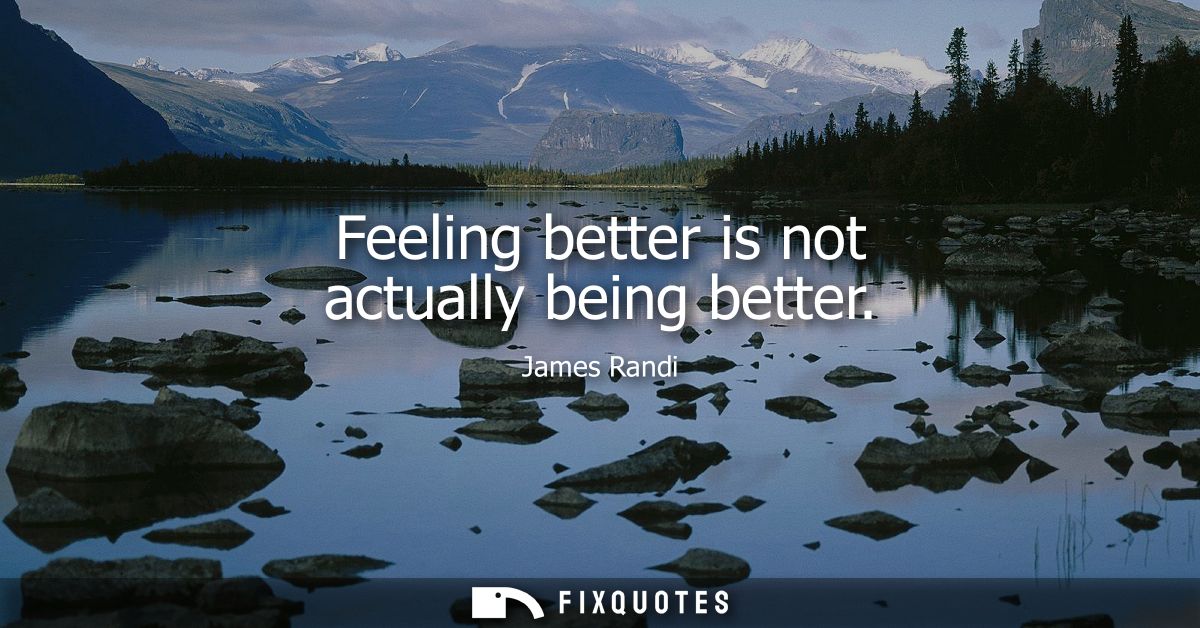
"Feeling better is not actually being better"
About this Quote
James Randi, the magician-turned-skeptic, spent a lifetime showing how easily people mistake a persuasive feeling for a real change. The line draws a bright boundary between subjective relief and objective improvement. People can feel lighter, calmer, or pain-free for a while, yet the underlying condition may be untouched or even worsening. Placebo effects, hopeful expectations, and the natural ebb and flow of symptoms all conspire to create a sense of progress where there may be none.
Randi targeted faith healers, psychic surgeons, and purveyors of miracle cures, not because comfort is unimportant, but because comfort should never be sold as a cure. Anecdotes about dramatic turnarounds overlook regression to the mean, selective memory, and the desire to believe. That is why medicine demands controlled trials, blinding, and measurable endpoints: blood markers, imaging, survival rates, function. The point is not to sneer at relief; it is to separate what soothes from what heals and to label each honestly.
The aphorism also travels beyond medicine. A productivity app can make someone feel organized while work remains undone. A motivational seminar can create a euphoric surge that fades without structural change. Policy can boost confidence indicators while leaving systemic problems intact. In each case, the test is external reality: mechanisms, replicable results, outcomes that endure after the mood passes.
There is ethical nuance here. Palliative care rightly prioritizes comfort, and it should be valued as such. But claims of correction require evidence of correction. Randi’s career in creating illusions equipped him to warn against self-deception: the thrill of a good trick does not alter the physics beneath it. Caring for ourselves and others means combining compassion with rigor, acknowledging how good it feels to feel better while demanding proof when the promise is to be better. That vigilance protects both our health and our ability to know when we have truly improved.
Randi targeted faith healers, psychic surgeons, and purveyors of miracle cures, not because comfort is unimportant, but because comfort should never be sold as a cure. Anecdotes about dramatic turnarounds overlook regression to the mean, selective memory, and the desire to believe. That is why medicine demands controlled trials, blinding, and measurable endpoints: blood markers, imaging, survival rates, function. The point is not to sneer at relief; it is to separate what soothes from what heals and to label each honestly.
The aphorism also travels beyond medicine. A productivity app can make someone feel organized while work remains undone. A motivational seminar can create a euphoric surge that fades without structural change. Policy can boost confidence indicators while leaving systemic problems intact. In each case, the test is external reality: mechanisms, replicable results, outcomes that endure after the mood passes.
There is ethical nuance here. Palliative care rightly prioritizes comfort, and it should be valued as such. But claims of correction require evidence of correction. Randi’s career in creating illusions equipped him to warn against self-deception: the thrill of a good trick does not alter the physics beneath it. Caring for ourselves and others means combining compassion with rigor, acknowledging how good it feels to feel better while demanding proof when the promise is to be better. That vigilance protects both our health and our ability to know when we have truly improved.
Quote Details
| Topic | Truth |
|---|
More Quotes by James
Add to List