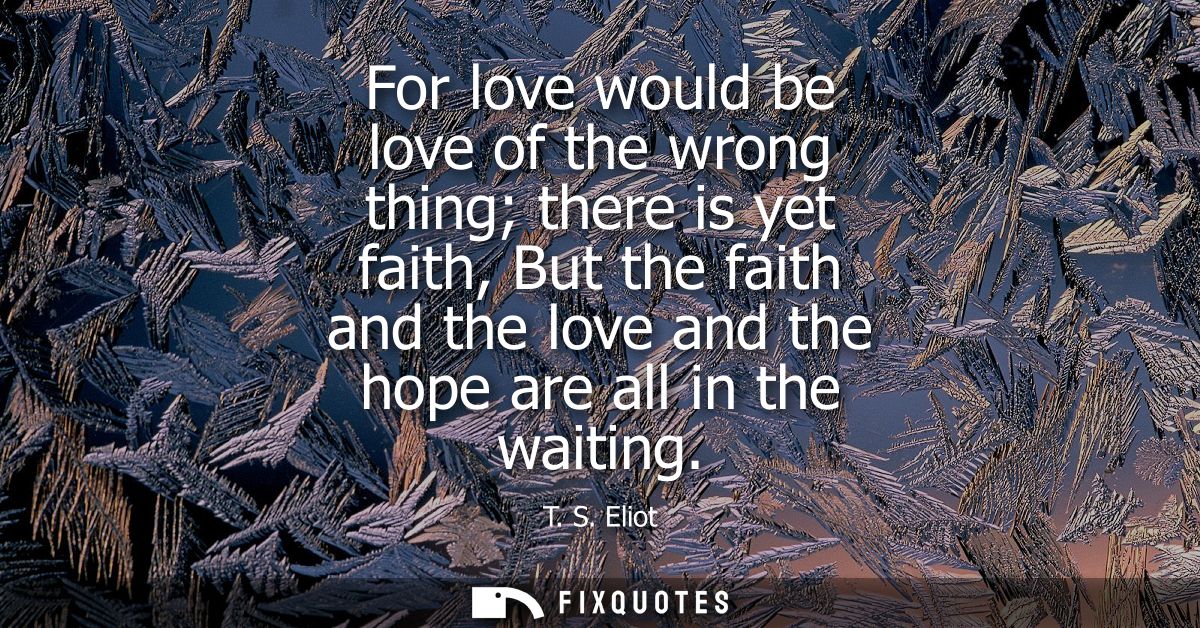
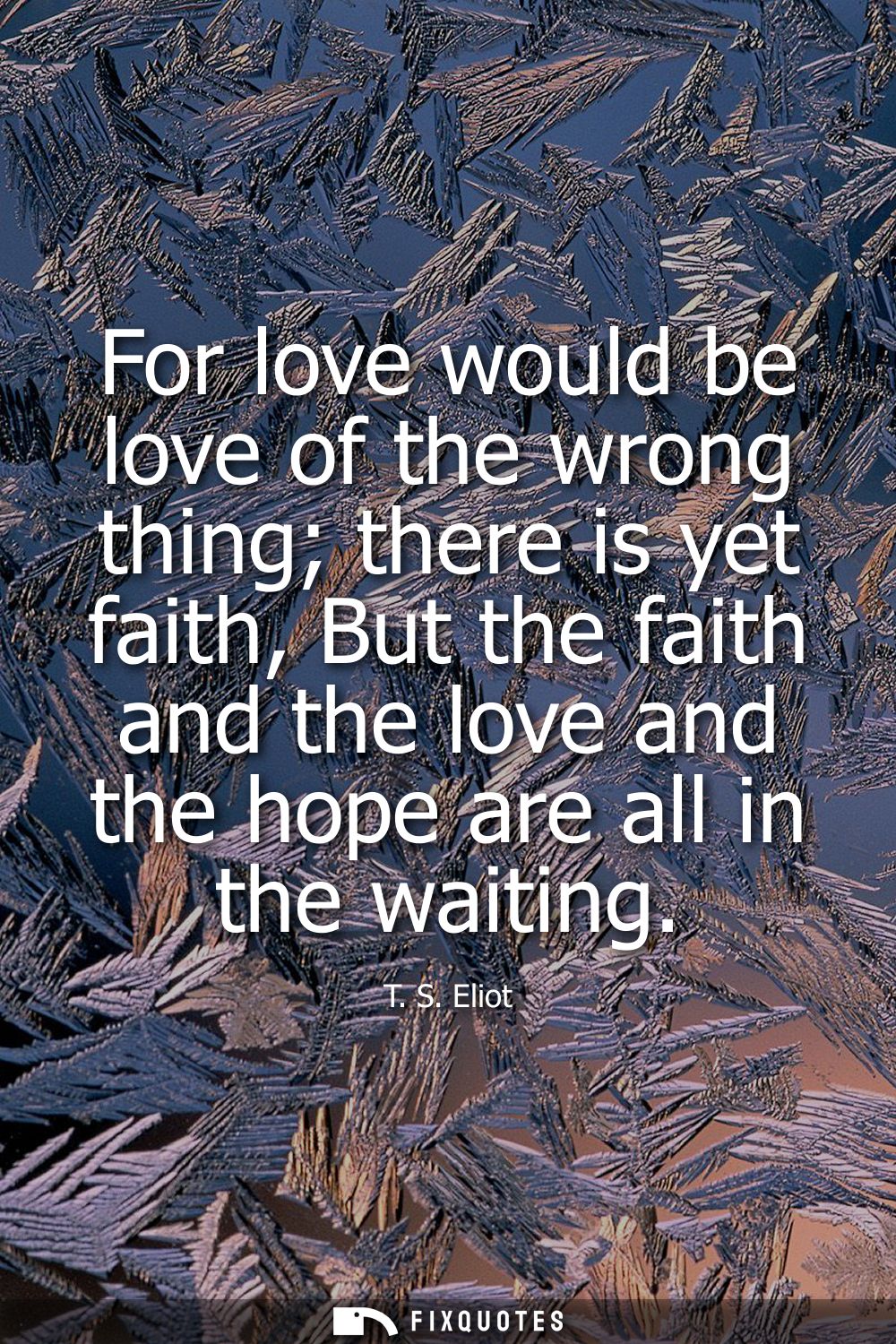
"For love would be love of the wrong thing; there is yet faith, But the faith and the love and the hope are all in the waiting"
About this Quote
Eliot turns the Christian triad on its head, then quietly puts it back together in a way that feels less like doctrine than survival technique. “Love would be love of the wrong thing” is a ruthless admission of misdirected appetite: the self, exhausted by desire, can’t trust its own instincts about what’s worthy. In Eliot’s world, wanting isn’t automatically virtuous; it’s often a form of spiritual bad taste. The line carries his signature suspicion that modern consciousness, drenched in distraction and self-justification, confuses intensity for meaning.
Then comes the pivot: “there is yet faith.” Not triumphantly, not even confidently. “Yet” is doing the heavy lifting, implying scarcity, residue, something salvaged after disappointment. Eliot doesn’t sell belief as ecstasy; he frames it as what remains when the usual objects of devotion (romance, ambition, ideology) have been exposed as inadequate.
The clincher is where he relocates “faith and the love and the hope”: “all in the waiting.” Waiting is not passive here; it’s a disciplined refusal to grab for the nearest counterfeit. It’s abstinence as ethics. In the broader Eliot context (especially the post-conversion poems), this is the hard spirituality of someone who thinks the soul can’t be bullied into clarity. The subtext is bracing: if you can’t love rightly, don’t love loudly. Learn to endure the in-between, because the only honest forms of faith, love, and hope might be the ones that can tolerate silence without immediately trying to fill it.
Then comes the pivot: “there is yet faith.” Not triumphantly, not even confidently. “Yet” is doing the heavy lifting, implying scarcity, residue, something salvaged after disappointment. Eliot doesn’t sell belief as ecstasy; he frames it as what remains when the usual objects of devotion (romance, ambition, ideology) have been exposed as inadequate.
The clincher is where he relocates “faith and the love and the hope”: “all in the waiting.” Waiting is not passive here; it’s a disciplined refusal to grab for the nearest counterfeit. It’s abstinence as ethics. In the broader Eliot context (especially the post-conversion poems), this is the hard spirituality of someone who thinks the soul can’t be bullied into clarity. The subtext is bracing: if you can’t love rightly, don’t love loudly. Learn to endure the in-between, because the only honest forms of faith, love, and hope might be the ones that can tolerate silence without immediately trying to fill it.
Quote Details
| Topic | Faith |
|---|
More Quotes by S. Eliot
Add to List