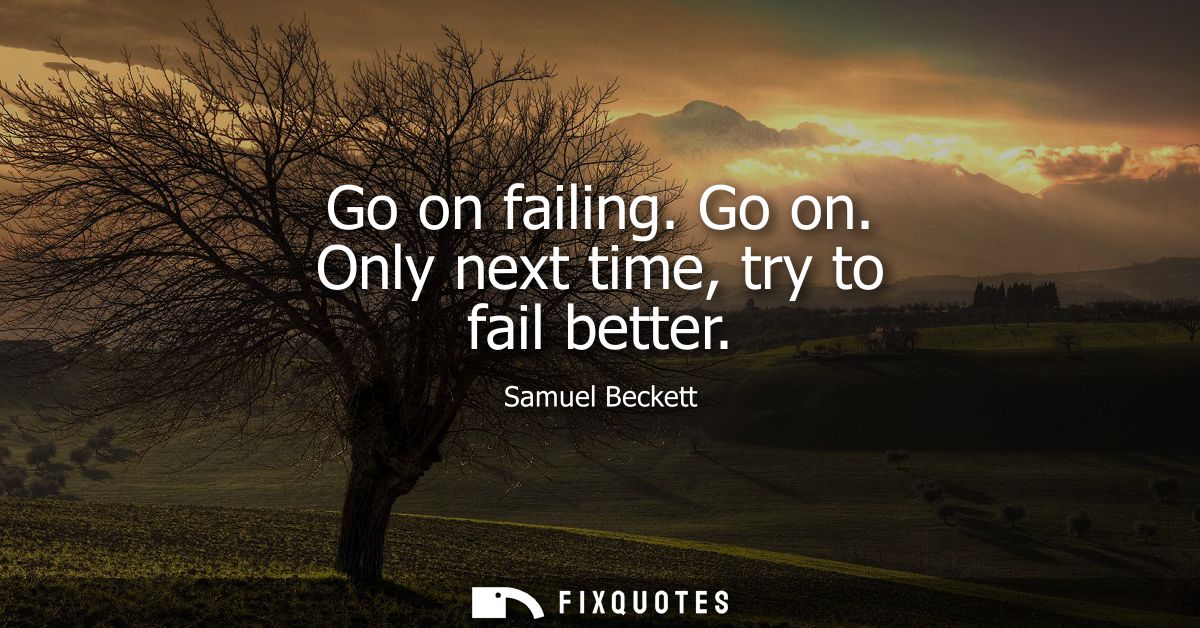
"Go on failing. Go on. Only next time, try to fail better"
About this Quote
Beckett turns failure into a practice, not a verdict. The urging to go on reframes defeat as a rhythm: stumble, rise, and stumble again with a finer attention. The point is not triumph over error but intimacy with it, learning its shape, reducing its waste, finding the smallest increment of lucidity within inevitable limitation. To fail better is to refine the miss: more honest, more exact, less self-deceived.
The line belongs to Beckett’s late aesthetic, where language is pared to bone and repetition becomes a form of knowledge. In Worstward Ho, he writes in staccato imperatives and fragments that enact the very brokenness they diagnose. That cadence is present here: go on, go on, but modulate the fall. It echoes the theater of the absurd that made him famous, where characters circle the same actions and hopes without resolution. Vladimir and Estragon never meet Godot; Hamm and Clov keep playing out the end. Yet the performance itself becomes the meaning: the craft of persistence, the exactness of description, the discipline of staying with the truth of human limits.
Popular culture often turns fail better into a startup slogan, a promise that enough iterations will yield victory. Beckett offers something colder and, paradoxically, more humane. Failure is not a temporary obstacle on the way to success; it is woven into effort, perception, and speech. The improvement sought is ethical and artistic: more precision, less bravado; more attention to what can be said and done, less fantasy about what cannot. There is dignity in refusing the consolations of final success and choosing, instead, the small, stubborn work of trying again more cleanly.
Go on is the hard command. Try to fail better is the soft qualification that makes it bearable: not hope of escape, but the modest freedom of narrowing error, sharpening care, and keeping faith with the work when victory is not on offer.
The line belongs to Beckett’s late aesthetic, where language is pared to bone and repetition becomes a form of knowledge. In Worstward Ho, he writes in staccato imperatives and fragments that enact the very brokenness they diagnose. That cadence is present here: go on, go on, but modulate the fall. It echoes the theater of the absurd that made him famous, where characters circle the same actions and hopes without resolution. Vladimir and Estragon never meet Godot; Hamm and Clov keep playing out the end. Yet the performance itself becomes the meaning: the craft of persistence, the exactness of description, the discipline of staying with the truth of human limits.
Popular culture often turns fail better into a startup slogan, a promise that enough iterations will yield victory. Beckett offers something colder and, paradoxically, more humane. Failure is not a temporary obstacle on the way to success; it is woven into effort, perception, and speech. The improvement sought is ethical and artistic: more precision, less bravado; more attention to what can be said and done, less fantasy about what cannot. There is dignity in refusing the consolations of final success and choosing, instead, the small, stubborn work of trying again more cleanly.
Go on is the hard command. Try to fail better is the soft qualification that makes it bearable: not hope of escape, but the modest freedom of narrowing error, sharpening care, and keeping faith with the work when victory is not on offer.
Quote Details
| Topic | Learning from Mistakes |
|---|
More Quotes by Samuel
Add to List