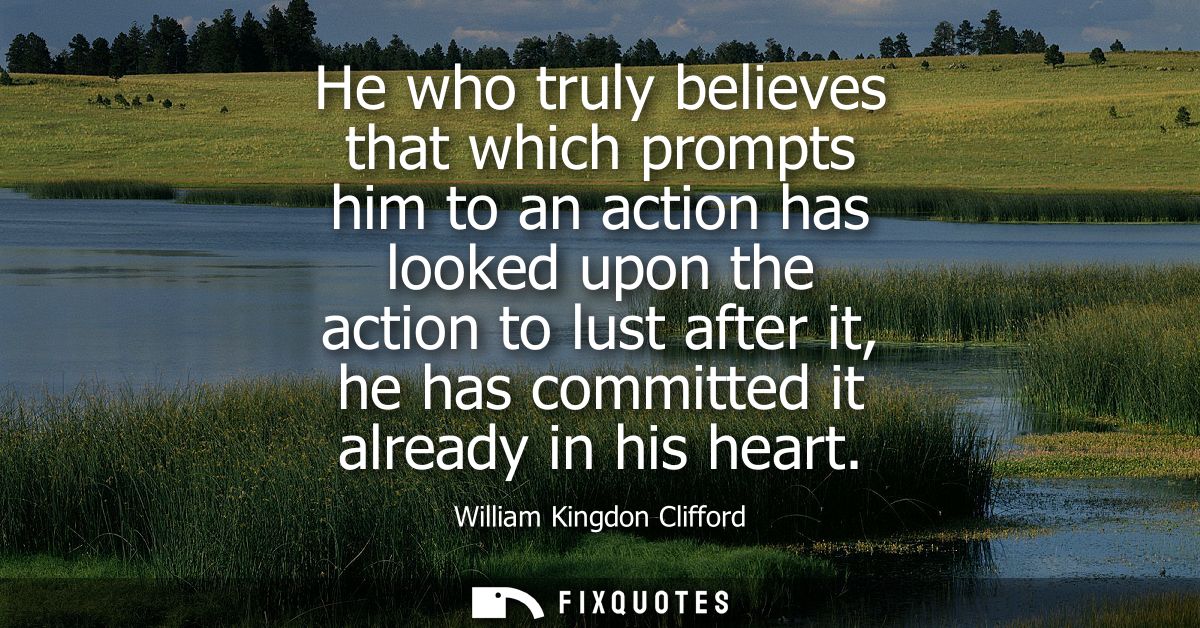
"He who truly believes that which prompts him to an action has looked upon the action to lust after it, he has committed it already in his heart"
About this Quote
Clifford writes like a Victorian moralist who’s been handed a mathematician’s scalpel. The sentence doesn’t merely warn against bad behavior; it relocates wrongdoing to an earlier, quieter place: the moment belief hardens into motive. By the time an action arrives, he implies, the ethical breach has already happened upstream, in the private act of consenting to a belief because it feels good, useful, or exciting.
The phrasing is doing deliberate double-duty. “Truly believes” sounds like a compliment, but in Clifford’s hands it’s an indictment: sincerity isn’t innocence if the belief is serving desire. The line “looked upon the action to lust after it” borrows the cadence of biblical admonition (the famous idea that to look with lust is to commit adultery in the heart), but Clifford secularizes it. He isn’t preaching chastity; he’s prosecuting intellectual temptation. Beliefs can be chosen the way vices are chosen: with appetite, self-justification, and a touch of theatre.
Context matters. Clifford is the author of “The Ethics of Belief,” written in an era when science, religion, and empire were locked in a contest over who got to define truth. His core claim is that believing on insufficient evidence is not a private quirk but a moral hazard: it shapes actions, spreads socially, and trains the mind to prefer comfort over rigor. The subtext is mercilessly modern: if you let desire write your convictions, you don’t just risk doing harm. You’re already practicing it.
The phrasing is doing deliberate double-duty. “Truly believes” sounds like a compliment, but in Clifford’s hands it’s an indictment: sincerity isn’t innocence if the belief is serving desire. The line “looked upon the action to lust after it” borrows the cadence of biblical admonition (the famous idea that to look with lust is to commit adultery in the heart), but Clifford secularizes it. He isn’t preaching chastity; he’s prosecuting intellectual temptation. Beliefs can be chosen the way vices are chosen: with appetite, self-justification, and a touch of theatre.
Context matters. Clifford is the author of “The Ethics of Belief,” written in an era when science, religion, and empire were locked in a contest over who got to define truth. His core claim is that believing on insufficient evidence is not a private quirk but a moral hazard: it shapes actions, spreads socially, and trains the mind to prefer comfort over rigor. The subtext is mercilessly modern: if you let desire write your convictions, you don’t just risk doing harm. You’re already practicing it.
Quote Details
| Topic | Ethics & Morality |
|---|
More Quotes by William
Add to List