
Kahlil Gibran Biography Quotes 90 Report mistakes
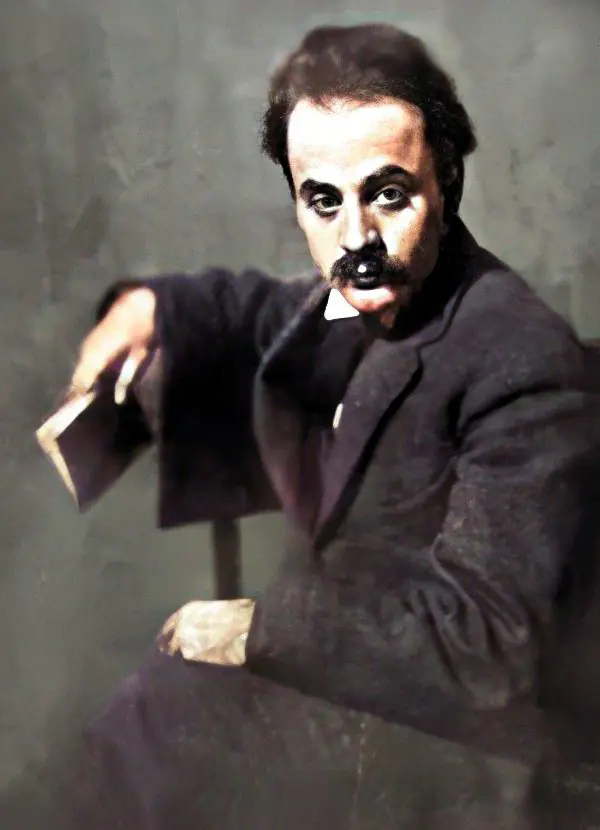
| 90 Quotes | |
| Born as | Gubran Khalil Gubran |
| Occup. | Poet |
| From | Lebanon |
| Born | January 6, 1883 Bsharri, Mount Lebanon Mutasarrifate, Ottoman Syria |
| Died | April 10, 1931 New York City, U.S. |
| Cause | Tuberculosis |
| Aged | 48 years |
Gubran Khalil Gubran was born on 1883-01-06 in Bsharri, a Maronite Christian town in Ottoman Mount Lebanon, a landscape of monasteries, cedars, and hard tenancy that trained the imagination on both beauty and deprivation. His father, Khalil, drifted through unstable work and debt; local accounts describe a household where precariousness was ordinary, and where the young Gibran learned early to read authority with skepticism. The collapse of his family fortunes and the pressures of Ottoman administration formed the first contour of his later moral voice: tenderness for the vulnerable paired with impatience for coercion.
In 1895 his mother, Kamila Rahmeh, emigrated with her children to Boston, settling in the Syrian-Lebanese quarter of the South End. Renamed "Kahlil Gibran" in school records, he moved between immigrant tenements and the citys institutions, absorbing the doubleness of exile - Arabic intimacy at home, American modernity outside. His early drawings, discovered by photographer and arts patron Fred Holland Day, already fused icon-like faces with fin-de-siècle symbolism, suggesting a child trying to translate homesickness into image and myth.
Education and Formative Influences
Gibran received limited formal schooling in Boston, but his education was accelerated by patrons and by the immigrant press; in 1898 he was sent back to Lebanon to study Arabic at al-Hikma (La Sagesse) in Beirut, where he read classical Arabic literature and began writing. Returning to Boston in 1902, he was struck by successive deaths - his sister Sultana, half-brother Peter, and mother - losses that deepened his fixation on grief as a portal rather than an endpoint. In 1904 his first Boston art exhibition opened; by 1908-1910, funded by Mary Haskell, he studied art in Paris, encountering Rodin, Symbolism, and the cosmopolitanism that would later let him write for both Arabic and English audiences.
Career, Major Works, and Turning Points
Gibran settled in New York in 1911, joining a circle of Arab American writers and reformers and helping found al-Rabita al-Qalamiyya (the Pen League) with figures such as Ameen Rihani and Mikhail Naimy. He published in Arabic and English, moving from romantic-prophetic prose toward a distilled parable style: The Madman (1918) announced his English voice; The Forerunner (1920) and Sand and Foam (1926) refined it into aphorism; Jesus, the Son of Man (1928) reimagined sacred biography through multiple witnesses. The pivotal work, The Prophet (1923), grew slowly from his long correspondence with Haskell and his private ambition to create a book that could function like scripture without becoming a church. By the late 1920s tuberculosis and alcoholism worsened; he died in New York on 1931-04-10 of cirrhosis and tuberculosis, and was reinterred in Bsharri, where his hermitage-like museum still frames him as both native son and wandering seer.
Philosophy, Style, and Themes
Gibrans inner life reads as a continual negotiation between intimacy and distance: he craved belonging yet guarded his autonomy, turning personal longing into universal address. His work insists that time is not merely chronology but a moral instrument that can either imprison or liberate: "Yesterday is but today's memory, and tomorrow is today's dream". The sentence is more than consolation; it reveals his psychology of survival, a mind trained by exile and bereavement to relocate meaning from what is lost to what can still be imagined. His speakers rarely argue; they bless, warn, and unveil, as if persuasion were secondary to awakening.
Stylistically he blended Arabic rhetorical cadences, Biblical parallelism, and modernist compression, arriving at a voice that feels ancient even when it speaks to contemporary dilemmas of marriage, freedom, and power. The moral tension in his writing is often volcanic - a fear that unmastered passion will scorch whatever it touches: "If your heart is a volcano, how shall you expect flowers to bloom?" Yet he was no ascetic; he treated love as both surrender and self-respect, skeptical of possession and sentimental coercion: "If you love somebody, let them go, for if they return, they were always yours. And if they don't, they never were". In those lines the romantic becomes ethical - a refusal to turn attachment into ownership - mirroring his own guardedness in relationships and his belief that the soul grows by release.
Legacy and Influence
Gibran became one of the most widely read poets of the 20th century, a rare Arab diasporic writer whose English work entered global popular culture while his Arabic prose helped push al-Nahda (the Arab literary renaissance) toward a freer, more personal idiom. The Prophet in particular traveled across religions and movements - quoted at weddings, funerals, and political gatherings - because it offered a vocabulary of spiritual humanism without sectarian demands. His influence persists in contemporary Arabic letters, immigrant memoir, and the modern genre of inspirational aphorism, but also in a durable model of the artist as bridge: a Lebanese-born Ottoman subject turned American writer who made exile sound like a homeland of the mind.
Our collection contains 90 quotes who is written by Kahlil, under the main topics: Motivational - Ethics & Morality - Wisdom - Truth - Justice.
Kahlil Gibran Famous Works
- 1933 The Garden of the Prophet (Book)
- 1931 The Earth Gods (Book)
- 1928 Jesus, the Son of Man (Book)
- 1923 The Prophet (Book)
- 1914 A Tear and a Smile (Book)
- 1912 Broken Wings (Book)
- 1908 Spirits Rebellious (Book)
Source / external links