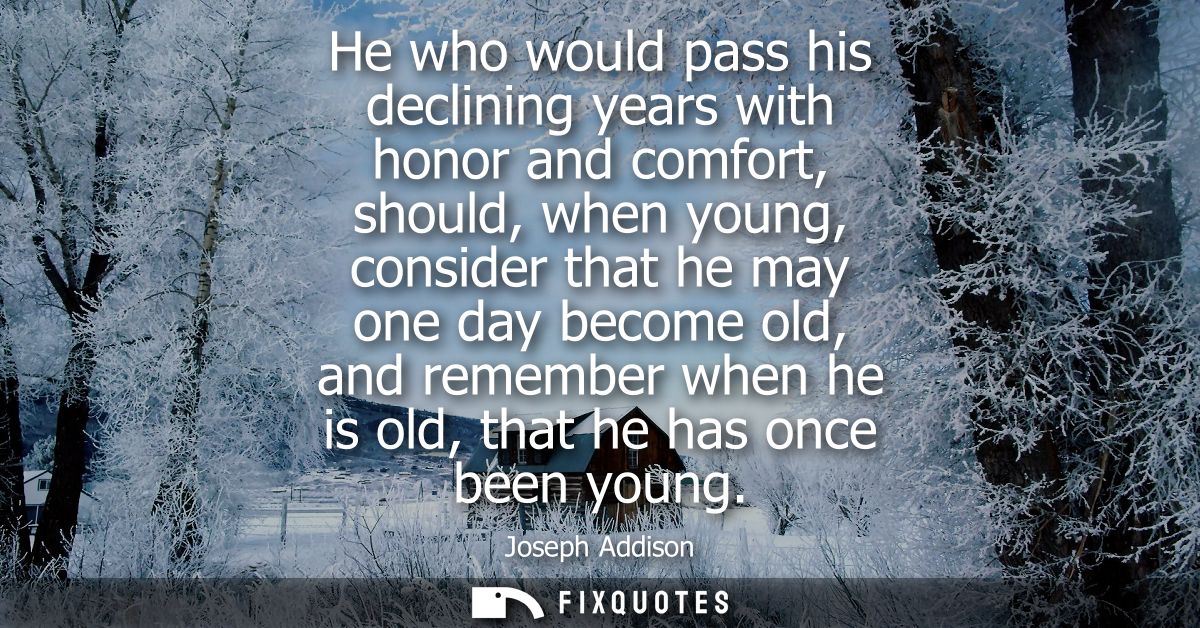
"He who would pass his declining years with honor and comfort, should, when young, consider that he may one day become old, and remember when he is old, that he has once been young"
About this Quote
Addison is selling a small moral time machine: borrow empathy from your future self, then repay it with gratitude when you get there. The line works because it refuses the common bargain youth makes with time, the one where aging is treated as a distant country with no visa requirements. Instead, he frames youth and old age as two versions of the same person in continuous negotiation. Honor and comfort aren’t presented as rewards for virtue; they’re the dividends of foresight and memory, earned by refusing to live as if you’ll never change.
The syntax is a neat two-step: when young, “consider” you’ll be old; when old, “remember” you were young. Those verbs matter. Consider is planning, discipline, investment. Remember is mercy, perspective, restraint. Addison isn’t just preaching thrift or stoicism; he’s proposing a psychological hack against cruelty and panic. Youth, thinking itself permanent, can be careless with the body, with money, with relationships, with reputation. Old age, forgetting its own earlier hunger and vanity, can become bitter, judgmental, or frightened. The subtext is social as much as personal: a culture that segregates the young and old breeds mutual contempt. A culture that keeps the timeline visible creates civility.
Contextually, this is early 18th-century essayist Addison: polished, didactic, aimed at the rising middle-class reader learning “character” as a kind of public performance. He’s not romanticizing age. He’s advising how to avoid being haunted by your earlier self: plan so you can age with dignity, and remember so you can age without spite.
The syntax is a neat two-step: when young, “consider” you’ll be old; when old, “remember” you were young. Those verbs matter. Consider is planning, discipline, investment. Remember is mercy, perspective, restraint. Addison isn’t just preaching thrift or stoicism; he’s proposing a psychological hack against cruelty and panic. Youth, thinking itself permanent, can be careless with the body, with money, with relationships, with reputation. Old age, forgetting its own earlier hunger and vanity, can become bitter, judgmental, or frightened. The subtext is social as much as personal: a culture that segregates the young and old breeds mutual contempt. A culture that keeps the timeline visible creates civility.
Contextually, this is early 18th-century essayist Addison: polished, didactic, aimed at the rising middle-class reader learning “character” as a kind of public performance. He’s not romanticizing age. He’s advising how to avoid being haunted by your earlier self: plan so you can age with dignity, and remember so you can age without spite.
Quote Details
| Topic | Aging |
|---|
More Quotes by Joseph
Add to List