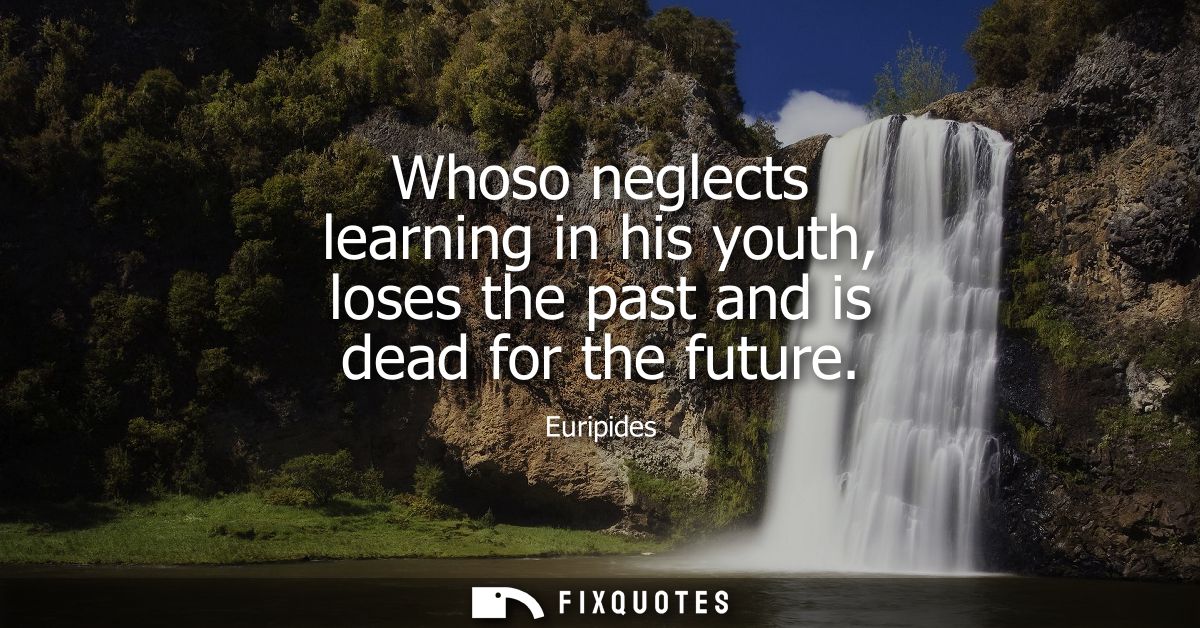
"Whoso neglects learning in his youth, loses the past and is dead for the future"
About this Quote
Euripides lands the blow with legal severity: neglect learning early and you don’t merely miss opportunities, you forfeit time itself. The line splits your life into two ruined territories. “Loses the past” is the sting people skim past. In a culture where education meant absorbing Homer, myth, civic memory, and the hard-won patterns of human behavior, the “past” wasn’t nostalgia; it was a toolbox and a credential. Without it, you’re cut off from the shared references that let you argue in the assembly, persuade a jury, or even understand what the city thinks it is.
Then comes the more chilling clause: “dead for the future.” Euripides isn’t talking about literal death. He’s describing social and political irrelevance, a living person unable to project themselves forward through judgment, craft, and foresight. Greek tragedy is full of characters who act blindly, repeating ancestral mistakes while believing they’re inventing something new. The quote reads like a diagnosis of that tragic loop: ignorance severs continuity, and severed continuity produces fate.
The subtext is also a critique of youthful arrogance. Youth imagines it can start clean; Euripides insists you can’t. You either inherit the past consciously through learning, or you inherit it unconsciously through consequences. The aphorism works because it frames education not as self-improvement but as survival inside history: fail to learn early, and you become a stranger to your own civilization, drifting without memory and without leverage.
Then comes the more chilling clause: “dead for the future.” Euripides isn’t talking about literal death. He’s describing social and political irrelevance, a living person unable to project themselves forward through judgment, craft, and foresight. Greek tragedy is full of characters who act blindly, repeating ancestral mistakes while believing they’re inventing something new. The quote reads like a diagnosis of that tragic loop: ignorance severs continuity, and severed continuity produces fate.
The subtext is also a critique of youthful arrogance. Youth imagines it can start clean; Euripides insists you can’t. You either inherit the past consciously through learning, or you inherit it unconsciously through consequences. The aphorism works because it frames education not as self-improvement but as survival inside history: fail to learn early, and you become a stranger to your own civilization, drifting without memory and without leverage.
Quote Details
| Topic | Learning |
|---|---|
| Source | Help us find the source |
More Quotes by Euripides
Add to List