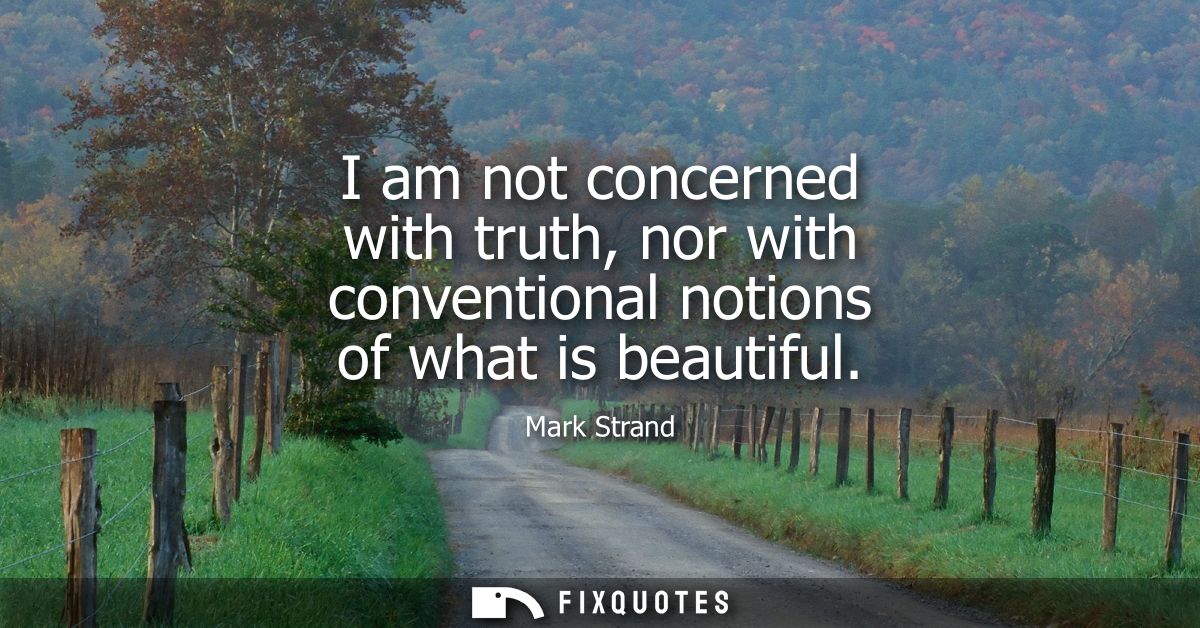
"I am not concerned with truth, nor with conventional notions of what is beautiful"
About this Quote
Mark Strand dismisses fact and prettiness as the primary aims of art to make room for something more elusive: the felt reality a poem creates. Rather than verifying the world or decorating it, his poems stage a kind of presence, an atmosphere in which the reader senses meaning without being handed a proposition. Truth, for him, is not a reportable accuracy but the truth of sensation, strangeness, and recognition; beauty is not symmetry or gracefulness but the arresting clarity that emerges when ordinary appearances are stripped to their metaphysical bones.
This stance aligns with his lifelong attraction to dream logic, restraint, and the aesthetics of absence. Strand often builds poems around vacancy, silence, and the self that slips out of view. The speaker who is the absence of field is emblematic: a figure defined by what is missing rather than by what can be itemized as factual. Such an approach resists confession and argument. It favors negative capability, the capacity to dwell in uncertainty and let the poem discover its own necessity.
Strand’s background as a painter and art critic reinforces the rejection of conventional beauty. He admired artists like Morandi and de Chirico, whose stillness and metaphysical hush turn the ordinary into an aperture of mystery. In a similar way, his spare diction and luminous surfaces invite attention not to ornament but to the pressure of the unsaid. The poem becomes an object that organizes feeling, a place to inhabit rather than a lesson to learn.
As a poet laureate and Pulitzer Prize winner, he often insisted that poems are made things, not vessels for doctrine. By refusing both factual truth and received beauty, he frees the poem to invent its own laws, to be exact in its music and brave in its silence. The result is a literature of presence: lucid, haunted, and transformative.
This stance aligns with his lifelong attraction to dream logic, restraint, and the aesthetics of absence. Strand often builds poems around vacancy, silence, and the self that slips out of view. The speaker who is the absence of field is emblematic: a figure defined by what is missing rather than by what can be itemized as factual. Such an approach resists confession and argument. It favors negative capability, the capacity to dwell in uncertainty and let the poem discover its own necessity.
Strand’s background as a painter and art critic reinforces the rejection of conventional beauty. He admired artists like Morandi and de Chirico, whose stillness and metaphysical hush turn the ordinary into an aperture of mystery. In a similar way, his spare diction and luminous surfaces invite attention not to ornament but to the pressure of the unsaid. The poem becomes an object that organizes feeling, a place to inhabit rather than a lesson to learn.
As a poet laureate and Pulitzer Prize winner, he often insisted that poems are made things, not vessels for doctrine. By refusing both factual truth and received beauty, he frees the poem to invent its own laws, to be exact in its music and brave in its silence. The result is a literature of presence: lucid, haunted, and transformative.
Quote Details
| Topic | Poetry |
|---|
More Quotes by Mark
Add to List