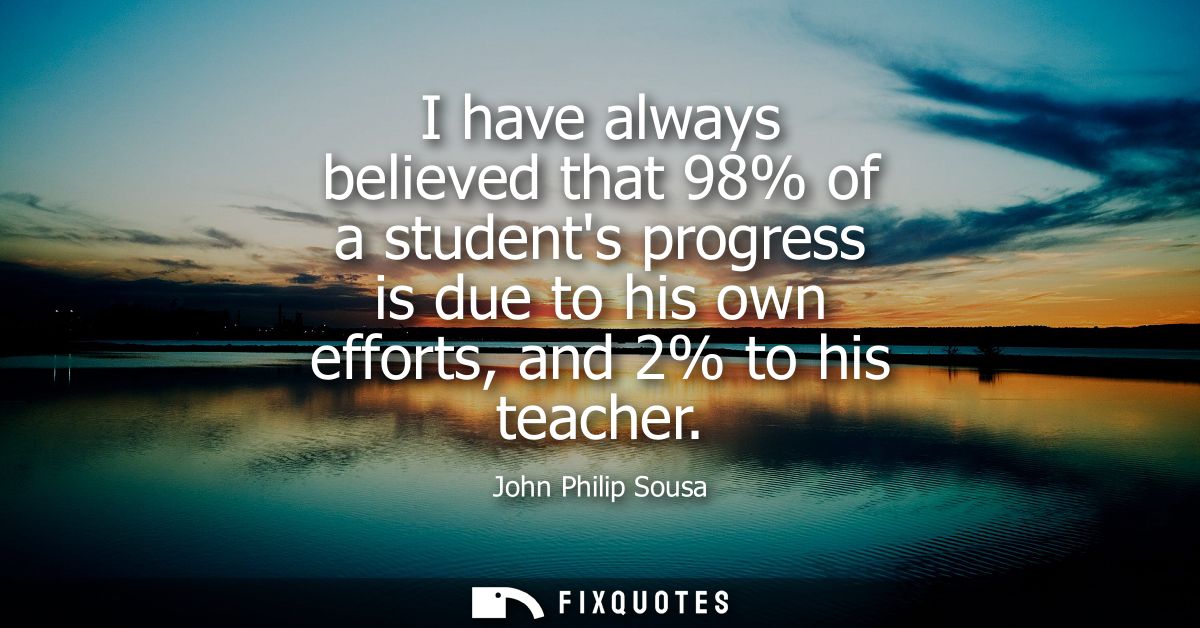
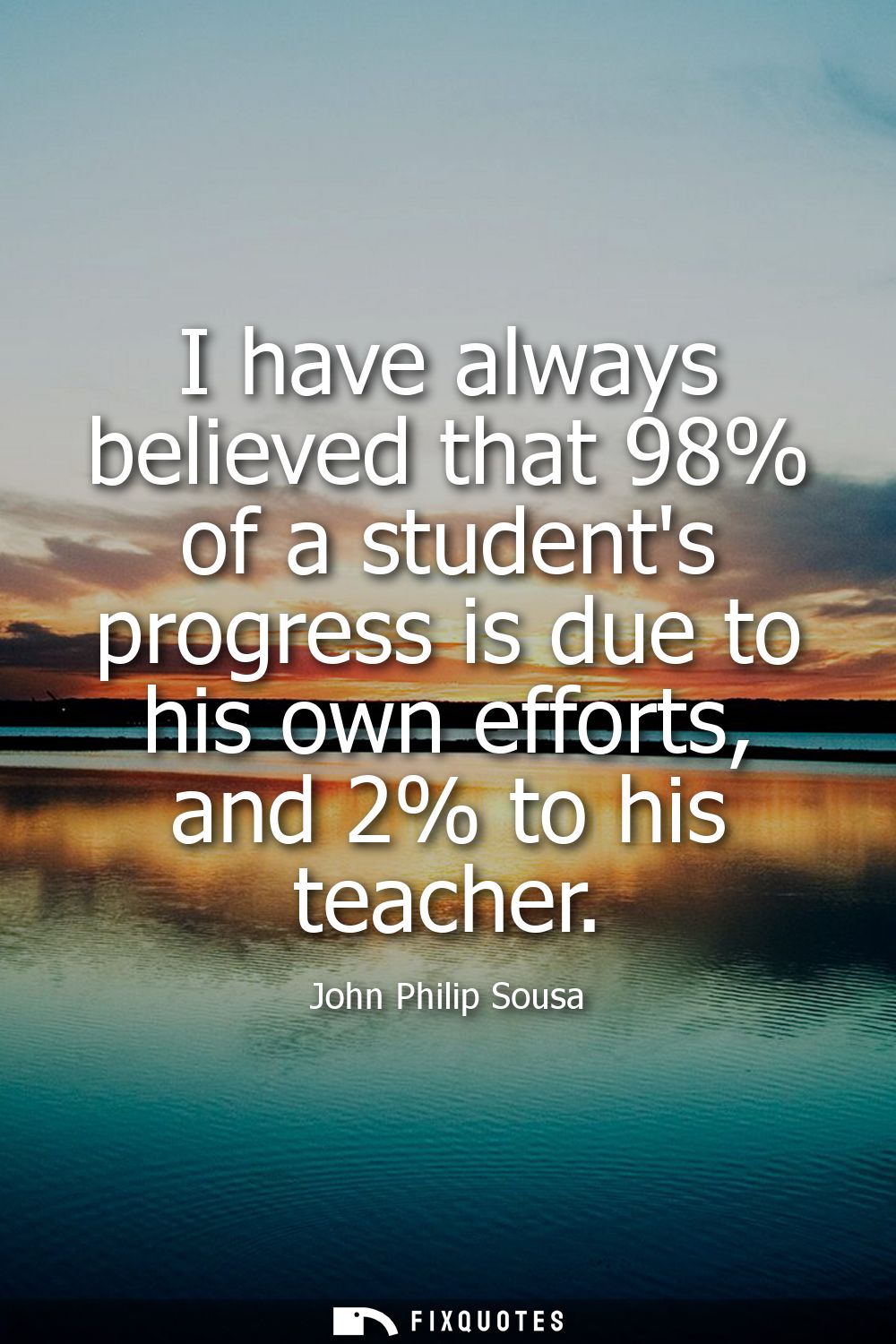
"I have always believed that 98% of a student's progress is due to his own efforts, and 2% to his teacher"
About this Quote
Sousa assigns near-total responsibility for learning to the learner. Coming from the March King, a bandleader who drilled ensembles to razor precision, the emphasis on self-discipline and steady practice fits his world. He led the U.S. Marine Band and the Sousa Band, demanded punctuality, uniformity, and endurance on tour, and believed that musical excellence grows from hours of focused work more than from flashes of inspiration. The 98 to 2 ratio is a pointed exaggeration to shake students out of passivity: no teacher can log your practice, strengthen your embouchure, or train your ear. Only you can.
The timing also reflects American ideals Sousa shared. Turn-of-the-century culture prized self-reliance and industriousness. Sousa wrote against the passivity encouraged by mechanical music, warning that listening without doing atrophies musical muscles. Progress, to him, meant learning by doing: scales repeated, rhythms internalized, breath controlled, phrasing refined. A teacher can show how, correct a hand position, assign repertoire, and model tone, but improvement crystallizes only when the student wrestles with the instrument between lessons.
The 2 percent is not contempt for teachers but a precise description of their catalytic role. A great teacher sets standards, designs challenges, gives accurate feedback, and lights a spark that sustains the lonely work. That spark can change a life, yet it does not substitute for the daily grind. The ratio also guards against blame-shifting: if progress stalls, the first place to look is practice habits, not pedagogy.
Modern learning science echoes Sousa. Deliberate practice, metacognition, and intrinsic motivation predict growth across domains. A teacher structures and guides that process, but ownership is the engine. Sousa reminds students to claim that engine, to treat lessons as launch pads, and to measure success in the quiet, consistent hours when nobody else is listening.
The timing also reflects American ideals Sousa shared. Turn-of-the-century culture prized self-reliance and industriousness. Sousa wrote against the passivity encouraged by mechanical music, warning that listening without doing atrophies musical muscles. Progress, to him, meant learning by doing: scales repeated, rhythms internalized, breath controlled, phrasing refined. A teacher can show how, correct a hand position, assign repertoire, and model tone, but improvement crystallizes only when the student wrestles with the instrument between lessons.
The 2 percent is not contempt for teachers but a precise description of their catalytic role. A great teacher sets standards, designs challenges, gives accurate feedback, and lights a spark that sustains the lonely work. That spark can change a life, yet it does not substitute for the daily grind. The ratio also guards against blame-shifting: if progress stalls, the first place to look is practice habits, not pedagogy.
Modern learning science echoes Sousa. Deliberate practice, metacognition, and intrinsic motivation predict growth across domains. A teacher structures and guides that process, but ownership is the engine. Sousa reminds students to claim that engine, to treat lessons as launch pads, and to measure success in the quiet, consistent hours when nobody else is listening.
Quote Details
| Topic | Student |
|---|
More Quotes by John
Add to List