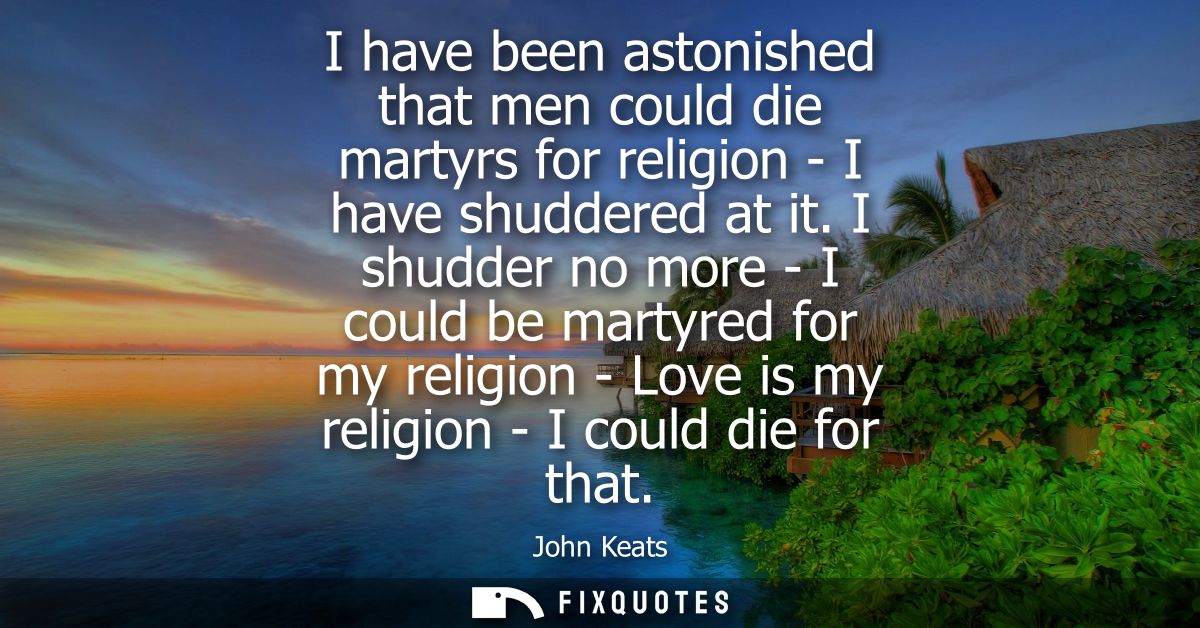
"I have been astonished that men could die martyrs for religion - I have shuddered at it. I shudder no more - I could be martyred for my religion - Love is my religion - I could die for that"
About this Quote
Keats takes the most extreme form of conviction - martyrdom - and drags it out of the church into the body. The opening note is almost anthropological: he has watched men die for religion and found it grotesque, the way a sensitive observer recoils from an idea that turns flesh into evidence. Then the pivot lands with a poet's sleight of hand. He "shudder[s] no more" not because he's become harder, but because he's found a devotion that feels truer than doctrine: love, not as a polite sentiment, but as an animating force worth staking a life on.
The subtext is half-romantic, half-heretical. Keats isn't dismissing religion so much as exposing what makes it persuasive: the promise of total meaning. By declaring "Love is my religion", he borrows religion's language of absolutes while refusing its institutions. It's a private creed, experiential rather than administered, and that matters for a writer who distrusted systems that flatten sensation. The line also performs a kind of self-mythologizing. Keats, chronically ill and living in an era when early death was common, knew the vocabulary of sacrifice wasn't metaphorical. He writes from a culture saturated with Christian martyr narratives and from a personal life moving toward Fanny Brawne and away from any stable future.
What makes the passage work is its escalation: astonishment, shudder, release, vow. It reenacts conversion while swapping the object of worship. Keats frames love as the one faith that doesn't ask you to deny the world; it asks you to feel it so intensely you're willing to pay the ultimate price.
The subtext is half-romantic, half-heretical. Keats isn't dismissing religion so much as exposing what makes it persuasive: the promise of total meaning. By declaring "Love is my religion", he borrows religion's language of absolutes while refusing its institutions. It's a private creed, experiential rather than administered, and that matters for a writer who distrusted systems that flatten sensation. The line also performs a kind of self-mythologizing. Keats, chronically ill and living in an era when early death was common, knew the vocabulary of sacrifice wasn't metaphorical. He writes from a culture saturated with Christian martyr narratives and from a personal life moving toward Fanny Brawne and away from any stable future.
What makes the passage work is its escalation: astonishment, shudder, release, vow. It reenacts conversion while swapping the object of worship. Keats frames love as the one faith that doesn't ask you to deny the world; it asks you to feel it so intensely you're willing to pay the ultimate price.
Quote Details
| Topic | Love |
|---|---|
| Source | Help us find the source |
More Quotes by John
Add to List