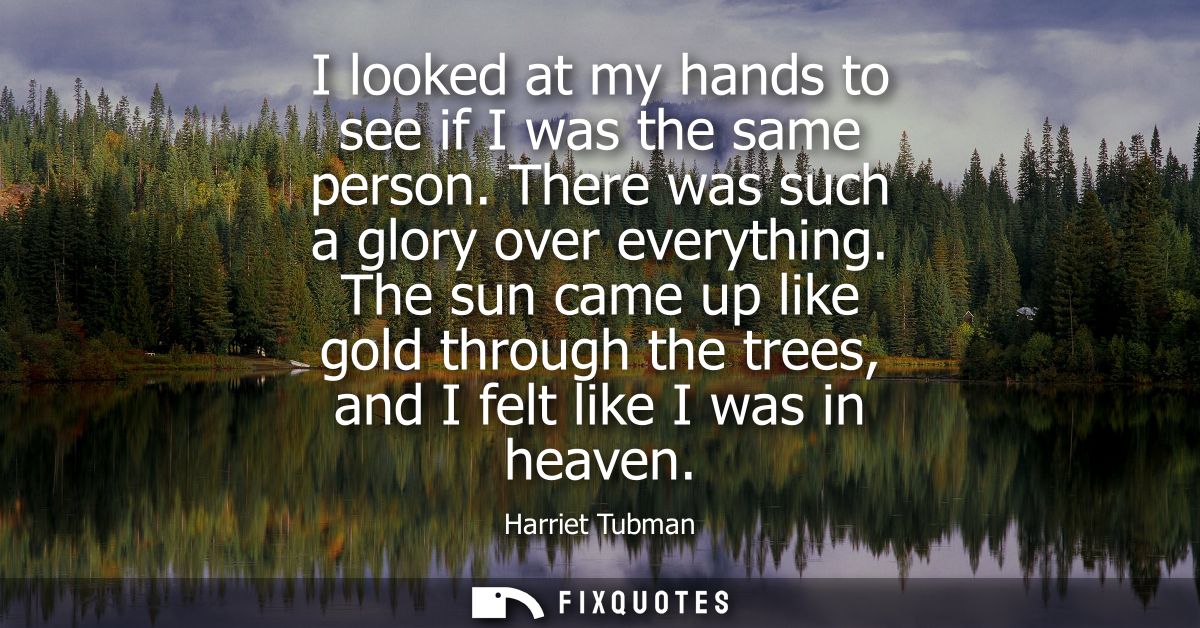
"I looked at my hands to see if I was the same person. There was such a glory over everything. The sun came up like gold through the trees, and I felt like I was in heaven"
About this Quote
Tubman turns liberation into something tactile: she checks her own hands, as if freedom might have altered the body itself. The gesture is quietly radical. Enslavement wasn’t only forced labor; it was a system designed to steal self-recognition, to make a person doubt their own personhood. So the first impulse after crossing into freedom isn’t a speech, or even a plan, but a verification. Am I still me? Or did I become someone else in the act of escaping?
Then she floods the scene with radiance. “Glory” isn’t decorative language; it’s a psychological counterweight to a life engineered for deprivation. The natural world becomes a witness that refuses the slave system’s definitions. The sun “like gold through the trees” reads as more than pretty imagery: it reframes value. Under slavery, Black bodies were treated as capital; here, gold is reassigned to light, to atmosphere, to a morning that belongs to nobody. It’s an economy of perception replacing an economy of ownership.
“I felt like I was in heaven” can sound like simple relief until you remember the stakes: Tubman lived in a culture where religion was used to discipline the enslaved, promising reward later while demanding submission now. Her line steals that language back. Heaven isn’t deferred; it’s briefly experienced on earth, in motion, under threat, at sunrise. The subtext is defiant: freedom is not abstract. It’s sensory, immediate, and so overwhelming it makes the self feel newly minted.
Then she floods the scene with radiance. “Glory” isn’t decorative language; it’s a psychological counterweight to a life engineered for deprivation. The natural world becomes a witness that refuses the slave system’s definitions. The sun “like gold through the trees” reads as more than pretty imagery: it reframes value. Under slavery, Black bodies were treated as capital; here, gold is reassigned to light, to atmosphere, to a morning that belongs to nobody. It’s an economy of perception replacing an economy of ownership.
“I felt like I was in heaven” can sound like simple relief until you remember the stakes: Tubman lived in a culture where religion was used to discipline the enslaved, promising reward later while demanding submission now. Her line steals that language back. Heaven isn’t deferred; it’s briefly experienced on earth, in motion, under threat, at sunrise. The subtext is defiant: freedom is not abstract. It’s sensory, immediate, and so overwhelming it makes the self feel newly minted.
Quote Details
| Topic | Faith |
|---|
More Quotes by Harriet
Add to List