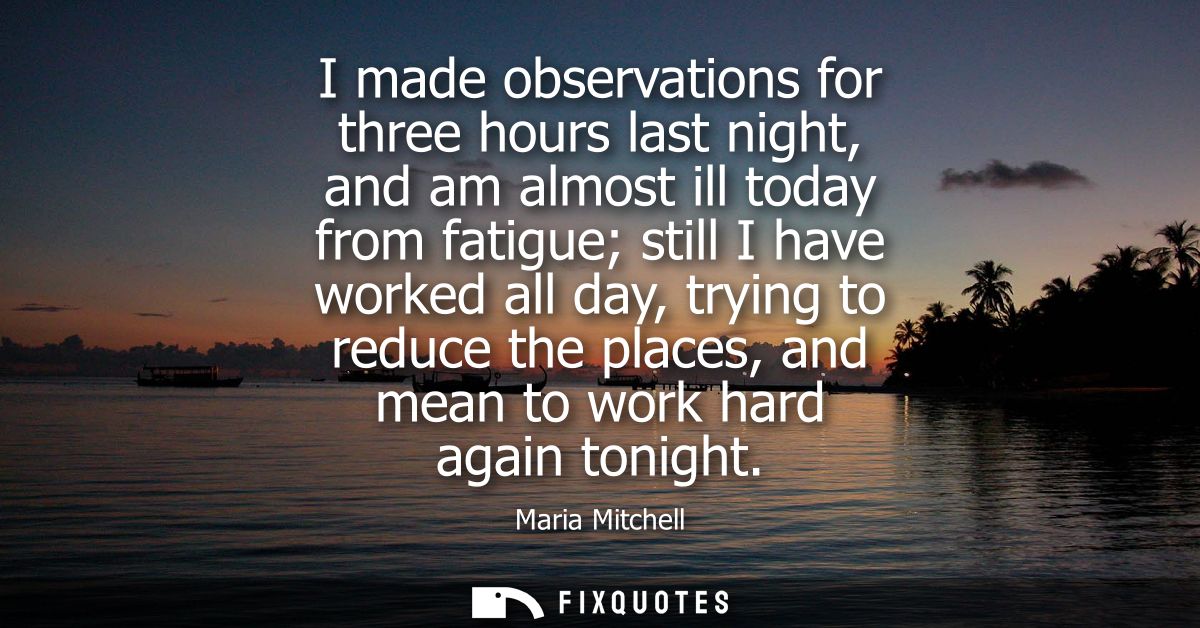
"I made observations for three hours last night, and am almost ill today from fatigue; still I have worked all day, trying to reduce the places, and mean to work hard again tonight"
About this Quote
Exhaustion sits in this line like a second gravity: it pulls on every clause, bending Maria Mitchells sentence into a quiet record of endurance. Three hours at the telescope is not just time spent; its night work, cold work, eyes-straining work, followed immediately by the second shift: reducing the places, the painstaking calculations that turn scattered points of light into usable knowledge. The phrase "almost ill" refuses the romantic myth of the serene stargazer. Science here is bodily, costly, and unapologetically repetitive.
Mitchell also slips in a subversive declaration of legitimacy. A 19th-century woman describing her labor in this register is doing more than keeping a diary; shes marking territory in a world that often treated womens intellectual ambition as an ornament, not a vocation. The matter-of-fact "still I have worked all day" reads like a rebuttal to anticipated doubt, the kind that hovers around anyone whose right to be there is questioned. Fatigue becomes proof of seriousness.
"Trying to reduce the places" carries another undertone: the tension between the awe of astronomy and the administrative grind required to make discovery publishable and credible. Mitchells intent is practical and disciplined, but the context gives it bite. The sentence is a self-portrait of scientific life before automation, before institutional support was evenly distributed: a lone worker insisting, in plain language, that the cosmos doesnt yield to inspiration. It yields to staying up again tonight.
Mitchell also slips in a subversive declaration of legitimacy. A 19th-century woman describing her labor in this register is doing more than keeping a diary; shes marking territory in a world that often treated womens intellectual ambition as an ornament, not a vocation. The matter-of-fact "still I have worked all day" reads like a rebuttal to anticipated doubt, the kind that hovers around anyone whose right to be there is questioned. Fatigue becomes proof of seriousness.
"Trying to reduce the places" carries another undertone: the tension between the awe of astronomy and the administrative grind required to make discovery publishable and credible. Mitchells intent is practical and disciplined, but the context gives it bite. The sentence is a self-portrait of scientific life before automation, before institutional support was evenly distributed: a lone worker insisting, in plain language, that the cosmos doesnt yield to inspiration. It yields to staying up again tonight.
Quote Details
| Topic | Work Ethic |
|---|
More Quotes by Maria
Add to List