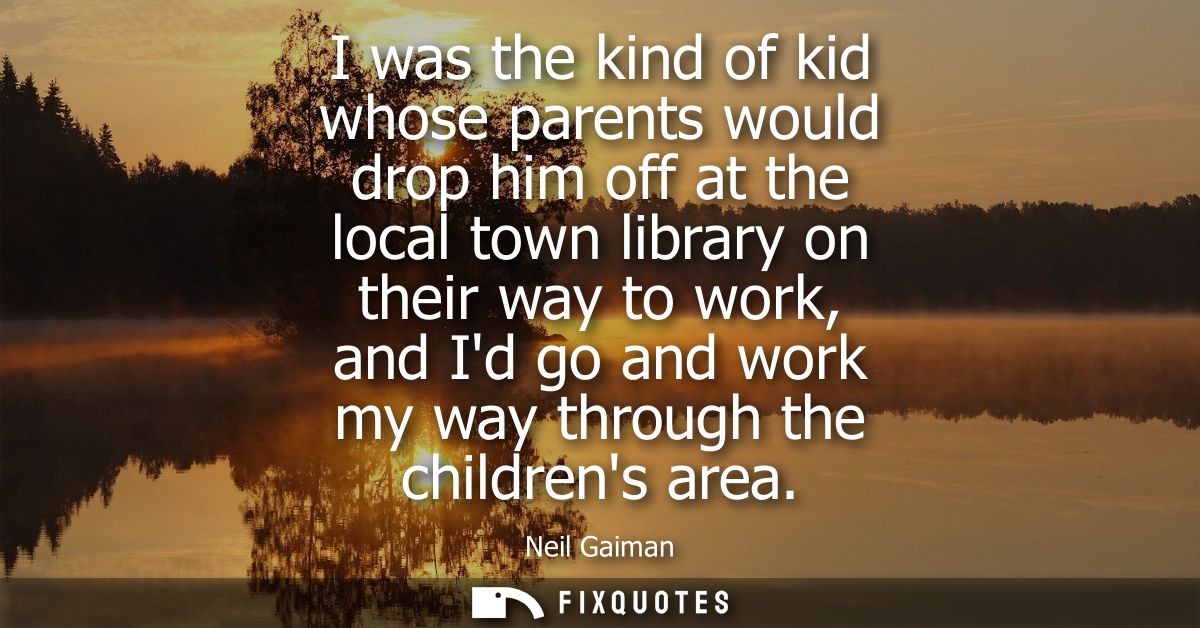
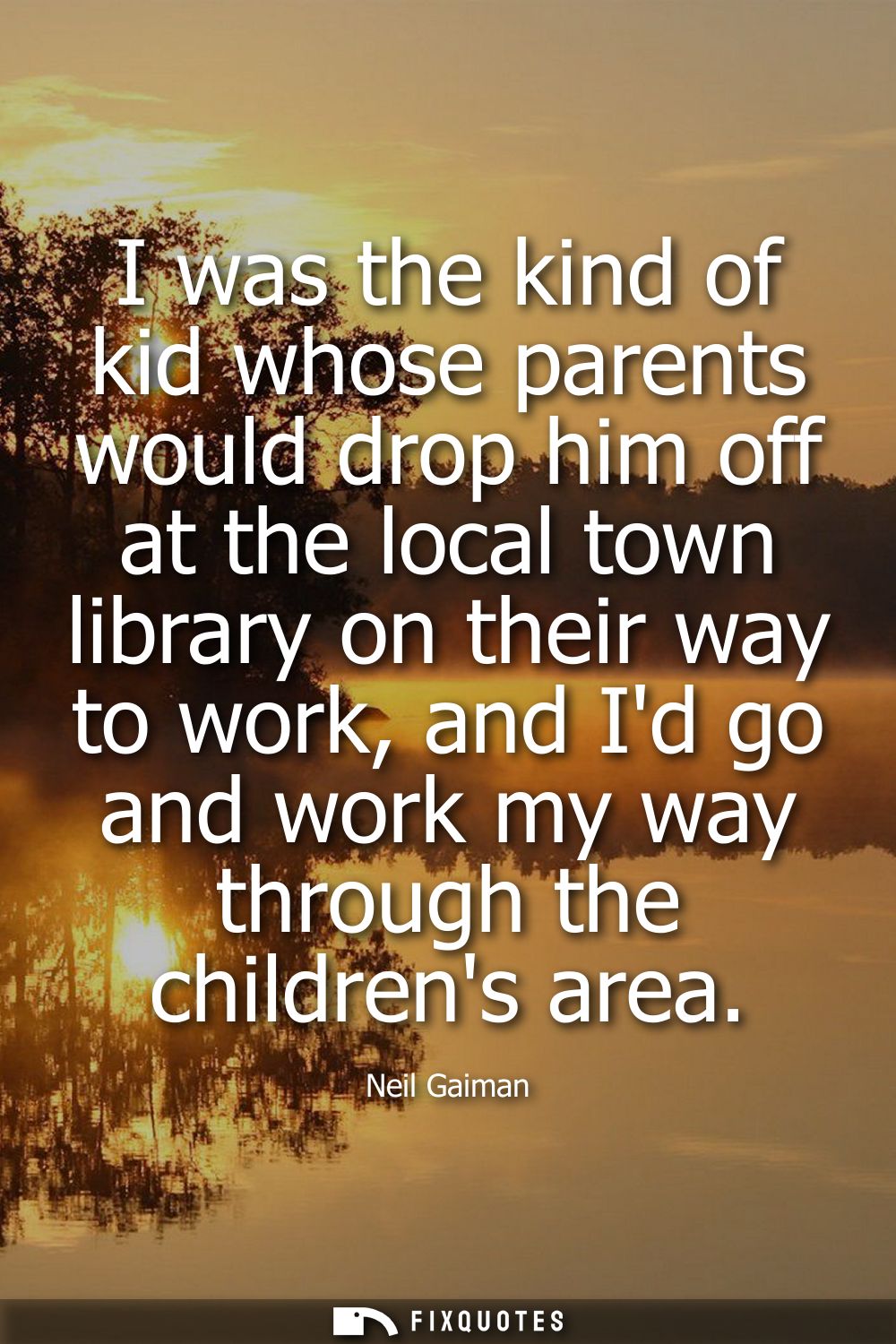
"I was the kind of kid whose parents would drop him off at the local town library on their way to work, and I'd go and work my way through the children's area"
About this Quote
There’s a quiet rebellion tucked inside this mild sentence: the library isn’t framed as a treat, but as a routine drop-off, like daycare for a mind that couldn’t stop roaming. Gaiman’s phrasing (“the kind of kid”) turns autobiography into a recognizable archetype: the solitary, self-propelled reader who makes a home out of public space. It’s less brag than origin story, the seedbed of a writer who later built entire universes out of borrowed pages.
The verb choice does the heavy lifting. “Drop him off” carries a whiff of abandonment, but also trust: parents outsourcing supervision to a civic institution. Then comes the counterweight: “I’d go and work my way through.” Reading becomes labor, method, even apprenticeship. It subtly rejects the idea of books as enrichment delivered from above; instead, the child actively mines the shelves, moving through the “children’s area” like it’s a territory to be mapped.
Context matters: Gaiman came up in a Britain where libraries were a durable piece of the social contract, not a luxury amenity. That background gives the quote its political undertone without making a speech out of it. The library functions as an engine of class mobility and imagination, a place where a kid can access worlds he can’t afford to buy. The subtext is a defense of public infrastructure as a creative incubator: you don’t just discover stories there; you learn that the door is allowed to be open.
The verb choice does the heavy lifting. “Drop him off” carries a whiff of abandonment, but also trust: parents outsourcing supervision to a civic institution. Then comes the counterweight: “I’d go and work my way through.” Reading becomes labor, method, even apprenticeship. It subtly rejects the idea of books as enrichment delivered from above; instead, the child actively mines the shelves, moving through the “children’s area” like it’s a territory to be mapped.
Context matters: Gaiman came up in a Britain where libraries were a durable piece of the social contract, not a luxury amenity. That background gives the quote its political undertone without making a speech out of it. The library functions as an engine of class mobility and imagination, a place where a kid can access worlds he can’t afford to buy. The subtext is a defense of public infrastructure as a creative incubator: you don’t just discover stories there; you learn that the door is allowed to be open.
Quote Details
| Topic | Book |
|---|
More Quotes by Neil
Add to List